The Aluminum Paradox: Why the Era of Cheap Metal May Be Ending
The Aluminum Paradox: Why the Era of Cheap Metal May Be Ending
Look around you. It holds your soda. It wraps your leftovers. It makes up the engine block of your car and the fuselage of the plane you fly out in.
We treat aluminum as disposable. It is the third most abundant element in the Earth’s crust, effectively the “cheap, cost-effective, and highly abundant” of the metal world.
But there was a time when this metal was the ultimate flex.
In the mid-19th century, aluminum was more valuable than gold. Because it bonds so tightly with other elements in nature, refining it into pure metal was nearly impossible. It was so rare that Emperor Napoleon III of France reportedly held dinner parties where the most honored guests were given aluminum cutlery, while the “lesser” nobility had to suffer the indignity of eating with mere gold and silver forks.
The obsession didn’t end in France. When the Washington Monument was completed in 1884, the U.S. government capped it with a 100-ounce pyramid of solid aluminum. It wasn’t just structural; it was a statement of industrial might. At the time, a pound of aluminum cost about $16, roughly $419 in today’s money.

The aluminum tip is placed atop the Washington Monument on Dec. 6, 1884 in a contemporary illustration.
Source: National Park Service, NPR
Then, everything changed. We discovered how to use massive amounts of electricity to refine it. The price crashed, and aluminum became the building block of the modern world.
But today, the pendulum is swinging back.
For the first time in a century, the era of cheap, infinite aluminum may be coming to an end. The price has surged past $3,000 per tonne, not because the metal is rare, but because global supply is struggling to respond. The supply is being killed by a hard cap in China, a drought in Africa, and a western industrial base that has forgotten how to build.
There is another side, though. Aluminum has been squeezed before: in March 2022 the price topped $4,000 a tonne, then fell by nearly half within six months. China could loosen its cap, new smelters in Indonesia and the Middle East could add supply, and higher prices tend to pull more scrap into recycling. Whether this time is different is the question the rest of this piece explores.
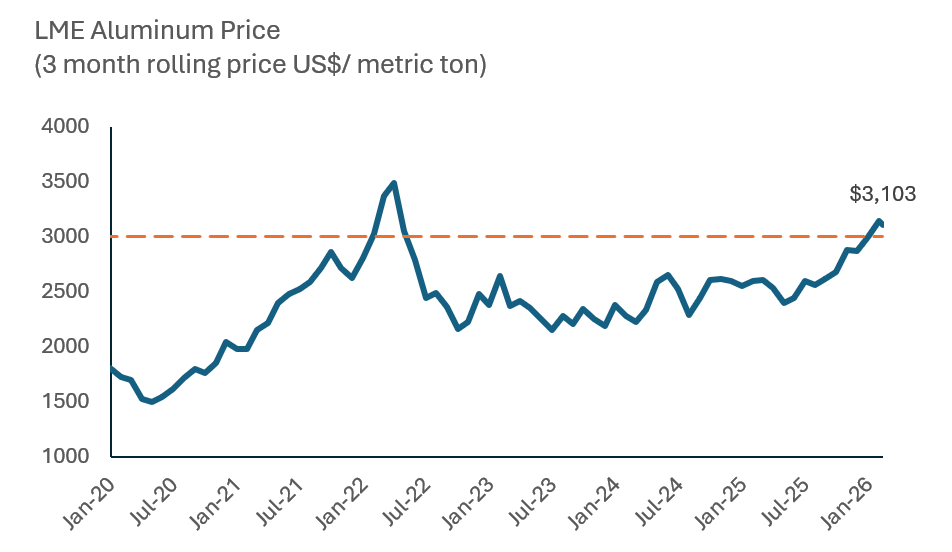
Aluminum hits above $3,000, which is a price not seen since 2022
Source: Bloomberg
We are not facing a temporary shortage. We are facing structural rigidity.
You don’t have to guess; the numbers tell the story. Look at the global supply-demand balance.
Since 2021, the market has been trapped in a persistent deficit. We haven’t seen a surplus in five years.
- 2024: A deficit of 544,000 tonnes.
- 2025: Deficit widening to 591,000 tonnes.
- 2026 (Projected): The deficit blows out to 843,000 tonnes.
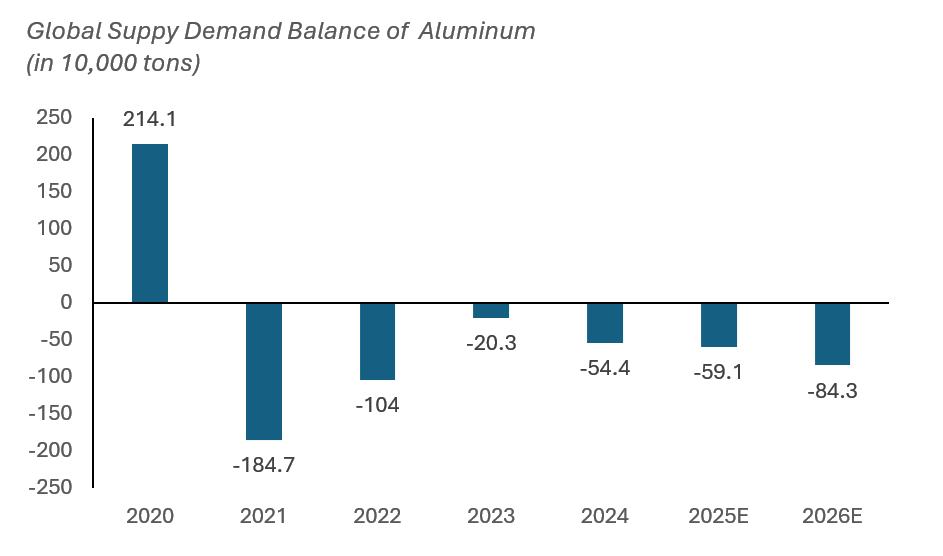
Note: The electrolytic aluminum demand figures above include the demand for electrolytic aluminum used in recycled aluminum production.
Source: SMM, CRU, Huatai Research Forecast
Demand is growing steadily where it’s up around 2.3% YoY, but supply is hitting a ceiling where growth is slowing to just 1.9%. When demand outpaces supply for half a decade, inventories vanish, and prices explode.
The Death of Elasticity
Elasticity just means when prices rise, supply usually expands to meet it, but it’s looking tougher with this pro-longed deficit. To understand why we are in a deficit, you have to look at the breakdown of the world’s supply engine: China.
For twenty years, China was the world’s “swing producer.” Whenever the world needed more metal, Beijing built a coal plant and a smelter. That valve has been welded shut.
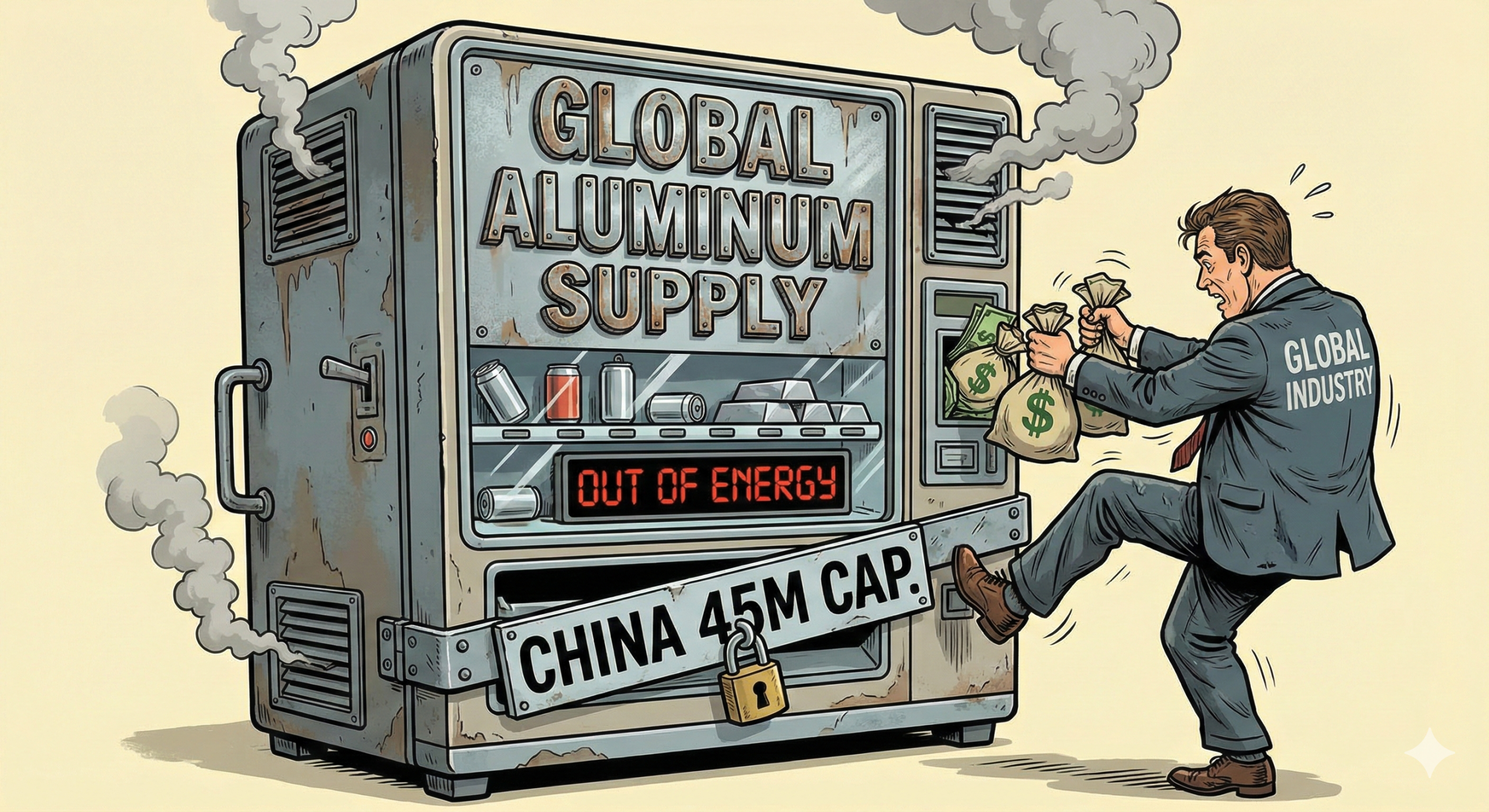
- The Hard Cap: The government is strictly enforcing a 45 million tonne capacity cap to curb pollution. They physically cannot legally build more smelters.
- The Internal Black Hole: Worse, they are no longer exporting their surplus. The new “Two New” stimulus policy (a massive trade-in program for old appliances and industrial gear) is sucking up that metal domestically. China has flipped from the world’s factory to the world’s consumer, and they are keeping their metal for themselves.
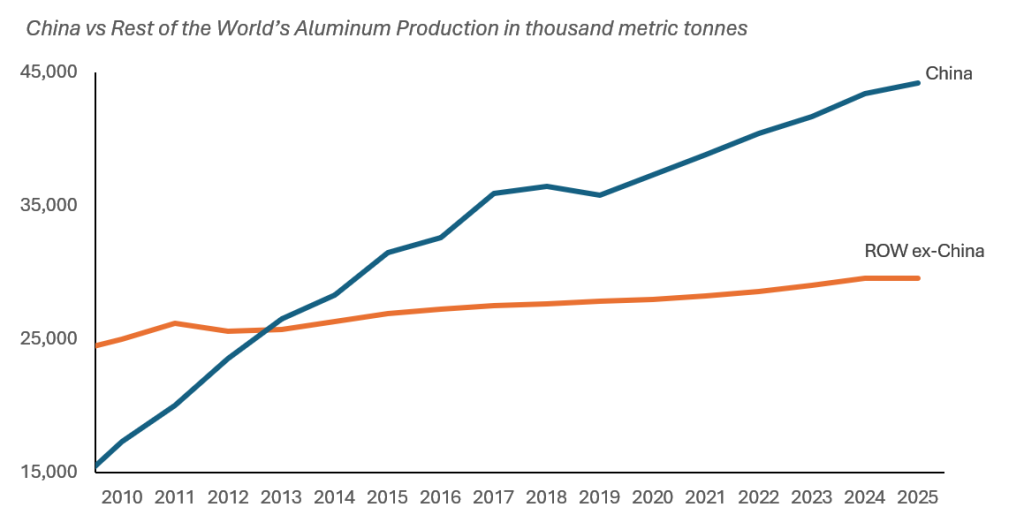
How can the rest of the world catch up to China?
Source: International Aluminum Org
The Western Supply Shock
While China locks its doors, the Western supply chain is snapping.
In March 2026, South32’s Mozal smelter, a giant facility responsible for supplying nearly 20% of Europe’s aluminum imports, is shutting down.
Why? Not because it isn’t profitable. But because of a severe drought in the Zambezi basin and a failed negotiation with the local utility. That is 560,000 tonnes of metal vanished from the market overnight, leaving Western buyers scrambling.
This isn’t an isolated incident. It is a symptom of a western industrial base that is crumbling. In the U.S. and Europe, high operating costs have already forced half of all smelting capacity offline since 2021. Those plants aren’t coming back.
The Demand Renaissance: Not Your Grandfather’s Foil
While supply is hitting a brick wall, demand is undergoing a quiet revolution. Aluminum is no longer just about soda cans and window frames. It has become the “lightweight champion” of the energy transition.
- The EV Diet Plan Electric vehicles are heavy. Batteries weigh thousands of pounds. To get decent range, automakers have to strip weight out of everything else. That means swapping heavy steel for light aluminum. An EV uses roughly 200kg of aluminum, which is 50% more than a gas car. As EV adoption grows, so does the baseline demand for the metal.
- The Poor Man’s Copper Copper prices have skyrocketed, making it too expensive for many industrial uses. With the copper-to-aluminum price ratio hitting a 20-year high (4.1x), manufacturers are switching to aluminum for wiring and cabling wherever physics allows. It is the “substitution trade” of the decade.
- The Skeleton of AI Even the digital world needs physical bones. The massive buildout of AI Data Centers isn’t just about chips; it’s about the chassis, the racks, and crucially, the cooling systems. Aluminum is the material of choice for heat sinks and thermal management because it dissipates heat efficiently. Every new data center coming online is effectively a massive structure of aluminum piping and plating.
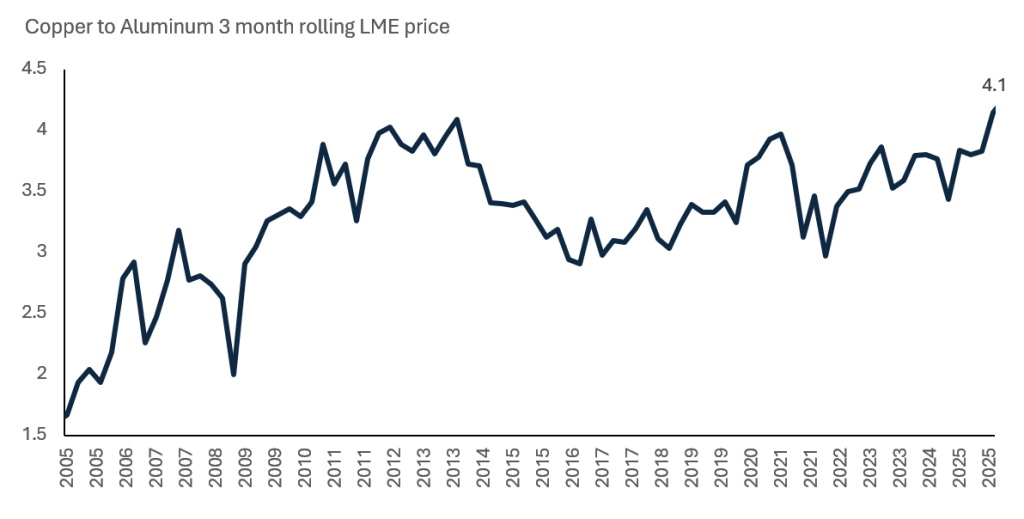
Aluminum is now 4x cheaper than Copper
Source: Bloomberg
The Investor Takeaway
We leave you not with a forecast, but with a dilemma.
The world is betting its future on the exponential growth of digital intelligence (AI) and the green transition (EVs). Both of these revolutions are physically built out of aluminum. Yet, the energy and geopolitical systems required to produce that metal are flashing red.
This disconnect forces us to ask tough questions about how—or if—this gap can be bridged:
- Can we recycle our way out? Secondary aluminum (scrap) requires 95% less energy than primary smelting. Is the world ready to build the sophisticated supply chains needed to turn old cars into new data center racks, or will the quality mismatch be too high?
- Is the “China Cap” a ceiling or a lever? Is the 45 million tonne limit a hard environmental line in the sand, or is it a geopolitical tool that Beijing will release once the price hurts Western manufacturers enough?
- The Substitution Trap: At what price does the AI industry stop using aluminum? Is there even a viable alternative for thermal management that is scalable, or is this metal the non-negotiable “bones” of the digital age?
Think about it this way: If aluminum hits $5,000/ton, do auto companies delay their EV models launch? Do tech companies slow its data center buildout? Or do they just eat the cost and pass it to consumers?”
Something has to give. Will it be the environmental goals, the profit margins, or the pace of the buildout itself? For the observant investor, the answer to that question will define the next commodity supercycle.
Tara Mulia
For more blogs like these, subscribe to our newsletter here!
Important information
This article is published by Heyokha Brothers Limited (“Heyokha”), a corporation licensed by the Securities and Futures Commission of Hong Kong (CE No. BOS569). It is provided for general information and discussion purposes only. It reflects the authors’ views and observations at the date of publication, and these may change without notice.
Nothing in this article is investment, legal, tax or other professional advice, investment research, or a recommendation, offer or solicitation to buy or sell any security, fund or other investment product. It is not directed at any person in any jurisdiction where its publication or availability would be unlawful. Any companies, securities or assets mentioned are for illustration only and are not a recommendation.
Information from third-party sources is believed to be reliable, but it has not been independently verified. No representation or warranty is given as to its accuracy or completeness. Forward-looking statements are inherently uncertain, and actual outcomes may differ materially. Investment involves risk, the value of investments can go down as well as up, and past performance is not indicative of future results. Heyokha, its directors and employees, and funds it manages may hold positions in assets mentioned.
Readers should seek independent professional advice before making any investment decision. This article has not been reviewed by the Securities and Futures Commission.
Admin heyokha

Share


Look around you. It holds your soda. It wraps your leftovers. It makes up the engine block of your car and the fuselage of the plane you fly out in.
We treat aluminum as disposable. It is the third most abundant element in the Earth’s crust, effectively the “cheap, cost-effective, and highly abundant” of the metal world.
But there was a time when this metal was the ultimate flex.
In the mid-19th century, aluminum was more valuable than gold. Because it bonds so tightly with other elements in nature, refining it into pure metal was nearly impossible. It was so rare that Emperor Napoleon III of France reportedly held dinner parties where the most honored guests were given aluminum cutlery, while the “lesser” nobility had to suffer the indignity of eating with mere gold and silver forks.
The obsession didn’t end in France. When the Washington Monument was completed in 1884, the U.S. government capped it with a 100-ounce pyramid of solid aluminum. It wasn’t just structural; it was a statement of industrial might. At the time, a pound of aluminum cost about $16, roughly $419 in today’s money.
The aluminum tip is placed atop the Washington Monument on Dec. 6, 1884 in a contemporary illustration.
Source: National Park Service, NPR
Then, everything changed. We discovered how to use massive amounts of electricity to refine it. The price crashed, and aluminum became the building block of the modern world.
But today, the pendulum is swinging back.
For the first time in a century, the era of cheap, infinite aluminum may be coming to an end. The price has surged past $3,000 per tonne, not because the metal is rare, but because global supply is struggling to respond. The supply is being killed by a hard cap in China, a drought in Africa, and a western industrial base that has forgotten how to build.
There is another side, though. Aluminum has been squeezed before: in March 2022 the price topped $4,000 a tonne, then fell by nearly half within six months. China could loosen its cap, new smelters in Indonesia and the Middle East could add supply, and higher prices tend to pull more scrap into recycling. Whether this time is different is the question the rest of this piece explores.
Aluminum hits above $3,000, which is a price not seen since 2022
Source: Bloomberg
We are not facing a temporary shortage. We are facing structural rigidity.
You don’t have to guess; the numbers tell the story. Look at the global supply-demand balance.
Since 2021, the market has been trapped in a persistent deficit. We haven’t seen a surplus in five years.
- 2024: A deficit of 544,000 tonnes.
- 2025: Deficit widening to 591,000 tonnes.
- 2026 (Projected): The deficit blows out to 843,000 tonnes.
Note: The electrolytic aluminum demand figures above include the demand for electrolytic aluminum used in recycled aluminum production.
Source: SMM, CRU, Huatai Research Forecast
Demand is growing steadily where it’s up around 2.3% YoY, but supply is hitting a ceiling where growth is slowing to just 1.9%. When demand outpaces supply for half a decade, inventories vanish, and prices explode.
The Death of Elasticity
Elasticity just means when prices rise, supply usually expands to meet it, but it’s looking tougher with this pro-longed deficit. To understand why we are in a deficit, you have to look at the breakdown of the world’s supply engine: China.
For twenty years, China was the world’s “swing producer.” Whenever the world needed more metal, Beijing built a coal plant and a smelter. That valve has been welded shut.
- The Hard Cap: The government is strictly enforcing a 45 million tonne capacity cap to curb pollution. They physically cannot legally build more smelters.
- The Internal Black Hole: Worse, they are no longer exporting their surplus. The new “Two New” stimulus policy (a massive trade-in program for old appliances and industrial gear) is sucking up that metal domestically. China has flipped from the world’s factory to the world’s consumer, and they are keeping their metal for themselves.
How can the rest of the world catch up to China?
Source: International Aluminum Org
The Western Supply Shock
While China locks its doors, the Western supply chain is snapping.
In March 2026, South32’s Mozal smelter, a giant facility responsible for supplying nearly 20% of Europe’s aluminum imports, is shutting down.
Why? Not because it isn’t profitable. But because of a severe drought in the Zambezi basin and a failed negotiation with the local utility. That is 560,000 tonnes of metal vanished from the market overnight, leaving Western buyers scrambling.
This isn’t an isolated incident. It is a symptom of a western industrial base that is crumbling. In the U.S. and Europe, high operating costs have already forced half of all smelting capacity offline since 2021. Those plants aren’t coming back.
The Demand Renaissance: Not Your Grandfather’s Foil
While supply is hitting a brick wall, demand is undergoing a quiet revolution. Aluminum is no longer just about soda cans and window frames. It has become the “lightweight champion” of the energy transition.
- The EV Diet Plan Electric vehicles are heavy. Batteries weigh thousands of pounds. To get decent range, automakers have to strip weight out of everything else. That means swapping heavy steel for light aluminum. An EV uses roughly 200kg of aluminum, which is 50% more than a gas car. As EV adoption grows, so does the baseline demand for the metal.
- The Poor Man’s Copper Copper prices have skyrocketed, making it too expensive for many industrial uses. With the copper-to-aluminum price ratio hitting a 20-year high (4.1x), manufacturers are switching to aluminum for wiring and cabling wherever physics allows. It is the “substitution trade” of the decade.
- The Skeleton of AI Even the digital world needs physical bones. The massive buildout of AI Data Centers isn’t just about chips; it’s about the chassis, the racks, and crucially, the cooling systems. Aluminum is the material of choice for heat sinks and thermal management because it dissipates heat efficiently. Every new data center coming online is effectively a massive structure of aluminum piping and plating.
Aluminum is now 4x cheaper than Copper
Source: Bloomberg
The Investor Takeaway
We leave you not with a forecast, but with a dilemma.
The world is betting its future on the exponential growth of digital intelligence (AI) and the green transition (EVs). Both of these revolutions are physically built out of aluminum. Yet, the energy and geopolitical systems required to produce that metal are flashing red.
This disconnect forces us to ask tough questions about how—or if—this gap can be bridged:
- Can we recycle our way out? Secondary aluminum (scrap) requires 95% less energy than primary smelting. Is the world ready to build the sophisticated supply chains needed to turn old cars into new data center racks, or will the quality mismatch be too high?
- Is the “China Cap” a ceiling or a lever? Is the 45 million tonne limit a hard environmental line in the sand, or is it a geopolitical tool that Beijing will release once the price hurts Western manufacturers enough?
- The Substitution Trap: At what price does the AI industry stop using aluminum? Is there even a viable alternative for thermal management that is scalable, or is this metal the non-negotiable “bones” of the digital age?
Think about it this way: If aluminum hits $5,000/ton, do auto companies delay their EV models launch? Do tech companies slow its data center buildout? Or do they just eat the cost and pass it to consumers?”
Something has to give. Will it be the environmental goals, the profit margins, or the pace of the buildout itself? For the observant investor, the answer to that question will define the next commodity supercycle.
Tara Mulia
For more blogs like these, subscribe to our newsletter here!
Important information
This article is published by Heyokha Brothers Limited (“Heyokha”), a corporation licensed by the Securities and Futures Commission of Hong Kong (CE No. BOS569). It is provided for general information and discussion purposes only. It reflects the authors’ views and observations at the date of publication, and these may change without notice.
Nothing in this article is investment, legal, tax or other professional advice, investment research, or a recommendation, offer or solicitation to buy or sell any security, fund or other investment product. It is not directed at any person in any jurisdiction where its publication or availability would be unlawful. Any companies, securities or assets mentioned are for illustration only and are not a recommendation.
Information from third-party sources is believed to be reliable, but it has not been independently verified. No representation or warranty is given as to its accuracy or completeness. Forward-looking statements are inherently uncertain, and actual outcomes may differ materially. Investment involves risk, the value of investments can go down as well as up, and past performance is not indicative of future results. Heyokha, its directors and employees, and funds it manages may hold positions in assets mentioned.
Readers should seek independent professional advice before making any investment decision. This article has not been reviewed by the Securities and Futures Commission.
Admin heyokha
Share