The Tollbooth at the End of the World: Dark Ships, Side Deals, and the Sprint for Physical Gold
The Tollbooth at the End of the World: Dark Ships, Side Deals, and the Sprint for Physical Gold
Trying to gauge the exact status of the Strait of Hormuz from a desk is a bit like trying to review a restaurant by reading the menu through a telescope. You can spend all day squinting at maritime transponder data on a Bloomberg terminal, trying to guess if the shipping lanes are clear.
Citrini Research decided to do something a bit more practical: they sent an analyst directly to the Strait of Hormuz.
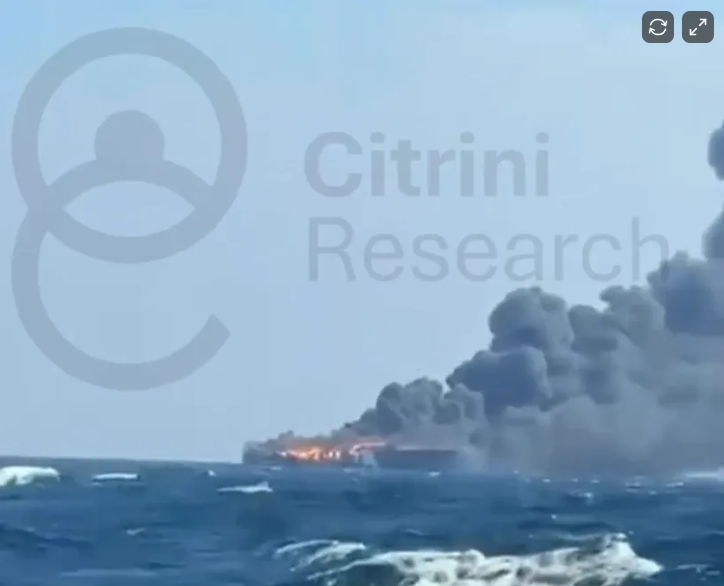
Analyst #3 is either the bravest person alive or in serious need of a raise
source: Citrini Research
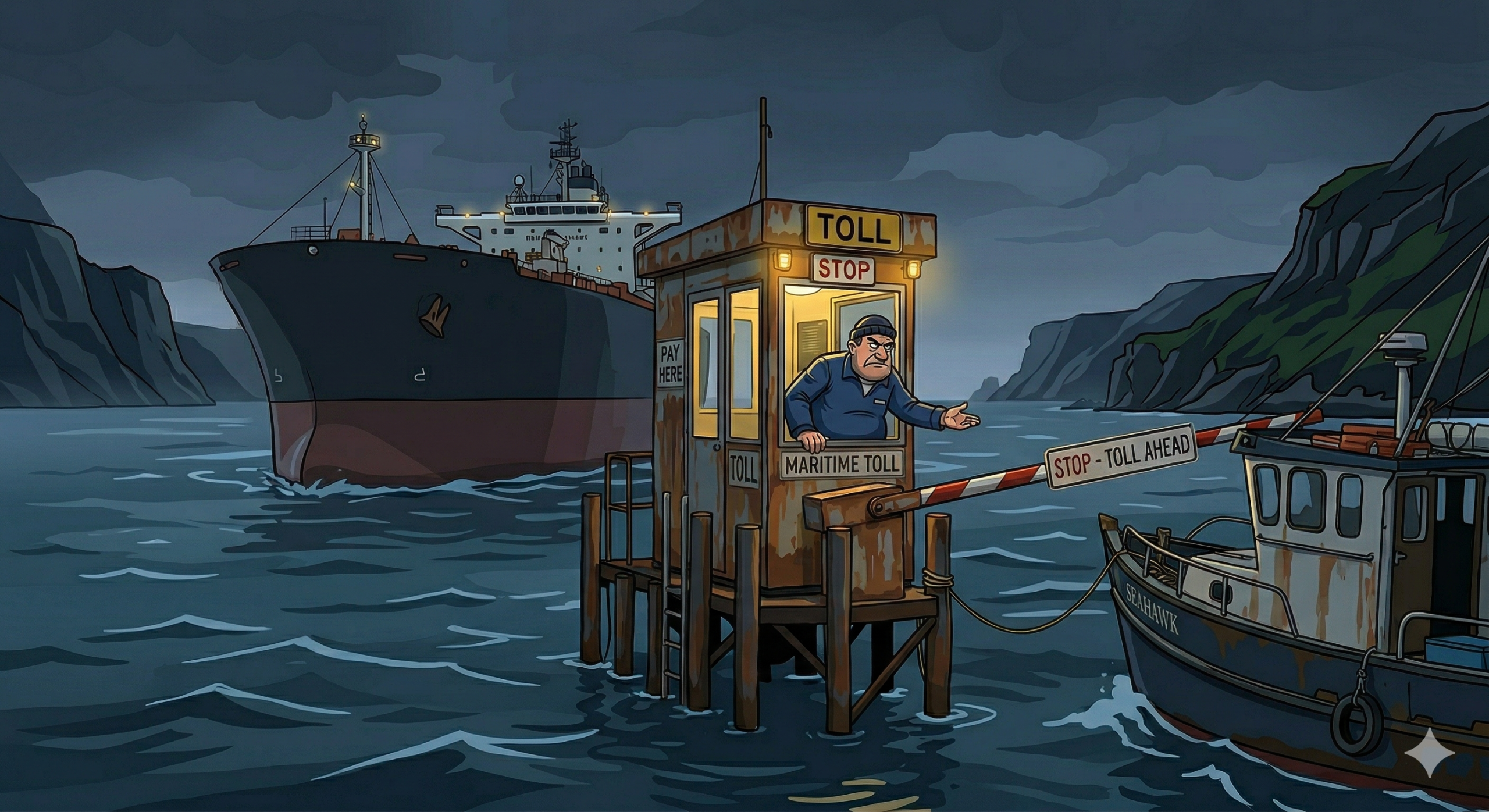
What their field agent found completely dismantles the mainstream narrative. The Strait of Hormuz hasn’t been completely barricaded, nor is it freely open. It has morphed into a geopolitical tollbooth. Standard maritime tracking is basically useless right now because as much as 50% of the vessel traffic is running “dark.”
Ships are turning their transponders off and tiptoeing through the Qeshm-Larak channel to dodge drones. It is global trade on incognito mode.
But the real punchline isn’t how the ships are passing. It is who is passing.
By early April, at least 10 major nations, including staunch U.S. allies like France, Japan, and India, had actively negotiated direct transit access with Iran. Think about that for a second. Sovereign nations allied with Washington are making bespoke side-deals with the exact country the U.S. is currently in direct conflict with.
It’s the geopolitical equivalent of finding out your loyal business partners are quietly negotiating a separate supply contract with your biggest rival.
Why are U.S. allies suddenly acting like free agents? Well take a look at Trump’s own tweet:

Last week, Donald Trump lashed out at European allies who refused to join the Middle East conflict. His message to countries sweating over their jet fuel and energy supplies was refreshingly blunt: “Build up some delayed courage, go to the Strait, and just TAKE IT,” adding that they should “go get your own oil.”
This validates the exact macro thesis we mapped out in 2018. De-globalization isn’t a forecast anymore. The United States has officially retired as the guarantor of frictionless global trade.
The Tollbooth Empire
This brings us to an interesting framework recently outlined by Jiang Xueqin, better known online as “Professor Jiang.” If you haven’t seen him on your timeline yet, he is a Beijing-based educator who recently skyrocketed to internet fame after an old YouTube lecture of his predicting the exact contours of the 2026 US-Iran war went incredibly viral.
Jiang points out a stark reality: If the U.S. is facing de-dollarization, how does it maintain its global leverage? By pivoting to a war of attrition.
For the last 50 years, the U.S. leveraged its status as the global reserve currency to encourage free trade. But if nations are going to actively opt out of the dollar system, the American strategy has to shift from guaranteeing the sea lanes to simply controlling the chokepoints. Whether it is the Panama Canal, the Strait of Malacca, or naval blockades in the Caribbean, the new playbook is brutally simple: If you want to access Western resources, you have to pay the toll and ask for permission.
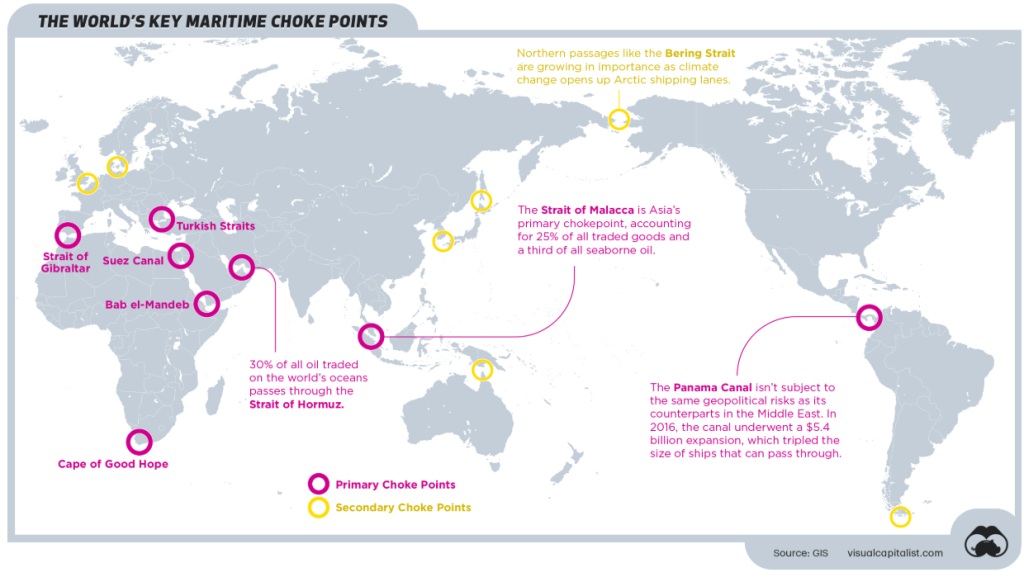
Source: GIS, Visual Capitalist
The global reaction to this new reality is a sudden, very expensive realization that every nation needs to build its own security apparatus. Industrial nations are waking up to the fact that if the energy supply from the GCC or Russia goes offline, like the 40% of Russian oil export capacity that recently got hit by Ukrainian drones, they are completely on their own. That is your fuel, your food, and your savings. The geopolitical anxiety is getting so heavy that rumors are even circulating about European nations drafting travel restrictions for fighting-age males just to prepare for conscription.
Nothing says “transitory geopolitical friction” quite like preparing for a national draft.
Heyokha’s “On the Ground” Research
Here at Heyokha, we also pride ourselves on doing on-the-ground research. Though, admittedly, our latest fieldwork didn’t involve dodging drones in the Middle East. It involved walking through the MRT stations and observing billboards here in Central Jakarta.
The desperate scramble for physical security isn’t just a macroeconomic debate for Davos attendees; it has hit the retail streets.
Right now, Jakarta is plastered with advertisements for the “Tring! Golden Run 2026″—a massive 5K and 10K race sponsored by Pegadaian, the state-owned pawnbroker. The prize? Participants are literally racing to win physical gold vouchers.
And guess what? It is completely sold out.
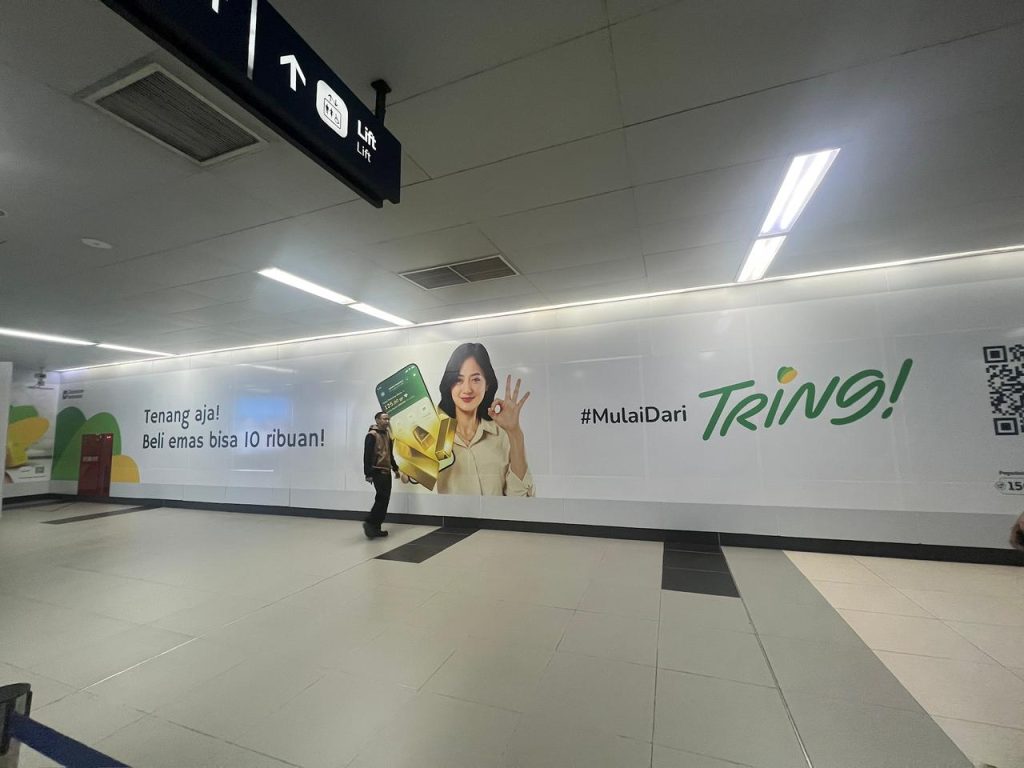
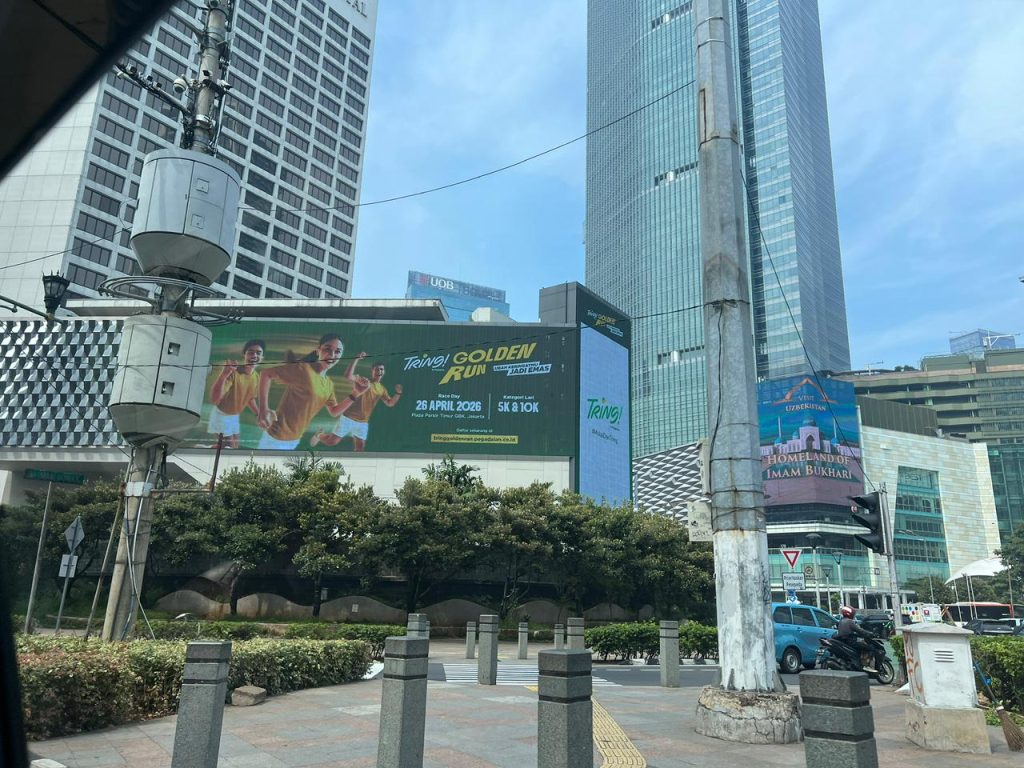
Fresh off the streets


Forget the finisher’s medal: the prize here is gold vouchers
When everyday citizens are voluntarily sprinting 10 kilometers through the Jakarta humidity just to get their hands on a fraction of an ounce of gold, the psychological shift has happened.
People are already moving. Literally sprinting.
The sea lanes are contested, and the freezing of Russia’s reserves in 2022 showed that money held abroad can be switched off. It is easy to see why some people want something they can hold in their hand.
But gold is one answer to that anxiety, not the only one, and not an obvious fit for everyone. It pays no income, and its price can fall hard and stay down: after peaking in 2011, it took the best part of a decade to recover. A sold-out fun run may also say as much about clever marketing as about macro conviction. Others are looking for security elsewhere, in government bonds, cash in a stronger currency, property, Bitcoin, or simply a bigger emergency fund.
What the Jakarta billboards do tell us is that the worry has left the trading floor and reached the running track. Whether that turns out to be early wisdom or a crowd all running in the same direction is the question worth watching.
Tara Mulia
For more blogs like these, subscribe to our newsletter here!
Important information
This article is published by Heyokha Brothers Limited (“Heyokha”), a corporation licensed by the Securities and Futures Commission of Hong Kong (CE No. BOS569). It is provided for general information and discussion purposes only. It reflects the authors’ views and observations at the date of publication, and these may change without notice.
Nothing in this article is investment, legal, tax or other professional advice, investment research, or a recommendation, offer or solicitation to buy or sell any security, fund or other investment product. It is not directed at any person in any jurisdiction where its publication or availability would be unlawful. Any companies, securities or assets mentioned are for illustration only and are not a recommendation.
Information from third-party sources is believed to be reliable, but it has not been independently verified. No representation or warranty is given as to its accuracy or completeness. Forward-looking statements are inherently uncertain, and actual outcomes may differ materially. Investment involves risk, the value of investments can go down as well as up, and past performance is not indicative of future results. Heyokha, its directors and employees, and funds it manages may hold positions in assets mentioned.
Readers should seek independent professional advice before making any investment decision. This article has not been reviewed by the Securities and Futures Commission.
Admin heyokha

Share


Trying to gauge the exact status of the Strait of Hormuz from a desk is a bit like trying to review a restaurant by reading the menu through a telescope. You can spend all day squinting at maritime transponder data on a Bloomberg terminal, trying to guess if the shipping lanes are clear.
Citrini Research decided to do something a bit more practical: they sent an analyst directly to the Strait of Hormuz.
Analyst #3 is either the bravest person alive or in serious need of a raise
source: Citrini Research
What their field agent found completely dismantles the mainstream narrative. The Strait of Hormuz hasn’t been completely barricaded, nor is it freely open. It has morphed into a geopolitical tollbooth. Standard maritime tracking is basically useless right now because as much as 50% of the vessel traffic is running “dark.”
Ships are turning their transponders off and tiptoeing through the Qeshm-Larak channel to dodge drones. It is global trade on incognito mode.
But the real punchline isn’t how the ships are passing. It is who is passing.
By early April, at least 10 major nations, including staunch U.S. allies like France, Japan, and India, had actively negotiated direct transit access with Iran. Think about that for a second. Sovereign nations allied with Washington are making bespoke side-deals with the exact country the U.S. is currently in direct conflict with.
It’s the geopolitical equivalent of finding out your loyal business partners are quietly negotiating a separate supply contract with your biggest rival.
Why are U.S. allies suddenly acting like free agents? Well take a look at Trump’s own tweet:
Last week, Donald Trump lashed out at European allies who refused to join the Middle East conflict. His message to countries sweating over their jet fuel and energy supplies was refreshingly blunt: “Build up some delayed courage, go to the Strait, and just TAKE IT,” adding that they should “go get your own oil.”
This validates the exact macro thesis we mapped out in 2018. De-globalization isn’t a forecast anymore. The United States has officially retired as the guarantor of frictionless global trade.
The Tollbooth Empire
This brings us to an interesting framework recently outlined by Jiang Xueqin, better known online as “Professor Jiang.” If you haven’t seen him on your timeline yet, he is a Beijing-based educator who recently skyrocketed to internet fame after an old YouTube lecture of his predicting the exact contours of the 2026 US-Iran war went incredibly viral.
Jiang points out a stark reality: If the U.S. is facing de-dollarization, how does it maintain its global leverage? By pivoting to a war of attrition.
For the last 50 years, the U.S. leveraged its status as the global reserve currency to encourage free trade. But if nations are going to actively opt out of the dollar system, the American strategy has to shift from guaranteeing the sea lanes to simply controlling the chokepoints. Whether it is the Panama Canal, the Strait of Malacca, or naval blockades in the Caribbean, the new playbook is brutally simple: If you want to access Western resources, you have to pay the toll and ask for permission.
Source: GIS, Visual Capitalist
The global reaction to this new reality is a sudden, very expensive realization that every nation needs to build its own security apparatus. Industrial nations are waking up to the fact that if the energy supply from the GCC or Russia goes offline, like the 40% of Russian oil export capacity that recently got hit by Ukrainian drones, they are completely on their own. That is your fuel, your food, and your savings. The geopolitical anxiety is getting so heavy that rumors are even circulating about European nations drafting travel restrictions for fighting-age males just to prepare for conscription.
Nothing says “transitory geopolitical friction” quite like preparing for a national draft.
Heyokha’s “On the Ground” Research
Here at Heyokha, we also pride ourselves on doing on-the-ground research. Though, admittedly, our latest fieldwork didn’t involve dodging drones in the Middle East. It involved walking through the MRT stations and observing billboards here in Central Jakarta.
The desperate scramble for physical security isn’t just a macroeconomic debate for Davos attendees; it has hit the retail streets.
Right now, Jakarta is plastered with advertisements for the “Tring! Golden Run 2026″—a massive 5K and 10K race sponsored by Pegadaian, the state-owned pawnbroker. The prize? Participants are literally racing to win physical gold vouchers.
And guess what? It is completely sold out.
Fresh off the streets
Forget the finisher’s medal: the prize here is gold vouchers
When everyday citizens are voluntarily sprinting 10 kilometers through the Jakarta humidity just to get their hands on a fraction of an ounce of gold, the psychological shift has happened.
People are already moving. Literally sprinting.
The sea lanes are contested, and the freezing of Russia’s reserves in 2022 showed that money held abroad can be switched off. It is easy to see why some people want something they can hold in their hand.
But gold is one answer to that anxiety, not the only one, and not an obvious fit for everyone. It pays no income, and its price can fall hard and stay down: after peaking in 2011, it took the best part of a decade to recover. A sold-out fun run may also say as much about clever marketing as about macro conviction. Others are looking for security elsewhere, in government bonds, cash in a stronger currency, property, Bitcoin, or simply a bigger emergency fund.
What the Jakarta billboards do tell us is that the worry has left the trading floor and reached the running track. Whether that turns out to be early wisdom or a crowd all running in the same direction is the question worth watching.
Tara Mulia
For more blogs like these, subscribe to our newsletter here!
Important information
This article is published by Heyokha Brothers Limited (“Heyokha”), a corporation licensed by the Securities and Futures Commission of Hong Kong (CE No. BOS569). It is provided for general information and discussion purposes only. It reflects the authors’ views and observations at the date of publication, and these may change without notice.
Nothing in this article is investment, legal, tax or other professional advice, investment research, or a recommendation, offer or solicitation to buy or sell any security, fund or other investment product. It is not directed at any person in any jurisdiction where its publication or availability would be unlawful. Any companies, securities or assets mentioned are for illustration only and are not a recommendation.
Information from third-party sources is believed to be reliable, but it has not been independently verified. No representation or warranty is given as to its accuracy or completeness. Forward-looking statements are inherently uncertain, and actual outcomes may differ materially. Investment involves risk, the value of investments can go down as well as up, and past performance is not indicative of future results. Heyokha, its directors and employees, and funds it manages may hold positions in assets mentioned.
Readers should seek independent professional advice before making any investment decision. This article has not been reviewed by the Securities and Futures Commission.
Admin heyokha
Share