Who Hires the Juniors Now? AI, the Missing First Rung, and Why the Data Won’t Settle It
Who Hires the Juniors Now? AI, the Missing First Rung, and Why the Data Won’t Settle It
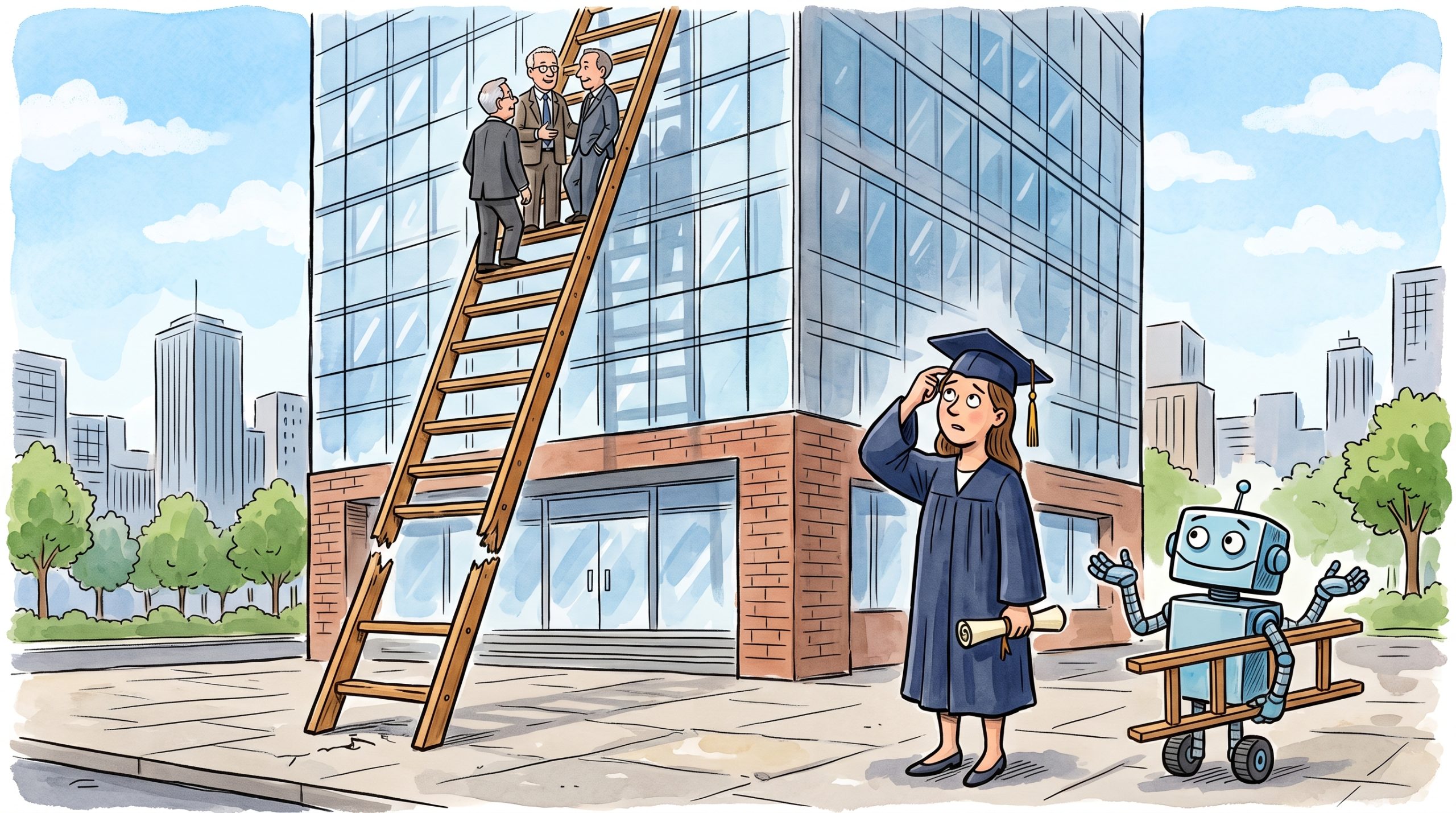
Every senior banker, lawyer and engineer you know has a version of the same story. Their first job was mostly grunt work: formatting slides at midnight, checking footnotes, writing code nobody would ever read, summarising documents for someone more important. It was dull, and it was also how they learned. Someone hired them before they knew much and gave them time to get better.
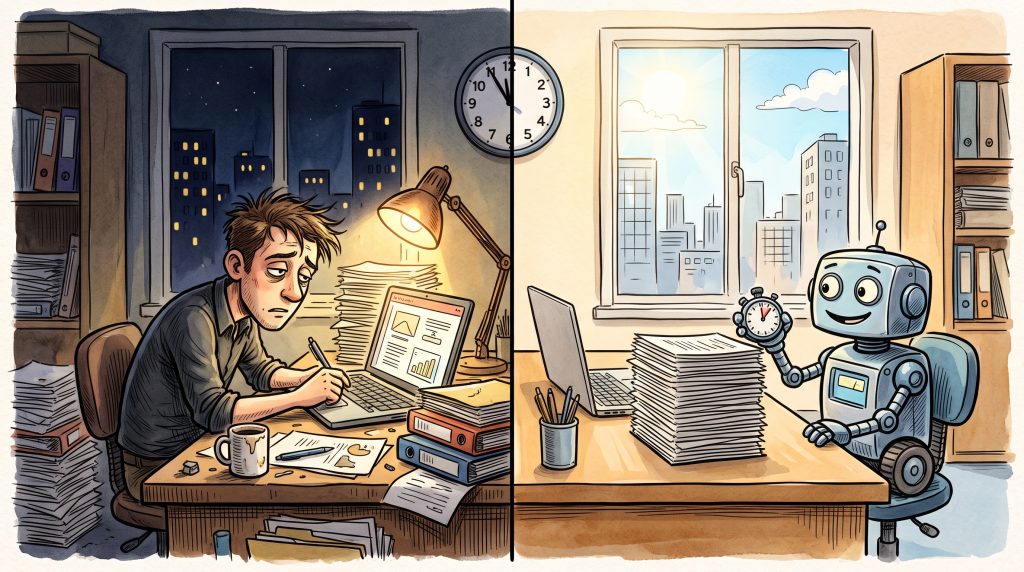
Now picture that work being done in eight seconds by software. The slides are formatted, the footnotes are checked and the summary is decent. For someone looking for a first job, the worry is straightforward: if that work disappears, where do you get the experience employers keep asking for?
Researchers are now trying to measure what is happening. Is AI quietly closing the door on graduates? Or are we blaming a new technology for an old-fashioned hiring slump? Here’s the difficult part: the data points in two directions.
Before we get into the numbers, one thing is worth saying plainly. For the young people living through this, it isn’t a debate. It’s the fortieth application with no reply, the rent that’s due anyway, and the awkward dinner where you explain to your parents why the degree they helped pay for hasn’t turned into a job yet.
Most of them did exactly what they were told to do. The ladder moved anyway.
The Case That AI Is Pulling Up the Ladder
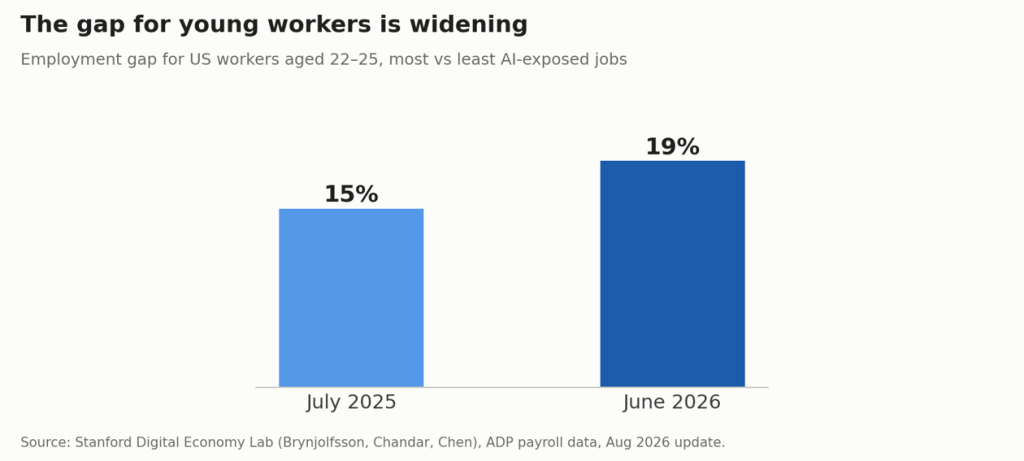
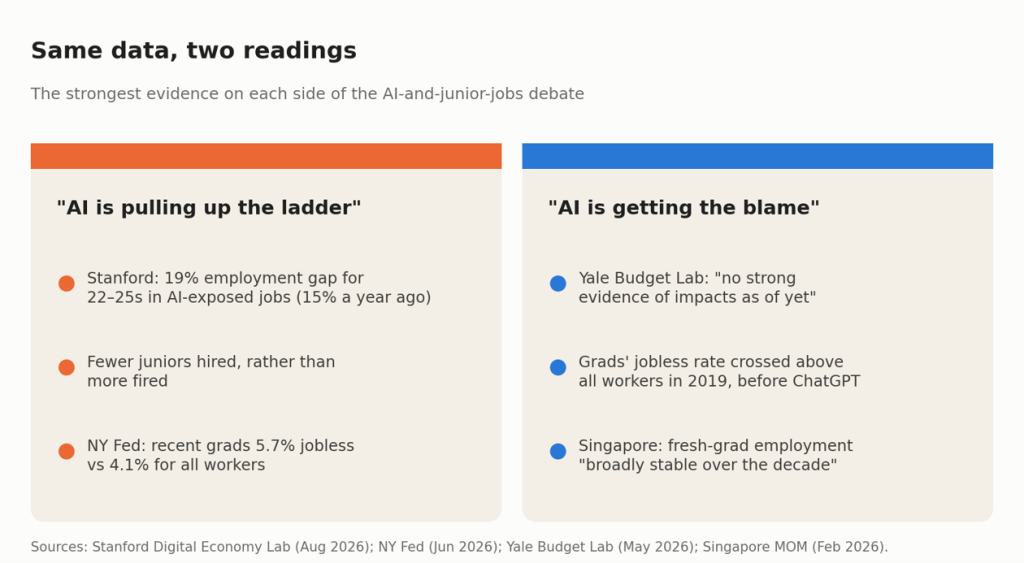
The most-cited evidence comes from Stanford. Economists Erik Brynjolfsson, Bharat Chandar and Ruyu Chen have been tracking payroll data from ADP, one of the biggest payroll processors in the US. In their August 2026 update, workers aged 22 to 25 in the jobs most exposed to AI had a 19% employment gap compared with young workers in less-exposed jobs. A year earlier the gap was 15%.
How it’s happening matters. Companies aren’t firing juniors en masse; they’re hiring fewer of them. The declines are concentrated in roles where AI can do the task outright, like customer service or routine coding, and in work built on “codified” knowledge, the kind you can write down in a manual. Experienced workers, whose value sits in judgment learned on the job, are doing fine or better.
There are louder voices too. In 2025, Anthropic’s chief executive Dario Amodei warned that AI could wipe out half of all entry-level white-collar jobs within five years. (We’ll note the obvious: a company selling AI has reasons to talk up its power. So do its critics have reasons to play it down.)
Why the Class of 2026 Is Worried
The anxiety was hard to miss at this year’s graduation ceremonies.
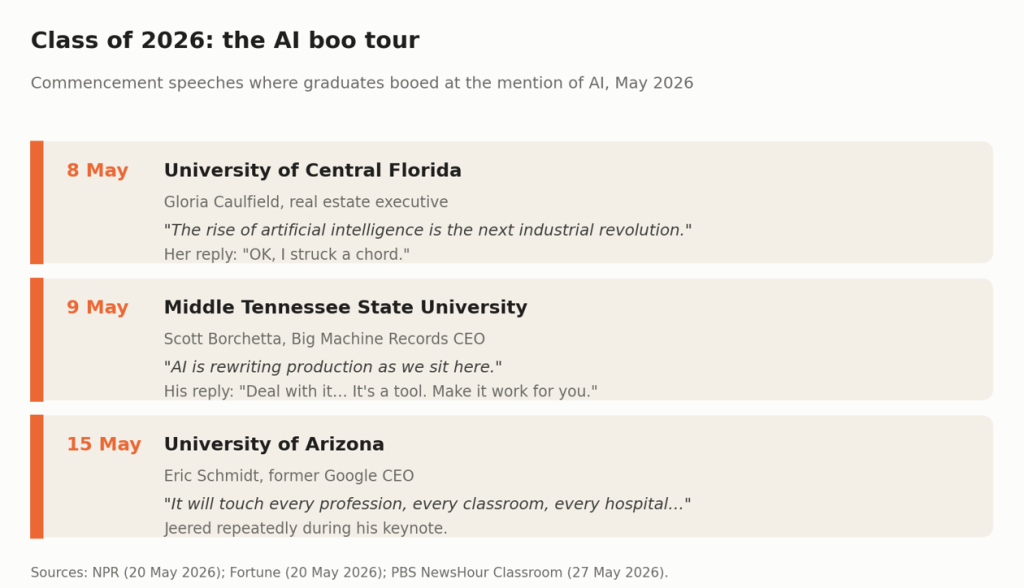
In May, commencement speakers across the US discovered that the fastest way to lose a room of graduates was to praise AI. At the University of Central Florida on 8 May, real estate executive Gloria Caulfield called AI “the next industrial revolution” and was met with boos. “OK, I struck a chord,” she said. The next day at Middle Tennessee State, music executive Scott Borchetta told graduates that “AI is rewriting production as we sit here.” When they booed, he pushed back: “Deal with it… It’s a tool. Make it work for you.” And on 15 May at the University of Arizona, former Google chief executive Eric Schmidt was jeered repeatedly as he told the class that AI “will touch every profession, every classroom, every hospital.”
You can watch a compilation here in PBS NewsHour Classroom, “Shorts: 2026 graduates boo commencement speeches on AI” (27 May 2026, 2m40s), which is embedded from YouTube on the PBS page: https://www.pbs.org/newshour/classroom/daily-news-lessons/2026/05/shorts-2026-graduates-boo-commencement-speeches-on-ai
The boos don’t tell us how many jobs AI has displaced. But we should take the worry seriously. These students have spent years working towards a qualification, often with considerable help and sacrifice from their families. Being told to embrace a technology that might reduce their chances of getting hired offers little reassurance.
Fortune reported a 2025 Harvard Kennedy School poll in which around seven in ten college students said AI threatened their job prospects. We still need to establish how much of the hiring slowdown AI explains. Graduates shouldn’t have to prove the cause before we take their difficulty finding work seriously.
The broader graduate data points the same way. In the US, the New York Fed’s series on recent college graduates shows their unemployment rate at about 5.7% in June 2026, against about 4.1% for all workers. More than four in ten recent grads are underemployed, working in jobs that don’t need a degree.
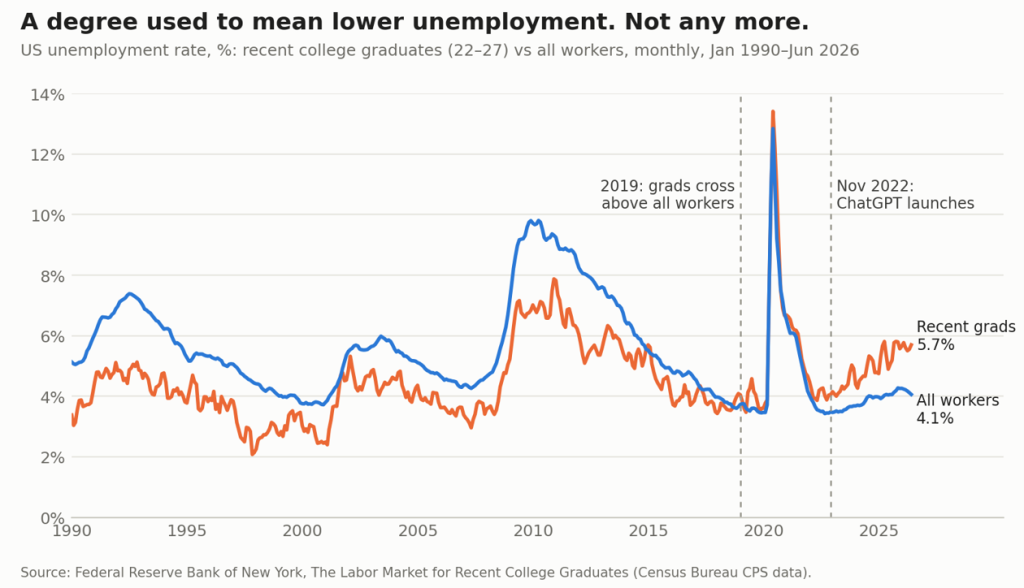
Read that again: for most of the past 35 years, a fresh degree meant you were less likely to be unemployed than the average worker. That’s no longer true. For anyone who studied hard on the understanding that a degree would help them find work, that is a difficult change to accept.
The Case That AI Is Getting the Blame
Now look at the same chart again, because it also contains the best argument on the other side.
The line for recent grads crossed above the line for all workers in 2019. ChatGPT launched in November 2022. Whatever opened the gap, it started three years before generative AI was a household word.
Researchers at Yale’s Budget Lab have gone looking for AI’s fingerprints in the wider job market and so far haven’t found them. Comparing AI-exposed jobs with unexposed ones, economist Ryan Nunn wrote in May: “When we apply our preferred strategy, we find no strong evidence of impacts as of yet.”
There are plenty of other suspects. Interest rates rose sharply from 2022, and hiring slowed across the economy. US payroll growth averaged only around 20,000 jobs a month over the year to March, according to the Budget Lab, and unemployment crept up from 3.4% in 2023 to 4.3%. Many tech companies over-hired during the pandemic and have spent the years since trimming. When companies stop hiring, the people who feel it first are always the ones trying to get in the door. They’re also the ones with the least savings to wait it out.
The Stanford data itself isn’t all gloom, either. In jobs where AI helps workers rather than replacing them, employment for young people has been flat or rising. So is the problem AI, or the kind of AI a company chooses to deploy?
Even the Stanford authors add a careful caveat: “We do not view this paper, or any single study, as definitive evidence of AI’s labor-market effects.”
Singapore offers a more reassuring data point, though it cannot speak for all of Asia. Singapore’s Manpower Ministry told parliament in February that employment rates for fresh graduates “have remained broadly stable over the decade,” and that AI’s specific impact on entry-level professional jobs “remains uncertain.”
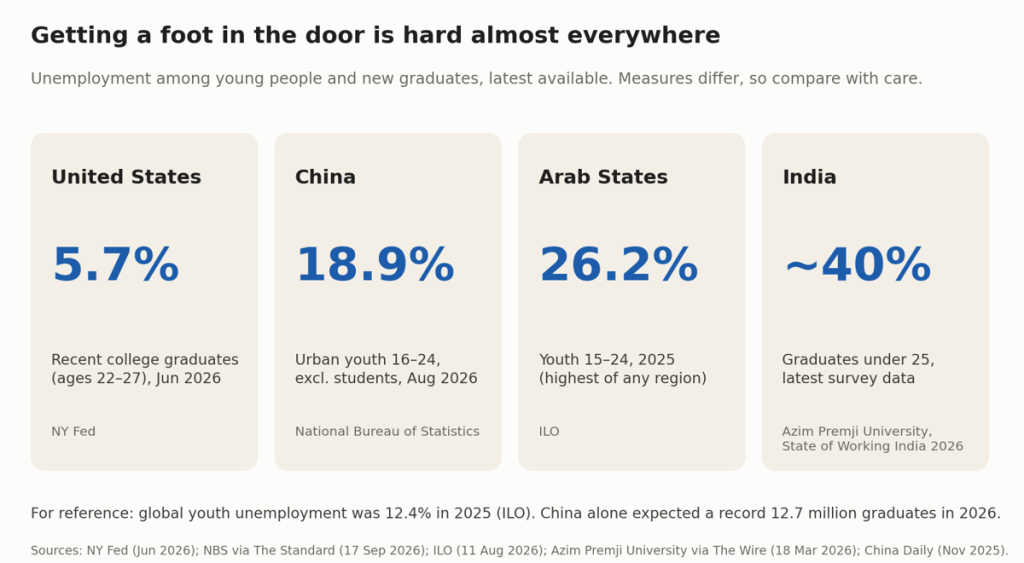
India shows why that distinction matters. Azim Premji University’s State of Working India 2026 report puts unemployment among graduates under 25 at about 39%, using 2023–24 survey data. That figure describes a broader difficulty finding work; it does not establish that AI caused it. For a young person sending out applications, though, the uncertainty about the cause doesn’t make the wait any easier.
Behind those numbers are young people, and the phrases they’ve coined for how it feels.
In China, the “lying flat” meme is often read by older generations as laziness. It is closer to exhaustion: a generation that studied hard, sat the exams and did what was asked, then found the reward wasn’t there. Graduates also joke about “Kong Yiji’s long gown,” after a classic literary character who couldn’t let go of his scholar’s robe even as it stopped doing him any good. For them, the degree they were proud of has become the gown: hard-earned, hard to take off, and no longer opening doors. In India, many young people spend years preparing for competitive government exams, putting their lives on hold for the chance of one secure job.
None of this is young people being picky or soft. It’s what happens when the promise made to them, work hard, get the degree and the job will follow, stops holding. AI is only one thread in that story, and in much of Asia it may not be the main one yet. But for a 24-year-old in her second year of waiting, the cause matters less than the fact that the door still hasn’t opened. As the ILO’s Sukti Dasgupta put it in August, AI’s direct impact on jobs “is still unclear,” but “we must not be complacent and underestimate the risks.”
We’ve Seen Machines Eat Entry-Level Work Before
History offers a useful rhyme, and a warning.
When the spreadsheet arrived around 1980, it wiped out a huge amount of clerical number-crunching. By one widely cited estimate, the US lost around 400,000 bookkeeping and accounting clerk jobs in the decades that followed. But it gained roughly 600,000 accountants and auditors, because cheap calculation created more demand for people who could interpret the numbers.
ATMs were supposed to end bank tellers. Instead, as economist James Bessen found, teller numbers in the US held up for decades: cheaper branches meant banks opened more of them, and tellers shifted from counting cash to selling products.
Then came the smartphone. Once people could bank from their sofa, they stopped visiting branches. Full-time teller jobs fell from about 332,000 in 2010 to about 164,000 in 2022. The ATM automated a task; the phone made the whole place unnecessary.
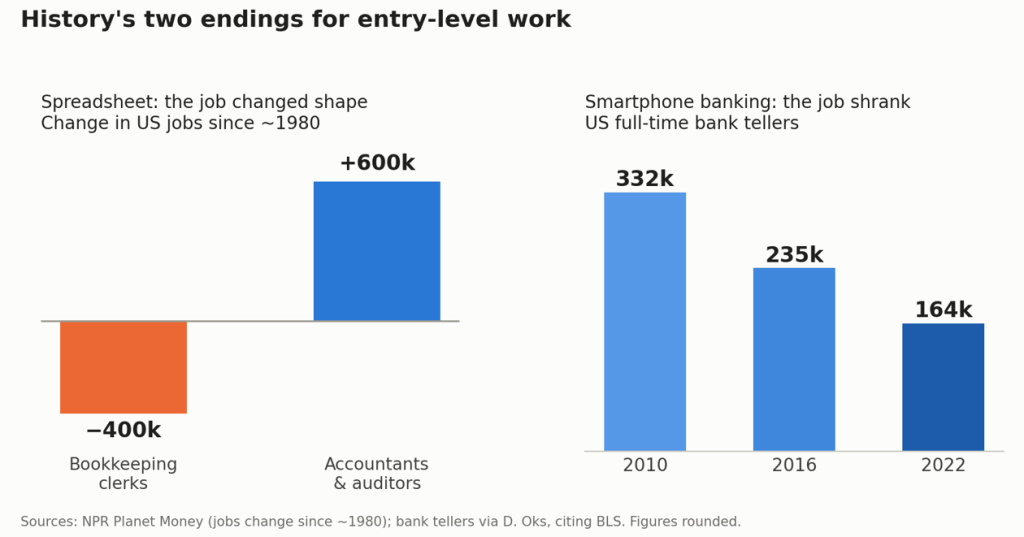
That’s the real lesson, and it cuts both ways. Technology that does one piece of a junior’s job tends to reshape the job. Technology that removes the reason the job exists is a different story. Which kind is AI? It may be both, depending on the job.
The other warning is timing: the new jobs weren’t always for the same people, and the transition took years. A 23-year-old doesn’t have years. At 23, waiting can mean another year relying on parents who may already be stretched, or taking whatever work pays the bills while the career you trained for feels further away. An eventual recovery doesn’t give that time back.
The Question Worth Asking
Here is where we land. It’s a view, not a verdict.
Alongside the question of how many junior jobs AI is taking, we need to ask how young people will learn to do those jobs. The junior job was never just a job. It was a training programme that companies paid for without calling it one. You learned judgment by doing the dull work under someone who already had it.
If AI does the dull work, the company saves money this year. But where does it get its senior people in 2036? Every firm has an incentive to let someone else train the juniors, and if everyone waits, nobody does it.
Employers need to decide who will do that training and pay for it. Otherwise, graduates are left waiting for a chance that each company expects another to provide.
There’s a second puzzle, and it lands hardest on the graduates themselves. If the new entry-level job is “check the AI’s work,” how do you check work you’ve never learned to do? The old ladder taught you to spot a wrong number by making a few yourself.
A new graduate needs someone experienced to explain why an answer is wrong, and time to learn without being expected to know everything already. What replaces that support?
Some firms are already experimenting with answers: apprenticeships redesigned around AI tools, juniors paired with agents rather than replaced by them, and programmes like Singapore’s graduate traineeships.
What would change our mind? A few things we’re watching:
- Whether the young-worker gap keeps widening in AI-exposed jobs while overall hiring recovers. That would point more clearly to AI.
- Whether the grad-versus-all gap narrows as interest rates fall. That would point to the business cycle.
- What happens in Asia’s graduate data over the next year or two, allowing for the very different starting points across countries.
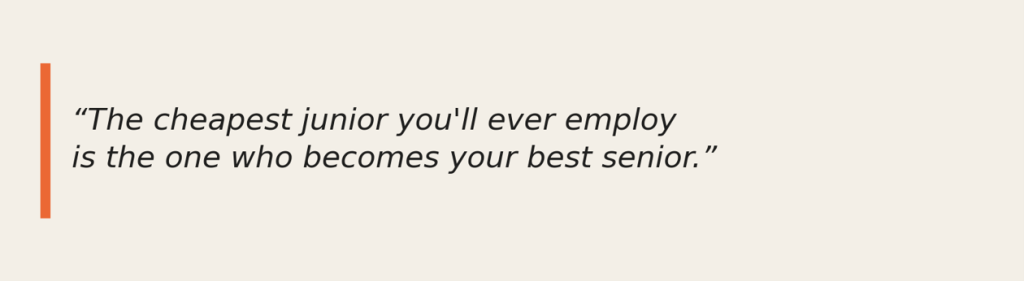
Until then, a small thought for anyone hiring: the cheapest junior you’ll ever employ is the one who becomes your best senior. The question is whether anyone is still willing to pay for that.
And to anyone graduating into this: the fact that the first rung is harder to find says more about this moment than it does about you. As the ILO’s director-general, Gilbert Houngbo, put it in August: “A generation that cannot find decent work cannot build its future with confidence.” Fixing that is everyone’s job, not only yours.
Who took a chance on you when you were starting out, and who are you taking a chance on now?
Tara Mulia
For more blogs like these, subscribe to our newsletter here!
Important information
This article is published by Heyokha Brothers Limited (“Heyokha”), a corporation licensed by the Securities and Futures Commission of Hong Kong (CE No. BOS569). It is provided for general information and discussion purposes only. It reflects the authors’ views and observations at the date of publication, and these may change without notice.
Nothing in this article is investment, legal, tax or other professional advice, investment research, or a recommendation, offer or solicitation to buy or sell any security, fund or other investment product. It is not directed at any person in any jurisdiction where its publication or availability would be unlawful. Any companies, securities or assets mentioned are for illustration only and are not a recommendation.
Information from third-party sources is believed to be reliable, but it has not been independently verified. No representation or warranty is given as to its accuracy or completeness. Forward-looking statements are inherently uncertain, and actual outcomes may differ materially. Investment involves risk, the value of investments can go down as well as up, and past performance is not indicative of future results. Heyokha, its directors and employees, and funds it manages may hold positions in assets mentioned.
Readers should seek independent professional advice before making any investment decision. This article has not been reviewed by the Securities and Futures Commission.
Admin heyokha

Share


Every senior banker, lawyer and engineer you know has a version of the same story. Their first job was mostly grunt work: formatting slides at midnight, checking footnotes, writing code nobody would ever read, summarising documents for someone more important. It was dull, and it was also how they learned. Someone hired them before they knew much and gave them time to get better.
Now picture that work being done in eight seconds by software. The slides are formatted, the footnotes are checked and the summary is decent. For someone looking for a first job, the worry is straightforward: if that work disappears, where do you get the experience employers keep asking for?
Researchers are now trying to measure what is happening. Is AI quietly closing the door on graduates? Or are we blaming a new technology for an old-fashioned hiring slump? Here’s the difficult part: the data points in two directions.
Before we get into the numbers, one thing is worth saying plainly. For the young people living through this, it isn’t a debate. It’s the fortieth application with no reply, the rent that’s due anyway, and the awkward dinner where you explain to your parents why the degree they helped pay for hasn’t turned into a job yet.
Most of them did exactly what they were told to do. The ladder moved anyway.
The Case That AI Is Pulling Up the Ladder
The most-cited evidence comes from Stanford. Economists Erik Brynjolfsson, Bharat Chandar and Ruyu Chen have been tracking payroll data from ADP, one of the biggest payroll processors in the US. In their August 2026 update, workers aged 22 to 25 in the jobs most exposed to AI had a 19% employment gap compared with young workers in less-exposed jobs. A year earlier the gap was 15%.
How it’s happening matters. Companies aren’t firing juniors en masse; they’re hiring fewer of them. The declines are concentrated in roles where AI can do the task outright, like customer service or routine coding, and in work built on “codified” knowledge, the kind you can write down in a manual. Experienced workers, whose value sits in judgment learned on the job, are doing fine or better.
There are louder voices too. In 2025, Anthropic’s chief executive Dario Amodei warned that AI could wipe out half of all entry-level white-collar jobs within five years. (We’ll note the obvious: a company selling AI has reasons to talk up its power. So do its critics have reasons to play it down.)
Why the Class of 2026 Is Worried
The anxiety was hard to miss at this year’s graduation ceremonies.
In May, commencement speakers across the US discovered that the fastest way to lose a room of graduates was to praise AI. At the University of Central Florida on 8 May, real estate executive Gloria Caulfield called AI “the next industrial revolution” and was met with boos. “OK, I struck a chord,” she said. The next day at Middle Tennessee State, music executive Scott Borchetta told graduates that “AI is rewriting production as we sit here.” When they booed, he pushed back: “Deal with it… It’s a tool. Make it work for you.” And on 15 May at the University of Arizona, former Google chief executive Eric Schmidt was jeered repeatedly as he told the class that AI “will touch every profession, every classroom, every hospital.”
You can watch a compilation here in PBS NewsHour Classroom, “Shorts: 2026 graduates boo commencement speeches on AI” (27 May 2026, 2m40s), which is embedded from YouTube on the PBS page: https://www.pbs.org/newshour/classroom/daily-news-lessons/2026/05/shorts-2026-graduates-boo-commencement-speeches-on-ai
The boos don’t tell us how many jobs AI has displaced. But we should take the worry seriously. These students have spent years working towards a qualification, often with considerable help and sacrifice from their families. Being told to embrace a technology that might reduce their chances of getting hired offers little reassurance.
Fortune reported a 2025 Harvard Kennedy School poll in which around seven in ten college students said AI threatened their job prospects. We still need to establish how much of the hiring slowdown AI explains. Graduates shouldn’t have to prove the cause before we take their difficulty finding work seriously.
The broader graduate data points the same way. In the US, the New York Fed’s series on recent college graduates shows their unemployment rate at about 5.7% in June 2026, against about 4.1% for all workers. More than four in ten recent grads are underemployed, working in jobs that don’t need a degree.
Read that again: for most of the past 35 years, a fresh degree meant you were less likely to be unemployed than the average worker. That’s no longer true. For anyone who studied hard on the understanding that a degree would help them find work, that is a difficult change to accept.
The Case That AI Is Getting the Blame
Now look at the same chart again, because it also contains the best argument on the other side.
The line for recent grads crossed above the line for all workers in 2019. ChatGPT launched in November 2022. Whatever opened the gap, it started three years before generative AI was a household word.
Researchers at Yale’s Budget Lab have gone looking for AI’s fingerprints in the wider job market and so far haven’t found them. Comparing AI-exposed jobs with unexposed ones, economist Ryan Nunn wrote in May: “When we apply our preferred strategy, we find no strong evidence of impacts as of yet.”
There are plenty of other suspects. Interest rates rose sharply from 2022, and hiring slowed across the economy. US payroll growth averaged only around 20,000 jobs a month over the year to March, according to the Budget Lab, and unemployment crept up from 3.4% in 2023 to 4.3%. Many tech companies over-hired during the pandemic and have spent the years since trimming. When companies stop hiring, the people who feel it first are always the ones trying to get in the door. They’re also the ones with the least savings to wait it out.
The Stanford data itself isn’t all gloom, either. In jobs where AI helps workers rather than replacing them, employment for young people has been flat or rising. So is the problem AI, or the kind of AI a company chooses to deploy?
Even the Stanford authors add a careful caveat: “We do not view this paper, or any single study, as definitive evidence of AI’s labor-market effects.”
Singapore offers a more reassuring data point, though it cannot speak for all of Asia. Singapore’s Manpower Ministry told parliament in February that employment rates for fresh graduates “have remained broadly stable over the decade,” and that AI’s specific impact on entry-level professional jobs “remains uncertain.”
India shows why that distinction matters. Azim Premji University’s State of Working India 2026 report puts unemployment among graduates under 25 at about 39%, using 2023–24 survey data. That figure describes a broader difficulty finding work; it does not establish that AI caused it. For a young person sending out applications, though, the uncertainty about the cause doesn’t make the wait any easier.
Behind those numbers are young people, and the phrases they’ve coined for how it feels.
In China, the “lying flat” meme is often read by older generations as laziness. It is closer to exhaustion: a generation that studied hard, sat the exams and did what was asked, then found the reward wasn’t there. Graduates also joke about “Kong Yiji’s long gown,” after a classic literary character who couldn’t let go of his scholar’s robe even as it stopped doing him any good. For them, the degree they were proud of has become the gown: hard-earned, hard to take off, and no longer opening doors. In India, many young people spend years preparing for competitive government exams, putting their lives on hold for the chance of one secure job.
None of this is young people being picky or soft. It’s what happens when the promise made to them, work hard, get the degree and the job will follow, stops holding. AI is only one thread in that story, and in much of Asia it may not be the main one yet. But for a 24-year-old in her second year of waiting, the cause matters less than the fact that the door still hasn’t opened. As the ILO’s Sukti Dasgupta put it in August, AI’s direct impact on jobs “is still unclear,” but “we must not be complacent and underestimate the risks.”
We’ve Seen Machines Eat Entry-Level Work Before
History offers a useful rhyme, and a warning.
When the spreadsheet arrived around 1980, it wiped out a huge amount of clerical number-crunching. By one widely cited estimate, the US lost around 400,000 bookkeeping and accounting clerk jobs in the decades that followed. But it gained roughly 600,000 accountants and auditors, because cheap calculation created more demand for people who could interpret the numbers.
ATMs were supposed to end bank tellers. Instead, as economist James Bessen found, teller numbers in the US held up for decades: cheaper branches meant banks opened more of them, and tellers shifted from counting cash to selling products.
Then came the smartphone. Once people could bank from their sofa, they stopped visiting branches. Full-time teller jobs fell from about 332,000 in 2010 to about 164,000 in 2022. The ATM automated a task; the phone made the whole place unnecessary.
That’s the real lesson, and it cuts both ways. Technology that does one piece of a junior’s job tends to reshape the job. Technology that removes the reason the job exists is a different story. Which kind is AI? It may be both, depending on the job.
The other warning is timing: the new jobs weren’t always for the same people, and the transition took years. A 23-year-old doesn’t have years. At 23, waiting can mean another year relying on parents who may already be stretched, or taking whatever work pays the bills while the career you trained for feels further away. An eventual recovery doesn’t give that time back.
The Question Worth Asking
Here is where we land. It’s a view, not a verdict.
Alongside the question of how many junior jobs AI is taking, we need to ask how young people will learn to do those jobs. The junior job was never just a job. It was a training programme that companies paid for without calling it one. You learned judgment by doing the dull work under someone who already had it.
If AI does the dull work, the company saves money this year. But where does it get its senior people in 2036? Every firm has an incentive to let someone else train the juniors, and if everyone waits, nobody does it.
Employers need to decide who will do that training and pay for it. Otherwise, graduates are left waiting for a chance that each company expects another to provide.
There’s a second puzzle, and it lands hardest on the graduates themselves. If the new entry-level job is “check the AI’s work,” how do you check work you’ve never learned to do? The old ladder taught you to spot a wrong number by making a few yourself.
A new graduate needs someone experienced to explain why an answer is wrong, and time to learn without being expected to know everything already. What replaces that support?
Some firms are already experimenting with answers: apprenticeships redesigned around AI tools, juniors paired with agents rather than replaced by them, and programmes like Singapore’s graduate traineeships.
What would change our mind? A few things we’re watching:
- Whether the young-worker gap keeps widening in AI-exposed jobs while overall hiring recovers. That would point more clearly to AI.
- Whether the grad-versus-all gap narrows as interest rates fall. That would point to the business cycle.
- What happens in Asia’s graduate data over the next year or two, allowing for the very different starting points across countries.
Until then, a small thought for anyone hiring: the cheapest junior you’ll ever employ is the one who becomes your best senior. The question is whether anyone is still willing to pay for that.
And to anyone graduating into this: the fact that the first rung is harder to find says more about this moment than it does about you. As the ILO’s director-general, Gilbert Houngbo, put it in August: “A generation that cannot find decent work cannot build its future with confidence.” Fixing that is everyone’s job, not only yours.
Who took a chance on you when you were starting out, and who are you taking a chance on now?
Tara Mulia
For more blogs like these, subscribe to our newsletter here!
Important information
This article is published by Heyokha Brothers Limited (“Heyokha”), a corporation licensed by the Securities and Futures Commission of Hong Kong (CE No. BOS569). It is provided for general information and discussion purposes only. It reflects the authors’ views and observations at the date of publication, and these may change without notice.
Nothing in this article is investment, legal, tax or other professional advice, investment research, or a recommendation, offer or solicitation to buy or sell any security, fund or other investment product. It is not directed at any person in any jurisdiction where its publication or availability would be unlawful. Any companies, securities or assets mentioned are for illustration only and are not a recommendation.
Information from third-party sources is believed to be reliable, but it has not been independently verified. No representation or warranty is given as to its accuracy or completeness. Forward-looking statements are inherently uncertain, and actual outcomes may differ materially. Investment involves risk, the value of investments can go down as well as up, and past performance is not indicative of future results. Heyokha, its directors and employees, and funds it manages may hold positions in assets mentioned.
Readers should seek independent professional advice before making any investment decision. This article has not been reviewed by the Securities and Futures Commission.
Admin heyokha
Share