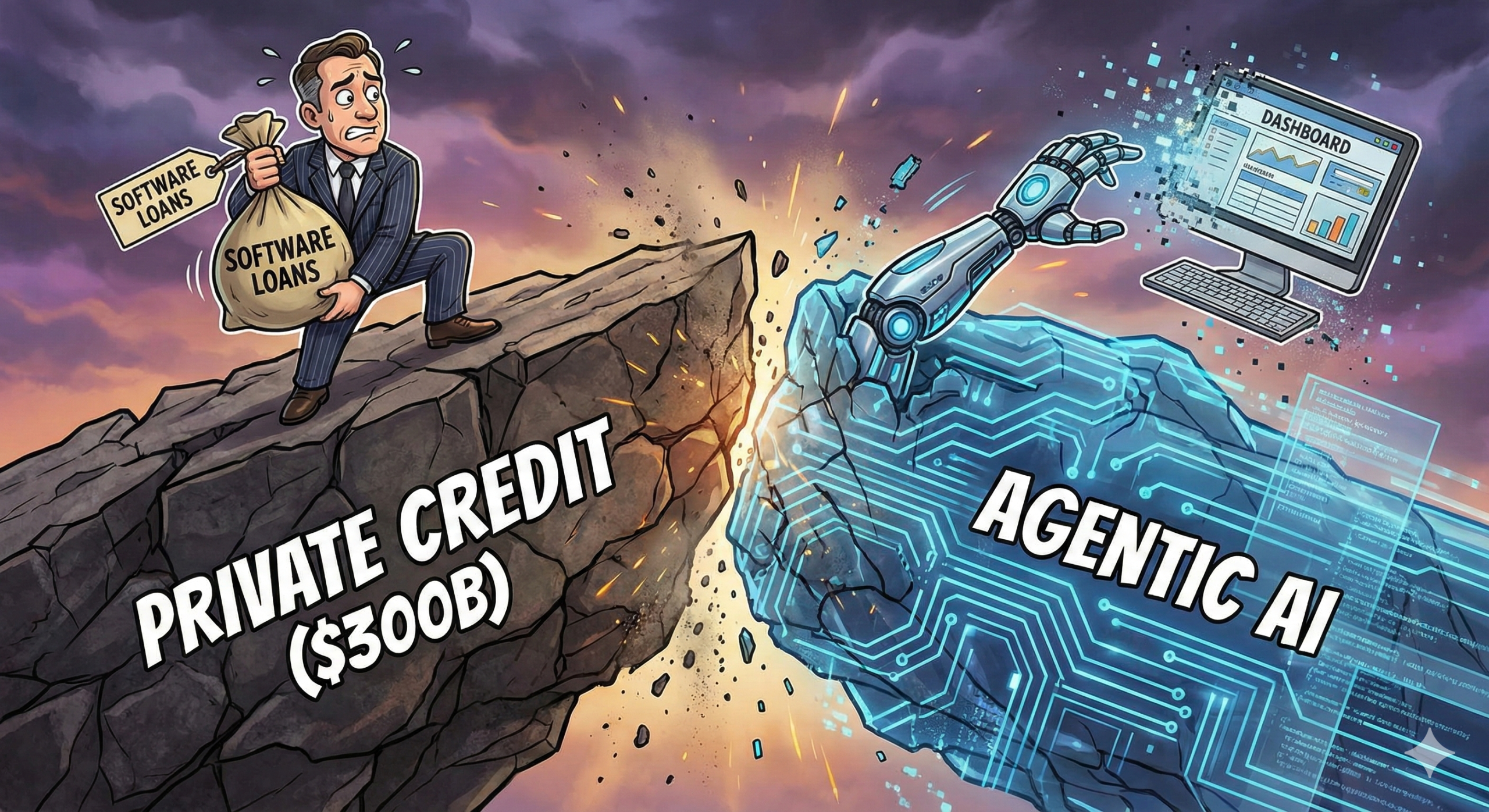
In November 2025, we warned you about the invisible engine funding the artificial intelligence boom in our piece, When AI Meets Private Credit: The Vessel, Not the Flaw. We noted that an opaque constellation of non-bank lenders was quietly fronting massive chunks of the $6.7 trillion needed for global AI infrastructure.

Six months prior, in AI Just Ate Your CRM. Now What?, we mapped out the existential threat facing traditional software, arguing that AI models would soon bypass clunky user dashboards entirely.

Today, those two distinct tectonic plates—shadow finance and AI software disruption are violently colliding. And the tremors are starting to crack the foundation of Wall Street.

Is This The Canary in the Coal Mine?

The shaking started a few weeks ago with Blue Owl Capital.

Blue Owl is a titan in the private credit space, managing nearly $300 billion in investor cash. But recently, their stock plunged as much as 10% in a single day. Why? They abruptly changed the rules on how investors can pull their money out of a major fund, shifting from a guaranteed 5% quarterly redemption to a discretionary payout model.
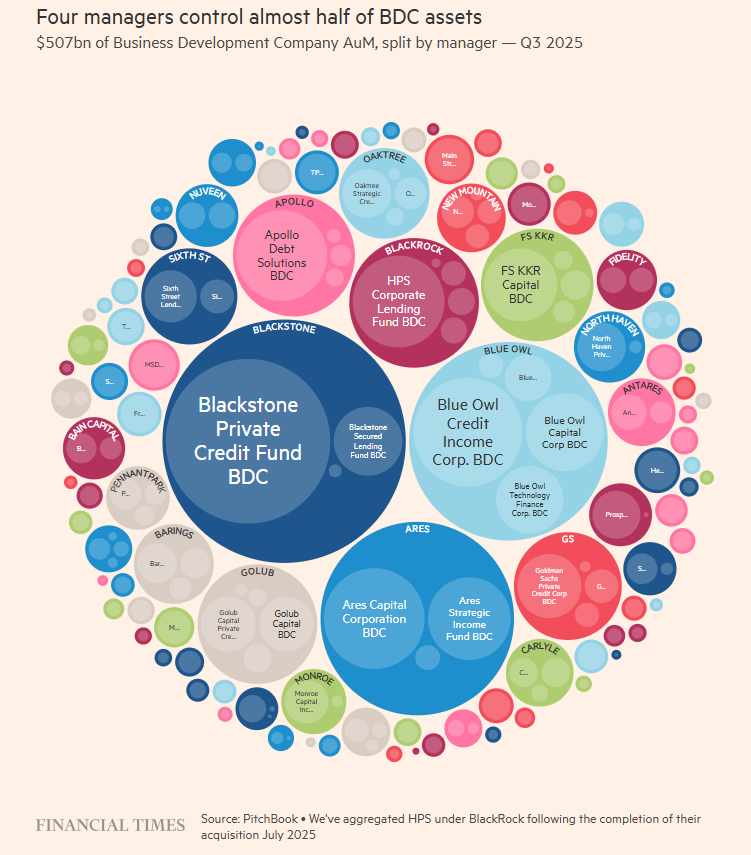
For perspective, Blue Owl is the second largest behind Blackstone on controlling almost half of BDC assets

Source: Financial Times, Pitchbook

Wall Street veterans immediately flashed back to August 2007. When a massive shadow lender suddenly throws up the gates to stop cash from leaving, it begs the ultimate question: What are they afraid of?

The answer lies in their loan books. In recent years, private credit has extended trillions of dollars in loans to businesses. And their absolute favorite borrower? Software companies.

By industry estimates, at least 20% of all loans extended by private credit funds—and heavily concentrated within Business Development Companies (BDCs)—have gone to software firms. But the true number is likely much higher. A recent Bloomberg analysis found at least 250 investments, worth over $9 billion, that were quietly categorized by lenders as “business services” or “specialty retail” instead of software.
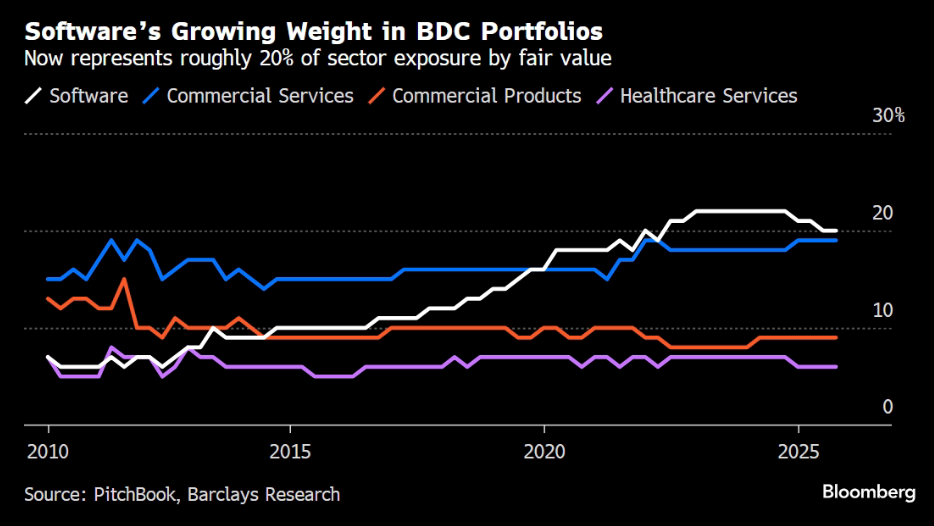
Source: Bloomberg, Barclays, Bloomberg

Private credit lenders loved software for one reason: predictable, recurring revenue. A company with 5,000 employees pays for 5,000 software “seats” every single month. That steady cash flow made it incredibly easy to underwrite massive loans.

But what happens to those loans when AI obliterates the “per-seat” business model?

The “SaaSpocalypse” and the Agentic Future

Let’s add some nuance to the “AI eats software” narrative.

People are panicked that AI will simply delete software companies from existence. That is not entirely true. Software isn’t dying; it is going headless.

To understand this, we need to look at the shift from basic AI Chatbots to AI Agents. A chatbot answers your questions. An AI Agent actually executes multi-step tasks for you across the internet. But an AI Agent does not have eyes. It doesn’t care about pretty dashboards, drop-down menus, or human-friendly interfaces.

It talks to software through an API (Application Programming Interface).

Think of an API as a “Digital Drive-Thru.” If you want food, you don’t have to park, walk inside the restaurant, read the menu, and sit at a table (the old software UI). Instead, you pull your car up to the drive-thru window, hand them a specific, structured order, and they hand you the food. An API allows an AI Agent to pull up to a software company, hand it code, and get the data back instantly without ever “looking” at the website.

A Day in the Life: The Agentic Shift

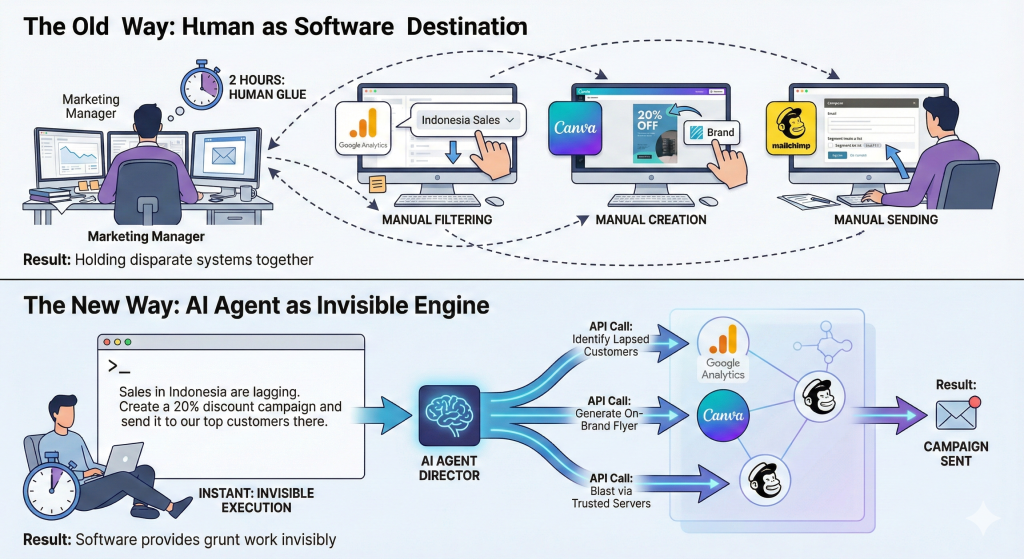
Let’s look at how this destroys the traditional software workflow. Compare a Marketing Manager’s job today versus the Agentic reality of 2027:

The Old Way (Software as a Destination):

  1. You log into Google Analytics, manually clicking through filters to discover sales are down in Indonesia.
  2. You log into Canva, picking a template and manually dragging your brand logo to create a “20% Off” flyer.
  3. You log into Mailchimp, uploading the flyer, typing the copy, and manually segmenting your Indonesian VIP email list to hit send.

Result: You spent two hours acting as the “Human Glue” holding three different websites together.

The New Way (Software as an Invisible Engine): You open one command window—your AI Agent—and simply say: “Sales in Indonesia are lagging. Create a 20% discount campaign and send it to our top customers there.”

The Agent acts as the Director:

  • It calls Google Analytics via API to instantly identify the lapsed customers.
  • It calls Canva via API to automatically generate a perfectly on-brand flyer.
  • It calls Mailchimp via API to blast the email through their trusted servers.

Result: You never looked at a single website. The software companies provided the grunt work invisibly in the background.
The Infrastructural Moats: Why Software Survives

So, why doesn’t the AI just build its own Mailchimp or Canva? Because traditional software companies own the physical and digital infrastructure.

  • The Pipe Moat (Mailchimp): An AI can write a brilliant email, but if it sends 10,000 messages from an unknown server, Gmail will instantly block it as spam. Mailchimp owns the “Trusted Pipes” that the internet respects.
  • The Sensor Moat (Google Analytics): An AI doesn’t inherently know what is happening on your website. Google has millions of digital sensors tracking clicks. The AI needs that raw data to “see.”
  • The Guardrail Moat (Canva): An AI hallucination might accidentally make your corporate logo neon pink. Canva provides the strict “Brand Kits” that force the AI to stay inside the lines.

Software companies aren’t going to zero. They will survive by becoming the invisible plumbing of the internet.

This transformation does not automatically spell out a wave of mass defaults. Just hours after delivering another blowout earnings report, Nvidia CEO Jensen Huang pushed back against Wall Street’s doomsday narrative.

His message was blunt: AI agents are not going to cannibalize enterprise software; they are going to become its power users. As he explained, “These agentic AI will be intelligent software that uses these tools on our behalf.”

Whether it is an Excel spreadsheet, a ServiceNow workflow, or an SAP database, these platforms exist for a fundamentally good reason. They are the organizational infrastructure. AI agents won’t replace the tools; they will operate them. As Huang noted, in the end, we still need these tools to finish the work and format the information in a way humans can actually understand.

The A2A Ecosystem: When Agents Talk to Agents

If you think the future is just your company’s internal AI agent pulling levers on different software APIs, you are still thinking too small. The industry is rapidly moving toward an external, machine-to-machine economy powered by open standards like Google’s Agent-to-Agent (A2A) protocol.

While internal “multi-agent” architectures involve a closed team of AIs working within your own company’s walled garden, A2A is the open internet for agents. It allows an AI built by one company to dynamically discover, securely communicate with, and effectively hire an entirely independent AI built by another company.
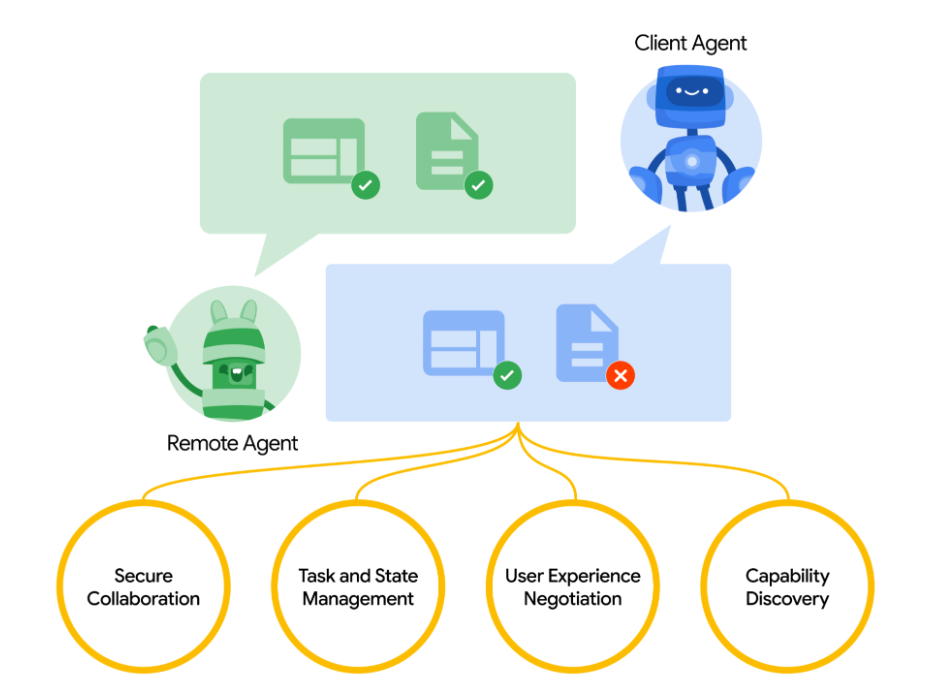
How A2A works

Source: Google

In our marketing example, you wouldn’t just use one AI. Your “Director Agent” would use the A2A protocol to hire a specialized “Google Analytics Agent” to pull the data, securely negotiate with a specialized “Canva Agent” to design the creative, and hand the final product to a specialized “Mailchimp Agent” for delivery.

Software companies will no longer just build platforms; they will build and lease specialized agents into this global workforce. For the private credit industry, this adds another layer of complexity. They aren’t just underwriting software tools anymore; they are underwriting digital employees operating in an entirely autonomous machine-to-machine economy.

The Economic Obliteration and the New Moats

For the shadow banking system holding hundreds of billions in debt, this isn’t an extinction event—it is a massive repricing of risk. The software industry isn’t dying; it is simply mutating into a new form. To keep generating cash and paying back those private credit loans, software companies must fundamentally change what they sell and how they charge for it.

  • The Death of the License and the Rise of the “Call”: Currently, if you have 50 employees, you buy 50 human “seats.” But what happens when a single AI agent can seamlessly do the work of those 50 people? The traditional per-seat license implodes. To survive, software companies must pivot to consumption pricing. Bosses will no longer pay flat monthly subscriptions for humans; they will pay fractions of a penny for every “API call” the agent makes. Software ceases to be a fixed subscription and becomes a variable expense—exactly like paying your electric bill.
  • Data Security is the New UI: For the last decade, companies spent billions making software “human-friendly.” That capital is now stranded. Agents don’t care about sleek drop-down menus, intuitive design, or pretty color schemes. Human-targeted UI improvements are no longer a selling feature. Instead, the ultimate premium feature is data security. When autonomous machines are rapidly moving massive amounts of proprietary company data across the internet via APIs, the surviving software giants will be the ones offering ironclad security, impenetrable “guardrails,” and flawless backend execution.
  • Open the API Gates: Software companies must become radically open. If a platform tries to build a walled garden and block AI agents from plugging in, the agent will simply take its transaction to a competitor that is open. In the agentic future, the path of least resistance wins the revenue.

For the $300 billion private credit market, the game has fundamentally changed. The lenders who survive this cycle will be the ones who realize that the companies they are funding are no longer selling dashboards to humans. They are selling secure, invisible tools to machines.


Tara Mulia

For more blogs like these, subscribe to our newsletter here!


Admin heyokha



Share


In November 2025, we warned you about the invisible engine funding the artificial intelligence boom in our piece, When AI Meets Private Credit: The Vessel, Not the Flaw. We noted that an opaque constellation of non-bank lenders was quietly fronting massive chunks of the $6.7 trillion needed for global AI infrastructure.

Six months prior, in AI Just Ate Your CRM. Now What?, we mapped out the existential threat facing traditional software, arguing that AI models would soon bypass clunky user dashboards entirely.

Today, those two distinct tectonic plates—shadow finance and AI software disruption are violently colliding. And the tremors are starting to crack the foundation of Wall Street.

Is This The Canary in the Coal Mine?

The shaking started a few weeks ago with Blue Owl Capital.

Blue Owl is a titan in the private credit space, managing nearly $300 billion in investor cash. But recently, their stock plunged as much as 10% in a single day. Why? They abruptly changed the rules on how investors can pull their money out of a major fund, shifting from a guaranteed 5% quarterly redemption to a discretionary payout model.

For perspective, Blue Owl is the second largest behind Blackstone on controlling almost half of BDC assets

Source: Financial Times, Pitchbook

Wall Street veterans immediately flashed back to August 2007. When a massive shadow lender suddenly throws up the gates to stop cash from leaving, it begs the ultimate question: What are they afraid of?

The answer lies in their loan books. In recent years, private credit has extended trillions of dollars in loans to businesses. And their absolute favorite borrower? Software companies.

By industry estimates, at least 20% of all loans extended by private credit funds—and heavily concentrated within Business Development Companies (BDCs)—have gone to software firms. But the true number is likely much higher. A recent Bloomberg analysis found at least 250 investments, worth over $9 billion, that were quietly categorized by lenders as “business services” or “specialty retail” instead of software.

Source: Bloomberg, Barclays, Bloomberg

Private credit lenders loved software for one reason: predictable, recurring revenue. A company with 5,000 employees pays for 5,000 software “seats” every single month. That steady cash flow made it incredibly easy to underwrite massive loans.

But what happens to those loans when AI obliterates the “per-seat” business model?

The “SaaSpocalypse” and the Agentic Future

Let’s add some nuance to the “AI eats software” narrative.

People are panicked that AI will simply delete software companies from existence. That is not entirely true. Software isn’t dying; it is going headless.

To understand this, we need to look at the shift from basic AI Chatbots to AI Agents. A chatbot answers your questions. An AI Agent actually executes multi-step tasks for you across the internet. But an AI Agent does not have eyes. It doesn’t care about pretty dashboards, drop-down menus, or human-friendly interfaces.

It talks to software through an API (Application Programming Interface).

Think of an API as a “Digital Drive-Thru.” If you want food, you don’t have to park, walk inside the restaurant, read the menu, and sit at a table (the old software UI). Instead, you pull your car up to the drive-thru window, hand them a specific, structured order, and they hand you the food. An API allows an AI Agent to pull up to a software company, hand it code, and get the data back instantly without ever “looking” at the website.

A Day in the Life: The Agentic Shift

Let’s look at how this destroys the traditional software workflow. Compare a Marketing Manager’s job today versus the Agentic reality of 2027:

The Old Way (Software as a Destination):

  1. You log into Google Analytics, manually clicking through filters to discover sales are down in Indonesia.
  2. You log into Canva, picking a template and manually dragging your brand logo to create a “20% Off” flyer.
  3. You log into Mailchimp, uploading the flyer, typing the copy, and manually segmenting your Indonesian VIP email list to hit send.

Result: You spent two hours acting as the “Human Glue” holding three different websites together.

The New Way (Software as an Invisible Engine): You open one command window—your AI Agent—and simply say: “Sales in Indonesia are lagging. Create a 20% discount campaign and send it to our top customers there.”

The Agent acts as the Director:

  • It calls Google Analytics via API to instantly identify the lapsed customers.
  • It calls Canva via API to automatically generate a perfectly on-brand flyer.
  • It calls Mailchimp via API to blast the email through their trusted servers.

Result: You never looked at a single website. The software companies provided the grunt work invisibly in the background.

The Infrastructural Moats: Why Software Survives

So, why doesn’t the AI just build its own Mailchimp or Canva? Because traditional software companies own the physical and digital infrastructure.

  • The Pipe Moat (Mailchimp): An AI can write a brilliant email, but if it sends 10,000 messages from an unknown server, Gmail will instantly block it as spam. Mailchimp owns the “Trusted Pipes” that the internet respects.
  • The Sensor Moat (Google Analytics): An AI doesn’t inherently know what is happening on your website. Google has millions of digital sensors tracking clicks. The AI needs that raw data to “see.”
  • The Guardrail Moat (Canva): An AI hallucination might accidentally make your corporate logo neon pink. Canva provides the strict “Brand Kits” that force the AI to stay inside the lines.

Software companies aren’t going to zero. They will survive by becoming the invisible plumbing of the internet.

This transformation does not automatically spell out a wave of mass defaults. Just hours after delivering another blowout earnings report, Nvidia CEO Jensen Huang pushed back against Wall Street’s doomsday narrative.

His message was blunt: AI agents are not going to cannibalize enterprise software; they are going to become its power users. As he explained, “These agentic AI will be intelligent software that uses these tools on our behalf.”

Whether it is an Excel spreadsheet, a ServiceNow workflow, or an SAP database, these platforms exist for a fundamentally good reason. They are the organizational infrastructure. AI agents won’t replace the tools; they will operate them. As Huang noted, in the end, we still need these tools to finish the work and format the information in a way humans can actually understand.

The A2A Ecosystem: When Agents Talk to Agents

If you think the future is just your company’s internal AI agent pulling levers on different software APIs, you are still thinking too small. The industry is rapidly moving toward an external, machine-to-machine economy powered by open standards like Google’s Agent-to-Agent (A2A) protocol.

While internal “multi-agent” architectures involve a closed team of AIs working within your own company’s walled garden, A2A is the open internet for agents. It allows an AI built by one company to dynamically discover, securely communicate with, and effectively hire an entirely independent AI built by another company.

How A2A works

Source: Google

In our marketing example, you wouldn’t just use one AI. Your “Director Agent” would use the A2A protocol to hire a specialized “Google Analytics Agent” to pull the data, securely negotiate with a specialized “Canva Agent” to design the creative, and hand the final product to a specialized “Mailchimp Agent” for delivery.

Software companies will no longer just build platforms; they will build and lease specialized agents into this global workforce. For the private credit industry, this adds another layer of complexity. They aren’t just underwriting software tools anymore; they are underwriting digital employees operating in an entirely autonomous machine-to-machine economy.

The Economic Obliteration and the New Moats

For the shadow banking system holding hundreds of billions in debt, this isn’t an extinction event—it is a massive repricing of risk. The software industry isn’t dying; it is simply mutating into a new form. To keep generating cash and paying back those private credit loans, software companies must fundamentally change what they sell and how they charge for it.

  • The Death of the License and the Rise of the “Call”: Currently, if you have 50 employees, you buy 50 human “seats.” But what happens when a single AI agent can seamlessly do the work of those 50 people? The traditional per-seat license implodes. To survive, software companies must pivot to consumption pricing. Bosses will no longer pay flat monthly subscriptions for humans; they will pay fractions of a penny for every “API call” the agent makes. Software ceases to be a fixed subscription and becomes a variable expense—exactly like paying your electric bill.
  • Data Security is the New UI: For the last decade, companies spent billions making software “human-friendly.” That capital is now stranded. Agents don’t care about sleek drop-down menus, intuitive design, or pretty color schemes. Human-targeted UI improvements are no longer a selling feature. Instead, the ultimate premium feature is data security. When autonomous machines are rapidly moving massive amounts of proprietary company data across the internet via APIs, the surviving software giants will be the ones offering ironclad security, impenetrable “guardrails,” and flawless backend execution.
  • Open the API Gates: Software companies must become radically open. If a platform tries to build a walled garden and block AI agents from plugging in, the agent will simply take its transaction to a competitor that is open. In the agentic future, the path of least resistance wins the revenue.

For the $300 billion private credit market, the game has fundamentally changed. The lenders who survive this cycle will be the ones who realize that the companies they are funding are no longer selling dashboards to humans. They are selling secure, invisible tools to machines.


Tara Mulia

For more blogs like these, subscribe to our newsletter here!


Admin heyokha


Share


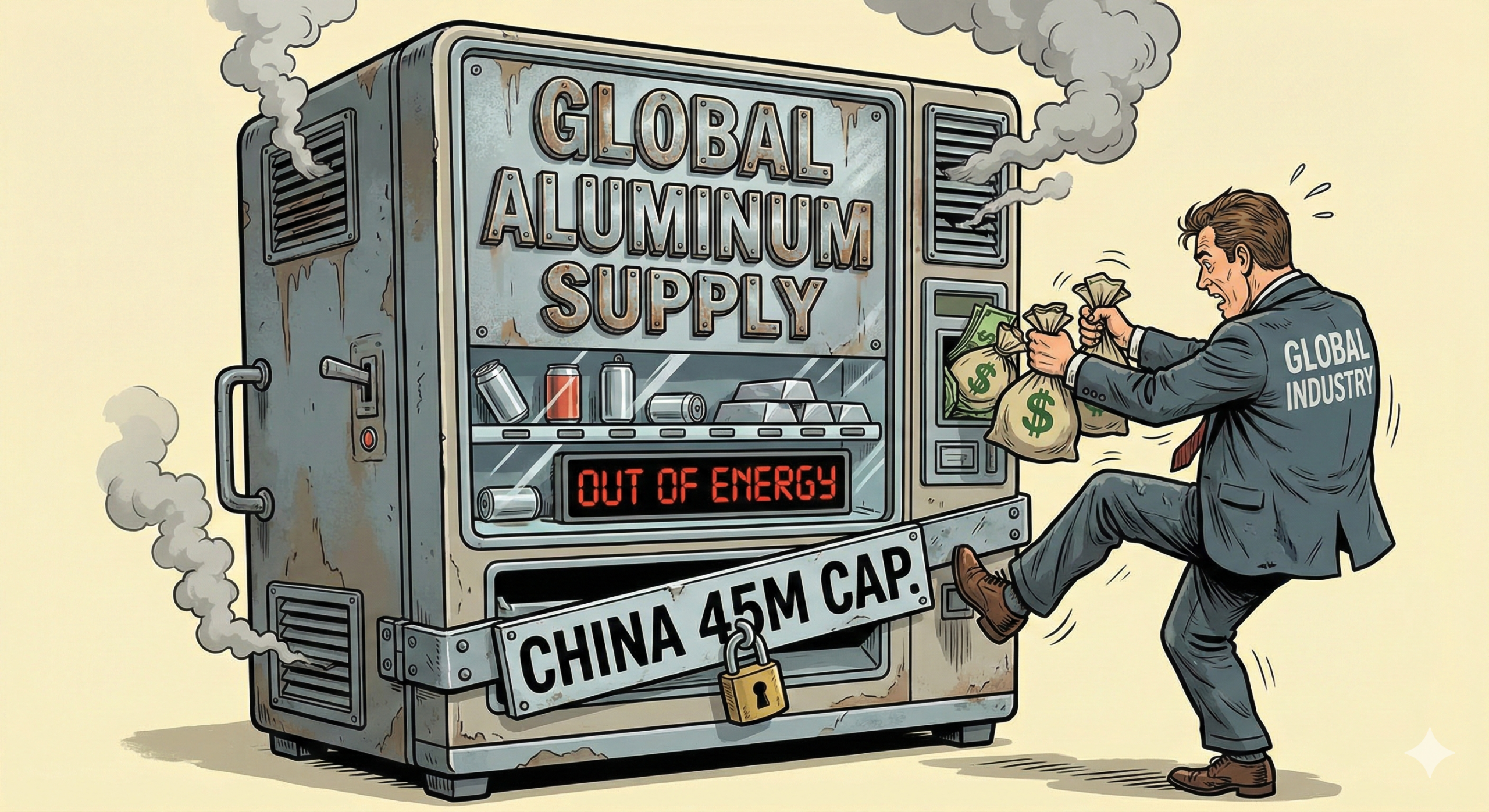
As we established in last week’s blog, the structural deficit in aluminum is widening, and the era of infinite, elastic supply is dead. We broke down China’s 45 million tonne production cap and the crumbling Western industrial base.

But to truly understand where this market is heading, we must ignore the metal itself. We need to look at the power plug.

The Physics of “Congealed Electricity”

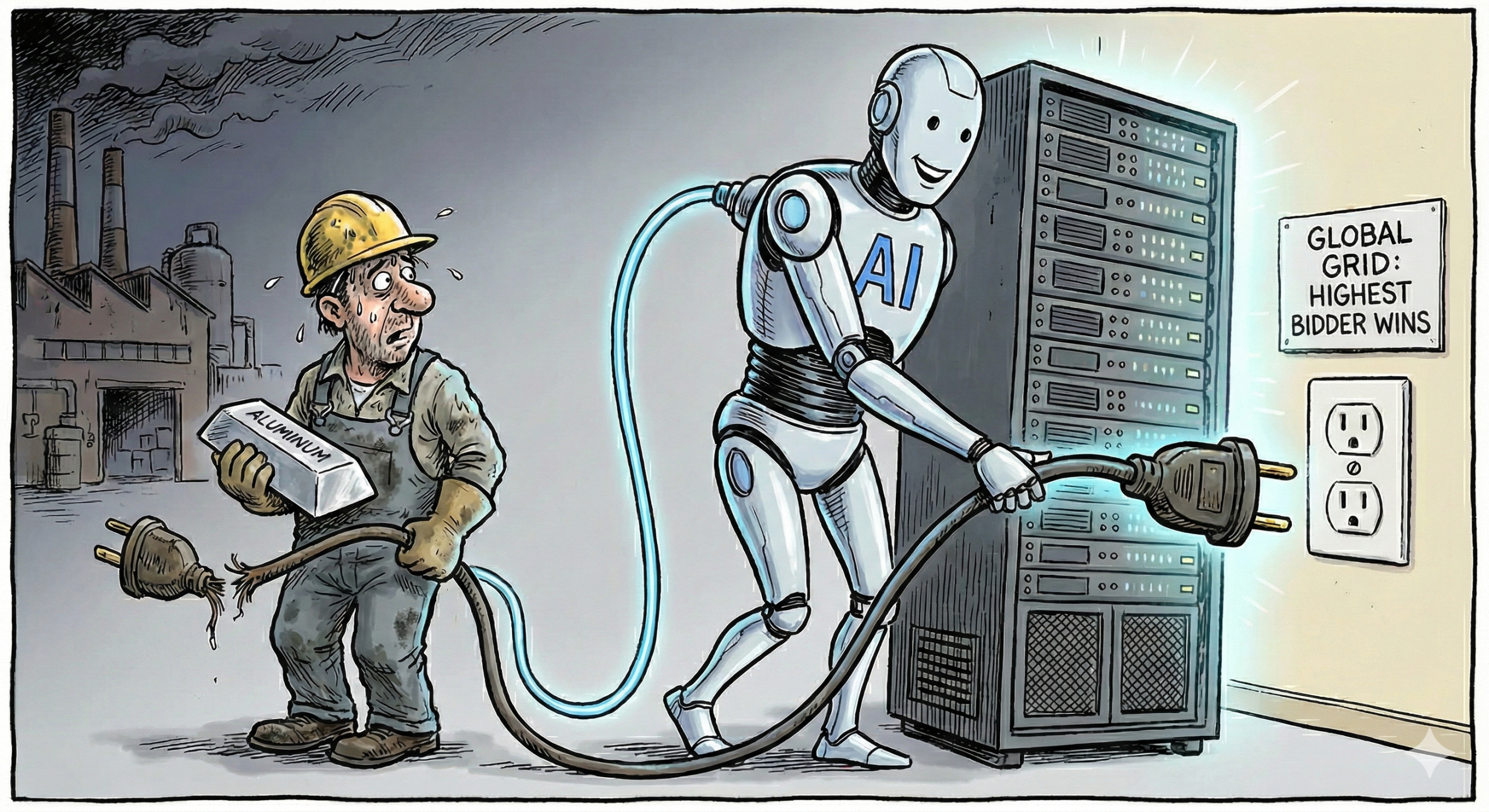
Most people miss the fundamental physics of this industry. Aluminum is not just a metal; it is effectively “congealed electricity.”

Power accounts for 30% to 40% of the total production cost of a single ingot. With global demand for the metal growing at 3% to 4% annually, the world requires an extra two million tonnes of metal every single year just to maintain the status quo.

To manufacture that extra metal, we need to add 3 to 4 gigawatts of continuous, baseload power to the grid annually. That is roughly the energy output of three to four nuclear reactors, or 15 to 20 massive data center campuses, running 24/7 forever.

The math is brutal. If we do not build the power plants, we cannot build the metal. In the past, we solved this by simply building more power generation. Today, that new power is being diverted to a much wealthier buyer.

The Auction for the Grid

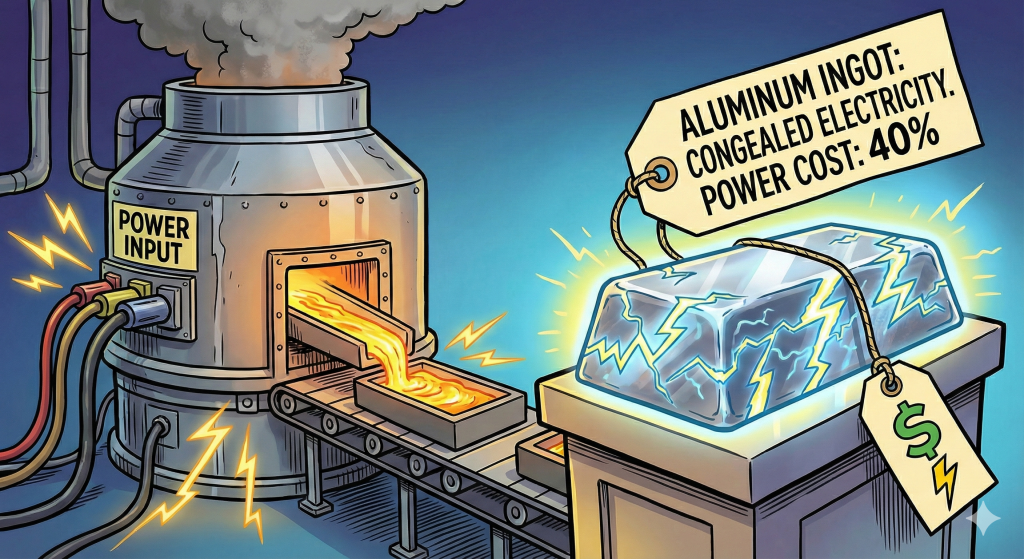
We are witnessing a direct auction for grid capacity that aluminum producers mathematically cannot win.

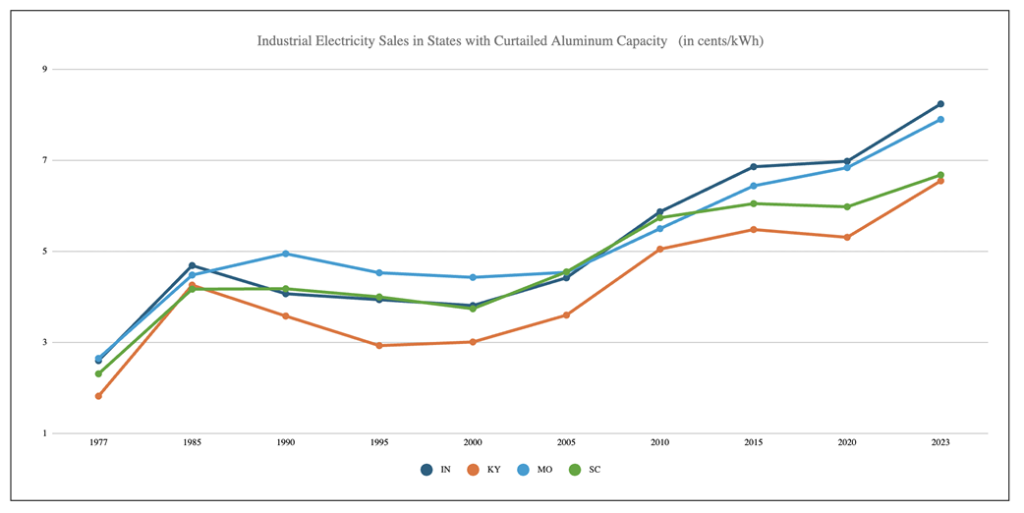
High electricity costs are not a future risk; they are the root cause of the current devastation across the primary aluminum sector. Look at the recent casualties. Century’s Hawesville facility in Kentucky and Magnitude 7’s New Madrid smelter in Missouri did not shut down because of a lack of demand. They died because they failed to secure long term, competitively priced power deals and were forced into the day ahead spot market.

Historical timeline where Aluminum smelters closed coinciding when energy prices rose in select states

Source: The Aluminum Association and Energy Information Administration

Data from the Energy Information Administration paints a grim picture. In states that have seen their primary aluminum capacity permanently idled or completely gutted, power prices have marched relentlessly upward. Because power is the second largest component of total operating costs, a primary aluminum producer requires fixed costs to survive. A 20 year, competitively priced power contract is a strict prerequisite for securing any project financing. Without it, a smelter is dead on arrival.

But securing those long term contracts is now nearly impossible because a new apex predator has entered the market.

Competition for power between traditional manufacturing and the tech sector is not a fair fight. Data center demand is entirely price inelastic. Recent market transactions prove that tech hyperscalers effectively have no limit on what they are prepared to pay for dependable, 24/7 baseload electricity. Because reliability is everything for their models, they are happily paying premiums of up to $100 per megawatt hour to secure guaranteed supply.

A smelter begins to bleed out if power prices rise above $40 per megawatt hour. Now, compare that to the tech industry. Microsoft recently struck a deal with Constellation Energy to resurrect Unit 1 of the Three Mile Island nuclear plant in Pennsylvania. Analysts estimate Microsoft conceded to a staggering $110 to $115 per megawatt hour over 20 years. That is an 80% to 90% premium over intermittent renewables in the same region, and it completely prices out any industrial competitor. Meta is executing the exact same playbook, locking up nuclear power from the Clinton Clean Energy Center in Illinois for two decades at an estimated $80 to $85 per megawatt hour.

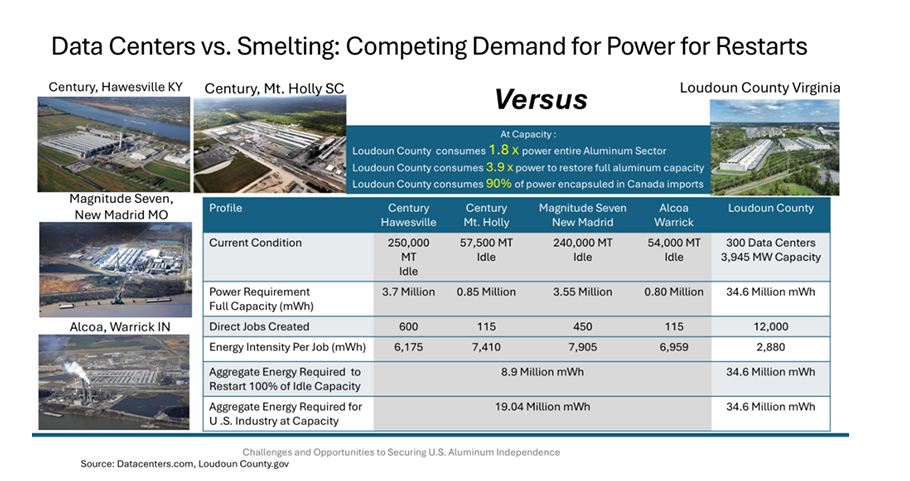
Data centers consume much more energy than aluminum. Would more focus and energy be given to the aluminum or on data centers?

Source: The Aluminum Association

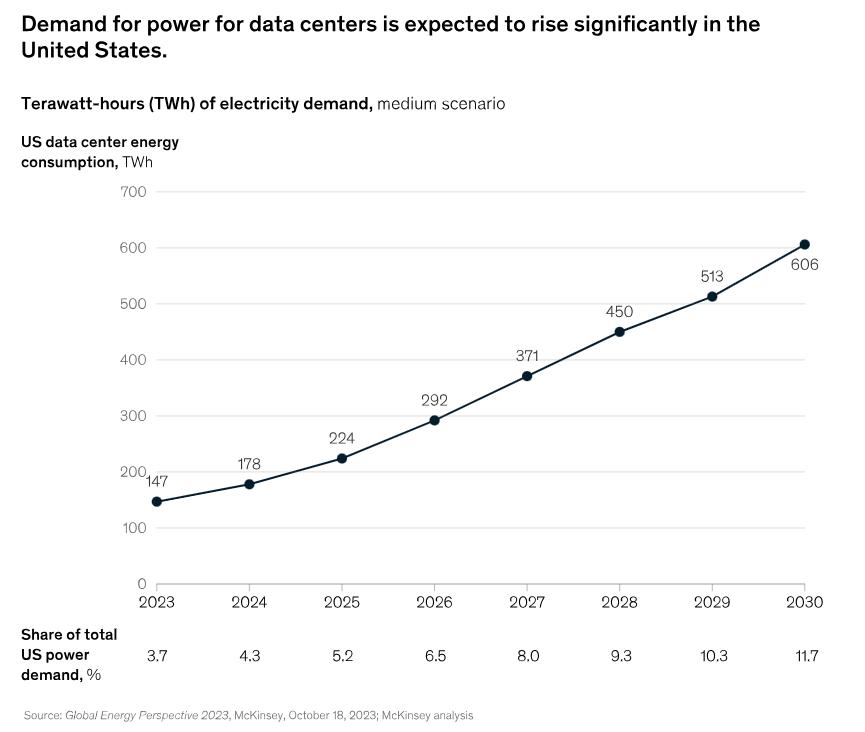
Smelters are being priced out of the grid. McKinsey projects that U.S. data center electricity demand will triple over the next five years, jumping from roughly 3% of total consumption today to nearly 12% by 2030. To replace the roughly 4.8 million metric tons of aluminum the U.S. imports in 2023 with domestic smelting capacity, the country would need to generate 71 terawatt hours of dedicated, continuous power annually. To put that scale into perspective, that is the equivalent output of more than 15 Hoover Dams, or the entire annual power consumption of the state of Minnesota.

Source: McKinsey

In a constrained grid, governments and utility companies will always prioritize the high margin, national security imperatives of AI over industrial smelting. But this creates a glaring paradox: if Big Tech buys up all the power, where will they source the physical metal to build their own infrastructure?

The auction heavily favors tech today, but it leaves us with a critical open question. Will this bidding war eventually break the physical supply chain, or will policymakers be forced to step in and subsidize the exact metal required to keep the AI revolution running?

The Investor Takeaway: Buy the Energy Privilege

The era of cheap metal is over. As these structural deficits take hold, the market is bracing for a period of extreme volatility and sustained upward pressure on prices.

The winners in this cycle will not just be the companies with the best bauxite mines; they will be the producers who possess moats that insulate them from the global energy bidding war. In this environment, the metal itself is secondary. The real asset is the energy contract.


Tara Mulia

For more blogs like these, subscribe to our newsletter here!


Admin heyokha


Share


As we established in last week’s blog, the structural deficit in aluminum is widening, and the era of infinite, elastic supply is dead. We broke down China’s 45 million tonne production cap and the crumbling Western industrial base.

But to truly understand where this market is heading, we must ignore the metal itself. We need to look at the power plug.

The Physics of “Congealed Electricity”

Most people miss the fundamental physics of this industry. Aluminum is not just a metal; it is effectively “congealed electricity.”

Power accounts for 30% to 40% of the total production cost of a single ingot. With global demand for the metal growing at 3% to 4% annually, the world requires an extra two million tonnes of metal every single year just to maintain the status quo.

To manufacture that extra metal, we need to add 3 to 4 gigawatts of continuous, baseload power to the grid annually. That is roughly the energy output of three to four nuclear reactors, or 15 to 20 massive data center campuses, running 24/7 forever.

The math is brutal. If we do not build the power plants, we cannot build the metal. In the past, we solved this by simply building more power generation. Today, that new power is being diverted to a much wealthier buyer.

The Auction for the Grid

We are witnessing a direct auction for grid capacity that aluminum producers mathematically cannot win.

High electricity costs are not a future risk; they are the root cause of the current devastation across the primary aluminum sector. Look at the recent casualties. Century’s Hawesville facility in Kentucky and Magnitude 7’s New Madrid smelter in Missouri did not shut down because of a lack of demand. They died because they failed to secure long term, competitively priced power deals and were forced into the day ahead spot market.

Historical timeline where Aluminum smelters closed coinciding when energy prices rose in select states

Source: The Aluminum Association and Energy Information Administration

Data from the Energy Information Administration paints a grim picture. In states that have seen their primary aluminum capacity permanently idled or completely gutted, power prices have marched relentlessly upward. Because power is the second largest component of total operating costs, a primary aluminum producer requires fixed costs to survive. A 20 year, competitively priced power contract is a strict prerequisite for securing any project financing. Without it, a smelter is dead on arrival.

But securing those long term contracts is now nearly impossible because a new apex predator has entered the market.

Competition for power between traditional manufacturing and the tech sector is not a fair fight. Data center demand is entirely price inelastic. Recent market transactions prove that tech hyperscalers effectively have no limit on what they are prepared to pay for dependable, 24/7 baseload electricity. Because reliability is everything for their models, they are happily paying premiums of up to $100 per megawatt hour to secure guaranteed supply.

A smelter begins to bleed out if power prices rise above $40 per megawatt hour. Now, compare that to the tech industry. Microsoft recently struck a deal with Constellation Energy to resurrect Unit 1 of the Three Mile Island nuclear plant in Pennsylvania. Analysts estimate Microsoft conceded to a staggering $110 to $115 per megawatt hour over 20 years. That is an 80% to 90% premium over intermittent renewables in the same region, and it completely prices out any industrial competitor. Meta is executing the exact same playbook, locking up nuclear power from the Clinton Clean Energy Center in Illinois for two decades at an estimated $80 to $85 per megawatt hour.

Data centers consume much more energy than aluminum. Would more focus and energy be given to the aluminum or on data centers?

Source: The Aluminum Association

Smelters are being priced out of the grid. McKinsey projects that U.S. data center electricity demand will triple over the next five years, jumping from roughly 3% of total consumption today to nearly 12% by 2030. To replace the roughly 4.8 million metric tons of aluminum the U.S. imports in 2023 with domestic smelting capacity, the country would need to generate 71 terawatt hours of dedicated, continuous power annually. To put that scale into perspective, that is the equivalent output of more than 15 Hoover Dams, or the entire annual power consumption of the state of Minnesota.

Source: McKinsey

In a constrained grid, governments and utility companies will always prioritize the high margin, national security imperatives of AI over industrial smelting. But this creates a glaring paradox: if Big Tech buys up all the power, where will they source the physical metal to build their own infrastructure?

The auction heavily favors tech today, but it leaves us with a critical open question. Will this bidding war eventually break the physical supply chain, or will policymakers be forced to step in and subsidize the exact metal required to keep the AI revolution running?

The Investor Takeaway: Buy the Energy Privilege

The era of cheap metal is over. As these structural deficits take hold, the market is bracing for a period of extreme volatility and sustained upward pressure on prices.

The winners in this cycle will not just be the companies with the best bauxite mines; they will be the producers who possess moats that insulate them from the global energy bidding war. In this environment, the metal itself is secondary. The real asset is the energy contract.


Tara Mulia

For more blogs like these, subscribe to our newsletter here!


Admin heyokha


Share


Look around you. It holds your soda. It wraps your leftovers. It makes up the engine block of your car and the fuselage of the plane you fly out in.

We treat aluminum as disposable. It is the third most abundant element in the Earth’s crust, effectively the “cheap, cost-effective, and highly abundant” of the metal world.

But there was a time when this metal was the ultimate flex.

In the mid-19th century, aluminum was more valuable than gold. Because it bonds so tightly with other elements in nature, refining it into pure metal was nearly impossible. It was so rare that Emperor Napoleon III of France reportedly held dinner parties where the most honored guests were given aluminum cutlery, while the “lesser” nobility had to suffer the indignity of eating with mere gold and silver forks.

The obsession didn’t end in France. When the Washington Monument was completed in 1884, the U.S. government capped it with a 100-ounce pyramid of solid aluminum. It wasn’t just structural; it was a statement of industrial might. At the time, a pound of aluminum cost about $16, roughly $419 in today’s money.

The aluminum tip is placed atop the Washington Monument on Dec. 6, 1884 in a contemporary illustration.

Source: National Park Service, NPR

Then, everything changed. We discovered how to use massive amounts of electricity to refine it. The price crashed, and aluminum became the building block of the modern world.

But today, the pendulum is swinging back.

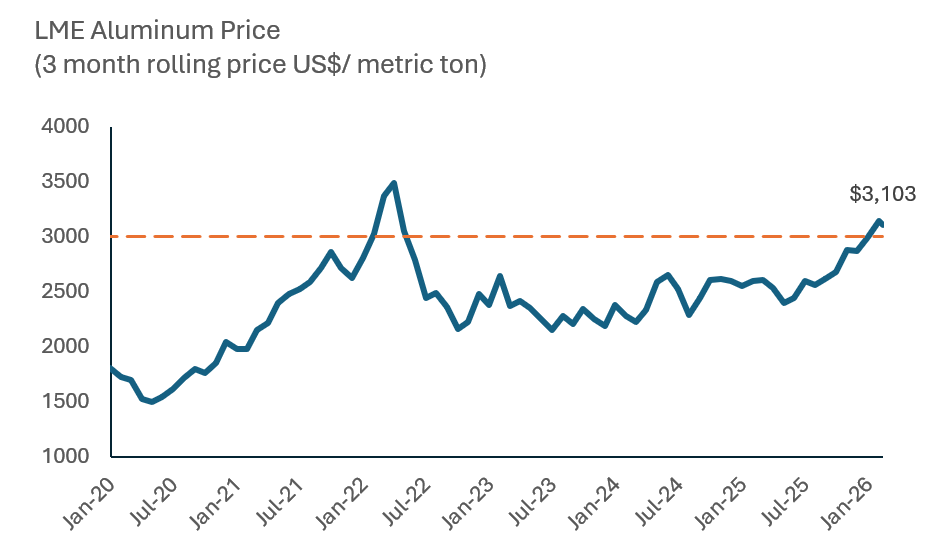
For the first time in a century, the era of cheap, infinite aluminum is over. The price has surged past $3,000 per tonne, not because the metal is rare, but because the global economy physically cannot respond. The supply is being killed by a hard cap in China, a drought in Africa, and a western industrial base that has forgotten how to build.

Aluminum hits above $3,000, which is a price not seen since 2022

Source: Bloomberg

We are not facing a temporary shortage. We are facing structural rigidity.

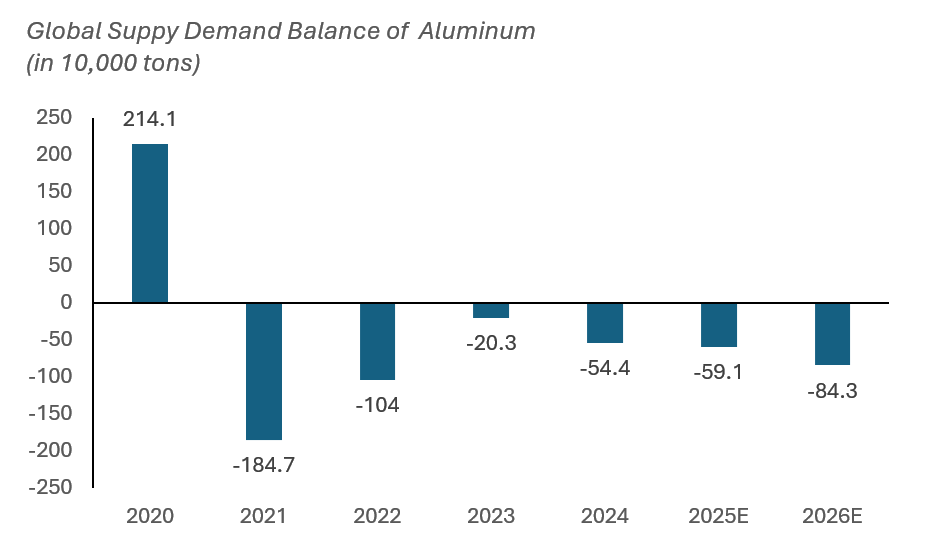
You don’t have to guess; the numbers tell the story. Look at the global supply-demand balance.

Since 2021, the market has been trapped in a persistent deficit. We haven’t seen a surplus in five years.

  • 2024: A deficit of 544,000 tonnes.
  • 2025: Deficit widening to 591,000 tonnes.
  • 2026 (Projected): The deficit blows out to 843,000 tonnes.

Note: The electrolytic aluminum demand figures above include the demand for electrolytic aluminum used in recycled aluminum production.

Source: SMM, CRU, Huatai Research Forecast


Demand is growing steadily where it’s up around 2.3% YoY, but supply is hitting a ceiling where growth is slowing to just 1.9%. When demand outpaces supply for half a decade, inventories vanish, and prices explode.

The Death of Elasticity

Elasticity just means when prices rise, supply usually expands to meet it, but it’s looking tougher with this pro-longed deficit. To understand why we are in a deficit, you have to look at the breakdown of the world’s supply engine: China.

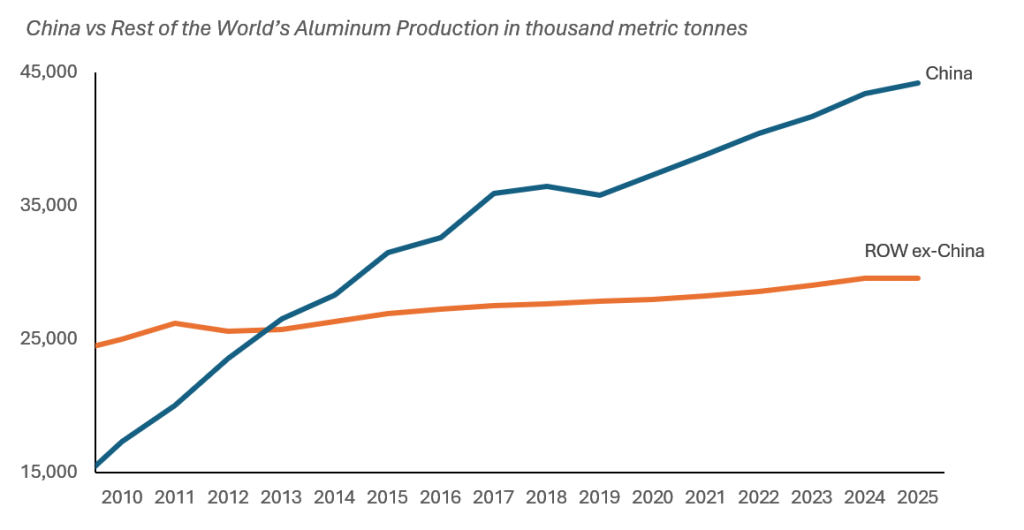
For twenty years, China was the world’s “swing producer.” Whenever the world needed more metal, Beijing built a coal plant and a smelter. That valve has been welded shut.

  • The Hard Cap: The government is strictly enforcing a 45 million tonne capacity cap to curb pollution. They physically cannot legally build more smelters.
  • The Internal Black Hole: Worse, they are no longer exporting their surplus. The new “Two New” stimulus policy (a massive trade-in program for old appliances and industrial gear) is sucking up that metal domestically. China has flipped from the world’s factory to the world’s consumer, and they are keeping their metal for themselves.

How can the rest of the world catch up to China?

Source: International Aluminum Org

The Western Supply Shock

While China locks its doors, the Western supply chain is snapping.

In March 2026, South32’s Mozal smelter, a giant facility responsible for supplying nearly 20% of Europe’s aluminum imports, is shutting down.

Why? Not because it isn’t profitable. But because of a severe drought in the Zambezi basin and a failed negotiation with the local utility. That is 560,000 tonnes of metal vanished from the market overnight, leaving Western buyers scrambling.

This isn’t an isolated incident. It is a symptom of a western industrial base that is crumbling. In the U.S. and Europe, high operating costs have already forced half of all smelting capacity offline since 2021. Those plants aren’t coming back.

The Demand Renaissance: Not Your Grandfather’s Foil

While supply is hitting a brick wall, demand is undergoing a quiet revolution. Aluminum is no longer just about soda cans and window frames. It has become the “lightweight champion” of the energy transition.

  1. The EV Diet Plan Electric vehicles are heavy. Batteries weigh thousands of pounds. To get decent range, automakers have to strip weight out of everything else. That means swapping heavy steel for light aluminum. An EV uses roughly 200kg of aluminum, which is 50% more than a gas car. As EV adoption grows, so does the baseline demand for the metal.
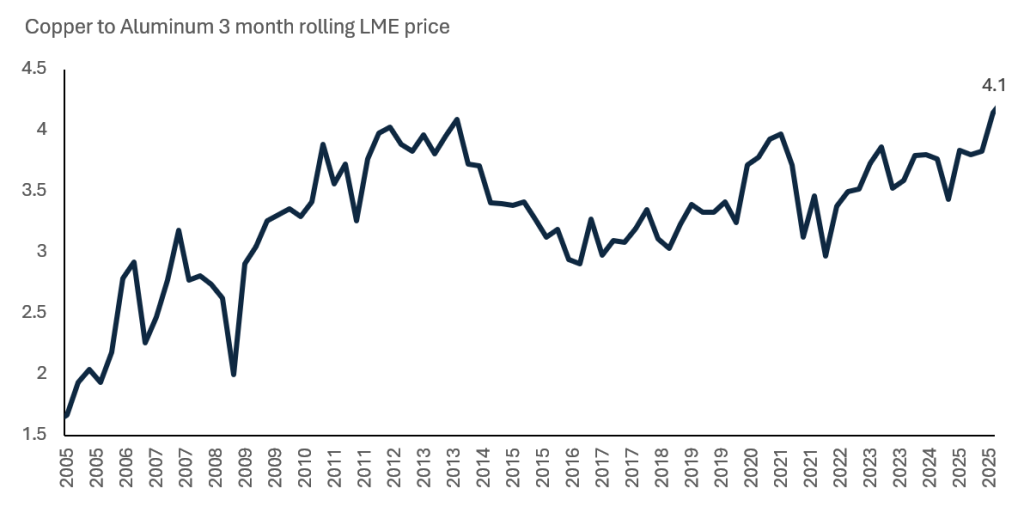
  2. The Poor Man’s Copper Copper prices have skyrocketed, making it too expensive for many industrial uses. With the copper-to-aluminum price ratio hitting a 20-year high (4.1x), manufacturers are switching to aluminum for wiring and cabling wherever physics allows. It is the “substitution trade” of the decade.
  3. The Skeleton of AI Even the digital world needs physical bones. The massive buildout of AI Data Centers isn’t just about chips; it’s about the chassis, the racks, and crucially, the cooling systems. Aluminum is the material of choice for heat sinks and thermal management because it dissipates heat efficiently. Every new data center coming online is effectively a massive structure of aluminum piping and plating.

Aluminum is now 4x cheaper than Copper

Source: Bloomberg

The Investor Takeaway

We leave you not with a forecast, but with a dilemma.

The world is betting its future on the exponential growth of digital intelligence (AI) and the green transition (EVs). Both of these revolutions are physically built out of aluminum. Yet, the energy and geopolitical systems required to produce that metal are flashing red.

This disconnect forces us to ask tough questions about how—or if—this gap can be bridged:

  • Can we recycle our way out? Secondary aluminum (scrap) requires 95% less energy than primary smelting. Is the world ready to build the sophisticated supply chains needed to turn old cars into new data center racks, or will the quality mismatch be too high?
  • Is the “China Cap” a ceiling or a lever? Is the 45 million tonne limit a hard environmental line in the sand, or is it a geopolitical tool that Beijing will release once the price hurts Western manufacturers enough?
  • The Substitution Trap: At what price does the AI industry stop using aluminum? Is there even a viable alternative for thermal management that is scalable, or is this metal the non-negotiable “bones” of the digital age?

Think about it this way: If aluminum hits $5,000/ton, do auto companies delay their EV models launch? Do tech companies slow its data center buildout? Or do they just eat the cost and pass it to consumers?”

Something has to give. Will it be the environmental goals, the profit margins, or the pace of the buildout itself? For the observant investor, the answer to that question will define the next commodity supercycle.


Tara Mulia

For more blogs like these, subscribe to our newsletter here!


Admin heyokha


Share


Look around you. It holds your soda. It wraps your leftovers. It makes up the engine block of your car and the fuselage of the plane you fly out in.

We treat aluminum as disposable. It is the third most abundant element in the Earth’s crust, effectively the “cheap, cost-effective, and highly abundant” of the metal world.

But there was a time when this metal was the ultimate flex.

In the mid-19th century, aluminum was more valuable than gold. Because it bonds so tightly with other elements in nature, refining it into pure metal was nearly impossible. It was so rare that Emperor Napoleon III of France reportedly held dinner parties where the most honored guests were given aluminum cutlery, while the “lesser” nobility had to suffer the indignity of eating with mere gold and silver forks.

The obsession didn’t end in France. When the Washington Monument was completed in 1884, the U.S. government capped it with a 100-ounce pyramid of solid aluminum. It wasn’t just structural; it was a statement of industrial might. At the time, a pound of aluminum cost about $16, roughly $419 in today’s money.

The aluminum tip is placed atop the Washington Monument on Dec. 6, 1884 in a contemporary illustration.

Source: National Park Service, NPR

Then, everything changed. We discovered how to use massive amounts of electricity to refine it. The price crashed, and aluminum became the building block of the modern world.

But today, the pendulum is swinging back.

For the first time in a century, the era of cheap, infinite aluminum is over. The price has surged past $3,000 per tonne, not because the metal is rare, but because the global economy physically cannot respond. The supply is being killed by a hard cap in China, a drought in Africa, and a western industrial base that has forgotten how to build.

Aluminum hits above $3,000, which is a price not seen since 2022

Source: Bloomberg

We are not facing a temporary shortage. We are facing structural rigidity.

You don’t have to guess; the numbers tell the story. Look at the global supply-demand balance.

Since 2021, the market has been trapped in a persistent deficit. We haven’t seen a surplus in five years.

  • 2024: A deficit of 544,000 tonnes.
  • 2025: Deficit widening to 591,000 tonnes.
  • 2026 (Projected): The deficit blows out to 843,000 tonnes.

Note: The electrolytic aluminum demand figures above include the demand for electrolytic aluminum used in recycled aluminum production.

Source: SMM, CRU, Huatai Research Forecast


Demand is growing steadily where it’s up around 2.3% YoY, but supply is hitting a ceiling where growth is slowing to just 1.9%. When demand outpaces supply for half a decade, inventories vanish, and prices explode.

The Death of Elasticity

Elasticity just means when prices rise, supply usually expands to meet it, but it’s looking tougher with this pro-longed deficit. To understand why we are in a deficit, you have to look at the breakdown of the world’s supply engine: China.

For twenty years, China was the world’s “swing producer.” Whenever the world needed more metal, Beijing built a coal plant and a smelter. That valve has been welded shut.

  • The Hard Cap: The government is strictly enforcing a 45 million tonne capacity cap to curb pollution. They physically cannot legally build more smelters.
  • The Internal Black Hole: Worse, they are no longer exporting their surplus. The new “Two New” stimulus policy (a massive trade-in program for old appliances and industrial gear) is sucking up that metal domestically. China has flipped from the world’s factory to the world’s consumer, and they are keeping their metal for themselves.

How can the rest of the world catch up to China?

Source: International Aluminum Org

The Western Supply Shock

While China locks its doors, the Western supply chain is snapping.

In March 2026, South32’s Mozal smelter, a giant facility responsible for supplying nearly 20% of Europe’s aluminum imports, is shutting down.

Why? Not because it isn’t profitable. But because of a severe drought in the Zambezi basin and a failed negotiation with the local utility. That is 560,000 tonnes of metal vanished from the market overnight, leaving Western buyers scrambling.

This isn’t an isolated incident. It is a symptom of a western industrial base that is crumbling. In the U.S. and Europe, high operating costs have already forced half of all smelting capacity offline since 2021. Those plants aren’t coming back.

The Demand Renaissance: Not Your Grandfather’s Foil

While supply is hitting a brick wall, demand is undergoing a quiet revolution. Aluminum is no longer just about soda cans and window frames. It has become the “lightweight champion” of the energy transition.

  1. The EV Diet Plan Electric vehicles are heavy. Batteries weigh thousands of pounds. To get decent range, automakers have to strip weight out of everything else. That means swapping heavy steel for light aluminum. An EV uses roughly 200kg of aluminum, which is 50% more than a gas car. As EV adoption grows, so does the baseline demand for the metal.
  2. The Poor Man’s Copper Copper prices have skyrocketed, making it too expensive for many industrial uses. With the copper-to-aluminum price ratio hitting a 20-year high (4.1x), manufacturers are switching to aluminum for wiring and cabling wherever physics allows. It is the “substitution trade” of the decade.
  3. The Skeleton of AI Even the digital world needs physical bones. The massive buildout of AI Data Centers isn’t just about chips; it’s about the chassis, the racks, and crucially, the cooling systems. Aluminum is the material of choice for heat sinks and thermal management because it dissipates heat efficiently. Every new data center coming online is effectively a massive structure of aluminum piping and plating.

Aluminum is now 4x cheaper than Copper

Source: Bloomberg

The Investor Takeaway

We leave you not with a forecast, but with a dilemma.

The world is betting its future on the exponential growth of digital intelligence (AI) and the green transition (EVs). Both of these revolutions are physically built out of aluminum. Yet, the energy and geopolitical systems required to produce that metal are flashing red.

This disconnect forces us to ask tough questions about how—or if—this gap can be bridged:

  • Can we recycle our way out? Secondary aluminum (scrap) requires 95% less energy than primary smelting. Is the world ready to build the sophisticated supply chains needed to turn old cars into new data center racks, or will the quality mismatch be too high?
  • Is the “China Cap” a ceiling or a lever? Is the 45 million tonne limit a hard environmental line in the sand, or is it a geopolitical tool that Beijing will release once the price hurts Western manufacturers enough?
  • The Substitution Trap: At what price does the AI industry stop using aluminum? Is there even a viable alternative for thermal management that is scalable, or is this metal the non-negotiable “bones” of the digital age?

Think about it this way: If aluminum hits $5,000/ton, do auto companies delay their EV models launch? Do tech companies slow its data center buildout? Or do they just eat the cost and pass it to consumers?”

Something has to give. Will it be the environmental goals, the profit margins, or the pace of the buildout itself? For the observant investor, the answer to that question will define the next commodity supercycle.


Tara Mulia

For more blogs like these, subscribe to our newsletter here!


Admin heyokha


Share


We are currently witnessing the largest capital expenditure in the history of technology. Hundreds of billions flowing into a machine designed to create infinite digital abundance. It looks like a paradox: Why fight a resource-heavy war over a technology that promises infinite digital abundance?

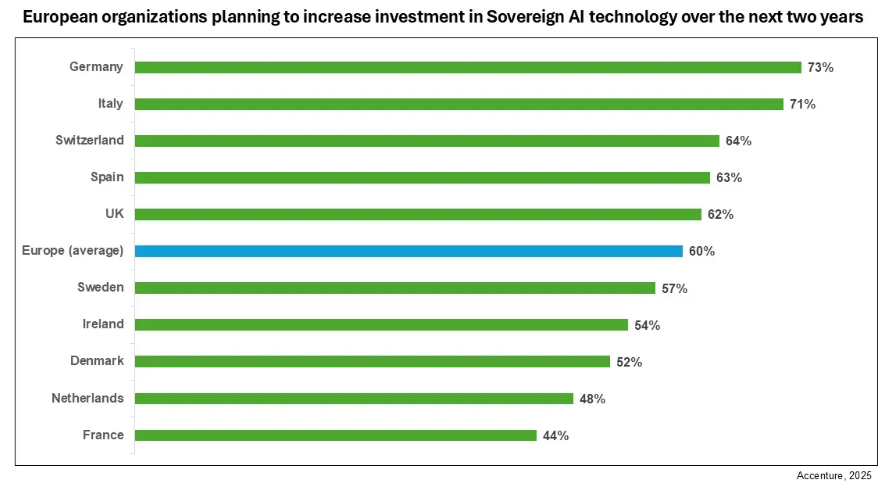
The answer lies in a lesson history has taught us repeatedly: Abundance does not mean equity. The neighbors fighting over the orange tree aren’t fighting for the fruit; they’re fighting to decide who owns the fence around the orchard.

Source: Accenture

The Logic of Control

The reason nations are hoarding chips and energy isn’t because they don’t believe in the abundance AI will bring. It’s because they don’t trust how it will be distributed.

History is littered with technologies that created massive surplus value, only to have that value concentrated in the hands of whoever owned the pipes.

  • The Printing Press made information cheap; publishing houses became gatekeepers.
  • Railroads made transportation cheap; railroad barons became oligarchs.
  • The Internet made distribution free; platform monopolies became trillion-dollar rentiers.


The lesson is clear: New technologies don’t make old power structures obsolete. They get captured by them.

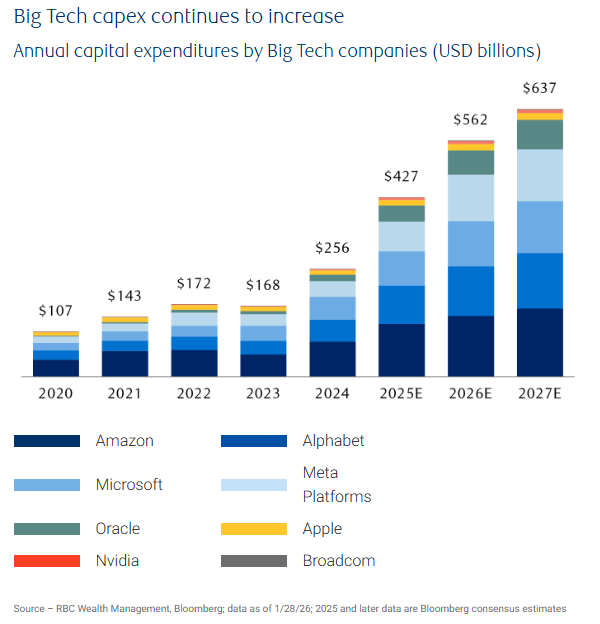
The question isn’t whether AI will make intelligence cheap. It is whether that cheap intelligence will be a public utility or a rentier’s monopoly. Right now, tech giants have been spending $427 billion on infrastructure in 2025 alone, and nations and corporations are betting trillions on it as well. They are securing their position not for a world of scarcity, but for a world where controlling the infrastructure of abundance is the new form of power.

For perspective, $427 billion is the size close to Norway’s entire GDP

Source: RBC Wealth Management

The Current Battlefield: Strategic Stockpiles

This shift has created a “Wartime Economy” for physical assets where nations have stopped viewing compute as a commercial service and started viewing it as a strategic reserve.

If you look at the global map, the chess pieces are moving to secure the two things AI consumes. Energy acts as the calories, and Rare Earths serve as the vitamins. The diplomatic maneuvering behind these acquisitions is geopolitical calculus rather than casual cooperation.

Read more on our Think Pieces and Reports page

  1. Three Mile Island: When AI Resurrects the Dead

In September 2024, Microsoft struck a deal that crystallizes just how desperate the energy situation has become: a 20-year power purchase agreement to restart Three Mile Island—yes, that Three Mile Island, site of America’s most notorious nuclear accident in 1979.

The reactor being restarted (renamed “Crane Clean Energy Center”) wasn’t part of the 1979 meltdown, but it had been shut down in 2019 for economic reasons. Now, with AI driving unprecedented electricity demand, what was economically unviable five years ago has become strategic necessity.

Here’s where government got involved: Pennsylvania Governor Josh Shapiro personally pushed for the project to be fast-tracked through PJM Interconnection’s grid approval process. Normally, power projects languish in PJM’s queue for years. Crane was the largest project ever expedited by PJM, cutting the timeline from an expected 2028 restart to 2027.

Then in 2025, the Trump administration’s Energy Department announced a $1 billion federal loan to support the restart. This is explicit government backing to resurrect a dormant nuclear plant exclusively to power Microsoft’s AI data centers.

This isn’t economic development. This is the government treating AI infrastructure like wartime production, fast-tracking approvals and deploying federal capital to ensure the power doesn’t run out. When you’re restarting nuclear reactors mothballed for safety concerns, you’re not optimizing—you’re scrambling.


  1. Greenland: The Fight for Vitamins

Greenland represents the other half of the equation. As we analyzed in “The Grandmaster’s Gambit,” the island is a fortress of strategic necessity because of its critical minerals.

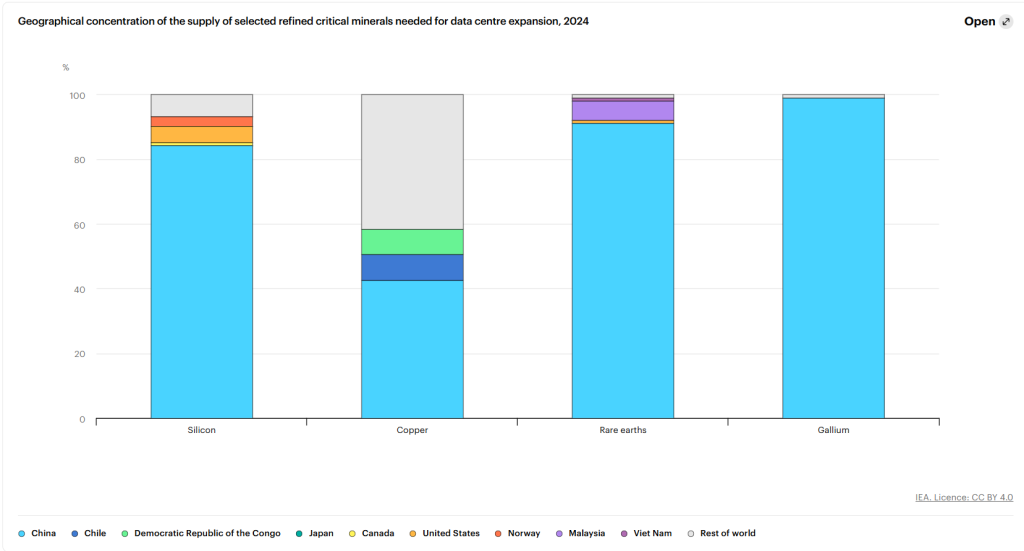
AI data centers require advanced cooling systems and high-performance magnets, which rely on rare earth elements like neodymium and dysprosium. China currently dominates roughly 90% of the processing for these minerals and 94% of rare earth magnet manufacturing. This leverage is a structural vulnerability that Western policymakers are desperate to close.

If China cuts off rare earth exports tomorrow (as they did during the 2010 rare earth crisis with Japan), Western AI infrastructure stops scaling. Not gradually. Immediately.

To counter this, the Trump administration announced Project Vault, a $12 billion strategic minerals stockpile designed to fortify supply chains. The goal is to treat Greenland and similar upstream sources as insurance against geopolitical supply disruptions. A supply chain that does not control its rare earth inputs cannot guarantee uninterrupted AI manufacturing.


  1. Pax Silica: The Allied Supply Bloc

Beyond unilateral stockpiling, we are seeing the formation of a “NATO for Supply Chains.”

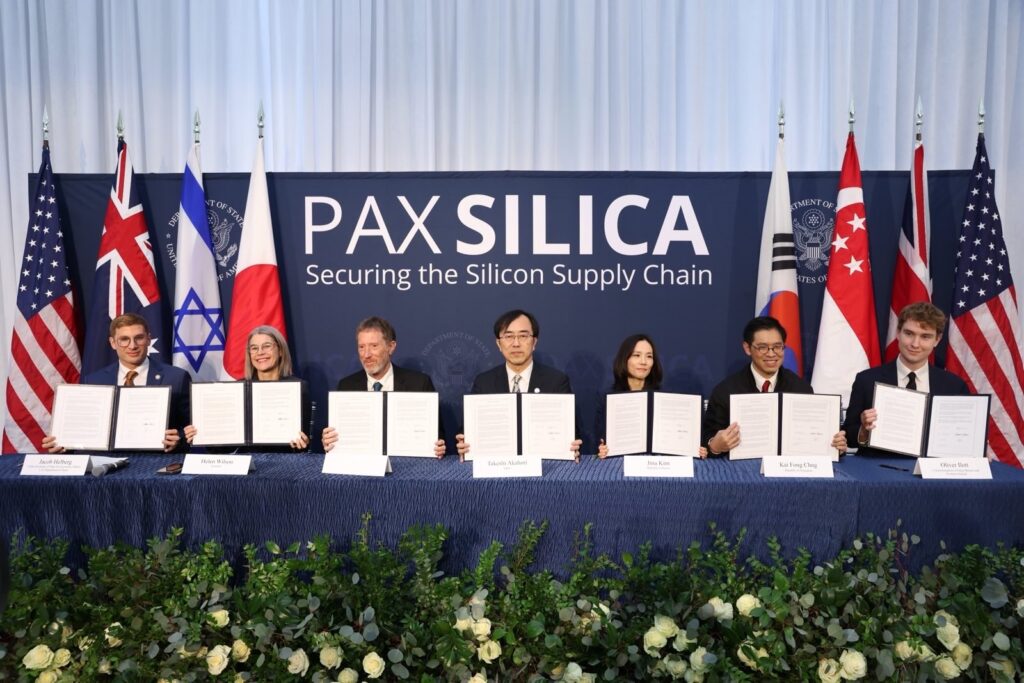
In late 2025, the U.S. and allied nations convened the Pax Silica Initiative. This coalition includes Japan, South Korea, the Netherlands, and the UK. Their goal is to build a resilient global silicon supply chain that spans from upstream minerals to data centers.

This initiative is explicitly positioned to protect against coercive dependencies—to ensure China can’t use rare earth leverage the way Russia used gas pipelines. It creates a collective stockpile and innovation infrastructure regime constrained by allied trust networks rather than free market arms races.

But there’s a vulnerability: the “America First” imperative. What happens when U.S. priorities clash with Japanese or Korean interests? Can partners be assured their access won’t be cut off when Washington changes course? This is the tension nobody wants to discuss publicly, but it’s the fault line that could fracture the coalition.

Some diplomacy had to be involved but can partners be assured the “America First” agenda imperative won’t overshadow efforts?

Source: U.S. Department of State

China Isn’t Sitting Idle

While the West scrambles to diversify supply chains, China is doubling down on its advantages.

  1. Export Controls as Strategic Leverage

China has moved beyond simple export policy tweaks to use export controls as a tool of industrial diplomacy:

  • April 2025: China placed seven medium and heavy rare earth elements including samarium, gadolinium, terbium, dysprosium, lutetium, scandium, and yttrium under an export-control licensing regime. This requires government permits for exports and gives Beijing bureaucratic discretion over flows.
  • October 9, 2025: Beijing announced a much broader set of export controls covering additional rare earths, associated technologies, and related materials, including five more medium/heavy rare earths (erbium, europium, holmium, thulium, and ytterbium) and even materials/tech that have downstream industrial applications.
  • November 7, 2025: China paused implementation of many provisions of the October export-control package through Nov 10, 2026 under an agreement with the United States, effectively creating a temporary suspension, not a full rollback. The underlying licensing requirements and levers of control remain in place, and China continues to control the vast majority of processed rare earth exports.

What this means:
Rather than an outright ban, China now works with a licensing and procedural regime that gives it a scalable strategic lever. Even during the “pause,” China retains control over rare earth export licenses and can tighten or relax terms as geopolitical conditions evolve.

Source: IEA

  1. Supply Chain Leverage and Global Flows

China’s dominance in rare earths remains remarkable:

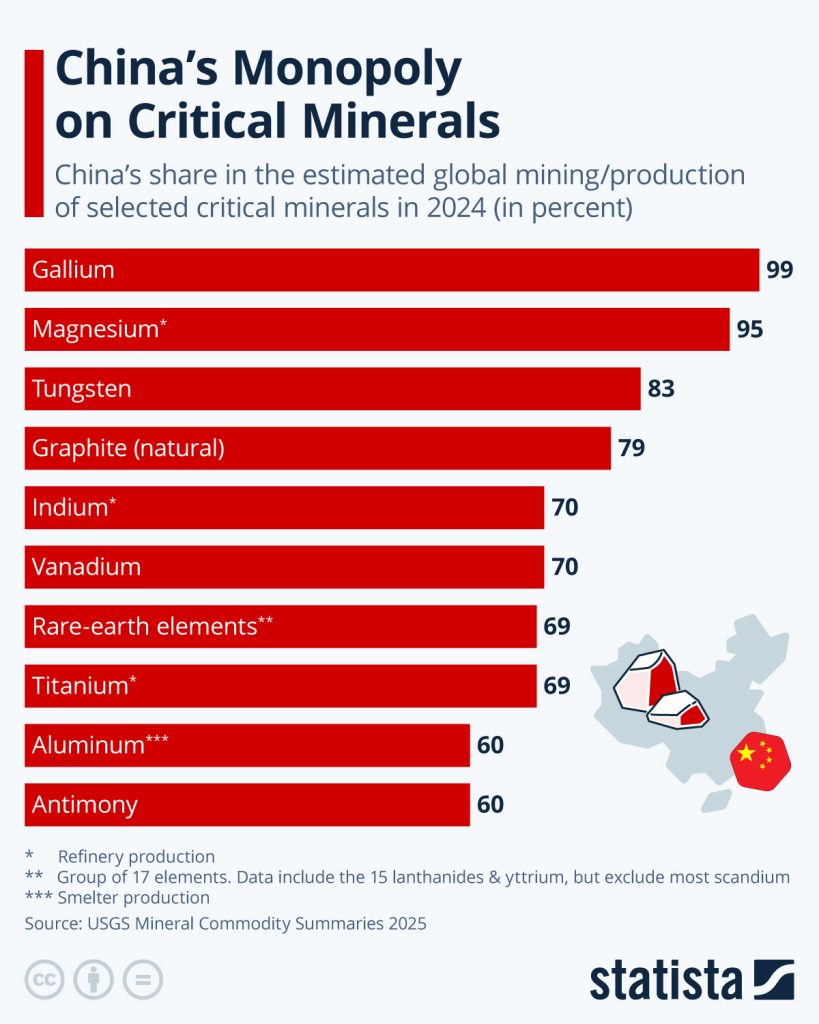
  • China accounts for over 90% of processed rare earth supply globally, a concentration that gives Beijing outsized influence over global magnet, EV, and high-tech supply chains — even if controls are not always actively tightened.
  • Western governments and firms remain acutely aware of this leverage: critics warn China could return to more aggressive export behavior once temporary suspensions lapse.

Source: Statista

  1. Domestic Stockpiling + Recycling as Resource Security

While precise numeric targets like “75% of global battery materials recycled by 2030” are difficult to verify in authoritative public policy documents, the direction of travel is clear: China is scaling recycling into a strategic extension of its critical minerals dominance.

  • China is rapidly expanding its battery recycling industry, with forecasts showing strong growth through 2030 and expectations that it will remain the global leader in recycling market share.
  • Installed recycling capacity was already in the multiple-million-tonnes per year range by 2024, positioning China as the world’s hub for end-of-life battery processing.
  • Chinese firms and state-linked enterprises are building global recycling footprints, partnering internationally on recycling centers and after-sales recovery networks.
  • Most importantly, Beijing has begun formalizing this into national industrial architecture: the China Resources Recycling Group Co., Ltd. (CRRG) was established in 2024 as a central, state-backed recycling platform spanning batteries, metals, and e-waste.

A state-owned recycling champion is a tell: China isn’t treating recycling as ESG. It’s treating it as resource security. If Beijing can control not just mining and refining, but also the “second mine” of end-of-life recovery, it can keep domestic industry fed while retaining long-term leverage over global supply chains.

The Real Bet

The question isn’t whether AI creates abundance. It’s who controls access once abundance arrives.

And they’re probably right.

You can have the smartest AI in the world. But if you don’t have the kilowatts to run it, the chips to scale it, the rare earths to cool it, or the legal sovereignty to control it, you’re a client state.

They’re not fighting over intelligence. They’re fighting over who gets to set the terms once intelligence is abundant.

And when intelligence is abundant, infrastructure is and will be the bottleneck.


Tara Mulia

For more blogs like these, subscribe to our newsletter here!


Admin heyokha


Share


We are currently witnessing the largest capital expenditure in the history of technology. Hundreds of billions flowing into a machine designed to create infinite digital abundance. It looks like a paradox: Why fight a resource-heavy war over a technology that promises infinite digital abundance?

The answer lies in a lesson history has taught us repeatedly: Abundance does not mean equity. The neighbors fighting over the orange tree aren’t fighting for the fruit; they’re fighting to decide who owns the fence around the orchard.

Source: Accenture

The Logic of Control

The reason nations are hoarding chips and energy isn’t because they don’t believe in the abundance AI will bring. It’s because they don’t trust how it will be distributed.

History is littered with technologies that created massive surplus value, only to have that value concentrated in the hands of whoever owned the pipes.

  • The Printing Press made information cheap; publishing houses became gatekeepers.
  • Railroads made transportation cheap; railroad barons became oligarchs.
  • The Internet made distribution free; platform monopolies became trillion-dollar rentiers.


The lesson is clear: New technologies don’t make old power structures obsolete. They get captured by them.

The question isn’t whether AI will make intelligence cheap. It is whether that cheap intelligence will be a public utility or a rentier’s monopoly. Right now, tech giants have been spending $427 billion on infrastructure in 2025 alone, and nations and corporations are betting trillions on it as well. They are securing their position not for a world of scarcity, but for a world where controlling the infrastructure of abundance is the new form of power.

For perspective, $427 billion is the size close to Norway’s entire GDP

Source: RBC Wealth Management

The Current Battlefield: Strategic Stockpiles

This shift has created a “Wartime Economy” for physical assets where nations have stopped viewing compute as a commercial service and started viewing it as a strategic reserve.

If you look at the global map, the chess pieces are moving to secure the two things AI consumes. Energy acts as the calories, and Rare Earths serve as the vitamins. The diplomatic maneuvering behind these acquisitions is geopolitical calculus rather than casual cooperation.

Read more on our Think Pieces and Reports page

  1. Three Mile Island: When AI Resurrects the Dead

In September 2024, Microsoft struck a deal that crystallizes just how desperate the energy situation has become: a 20-year power purchase agreement to restart Three Mile Island—yes, that Three Mile Island, site of America’s most notorious nuclear accident in 1979.

The reactor being restarted (renamed “Crane Clean Energy Center”) wasn’t part of the 1979 meltdown, but it had been shut down in 2019 for economic reasons. Now, with AI driving unprecedented electricity demand, what was economically unviable five years ago has become strategic necessity.

Here’s where government got involved: Pennsylvania Governor Josh Shapiro personally pushed for the project to be fast-tracked through PJM Interconnection’s grid approval process. Normally, power projects languish in PJM’s queue for years. Crane was the largest project ever expedited by PJM, cutting the timeline from an expected 2028 restart to 2027.

Then in 2025, the Trump administration’s Energy Department announced a $1 billion federal loan to support the restart. This is explicit government backing to resurrect a dormant nuclear plant exclusively to power Microsoft’s AI data centers.

This isn’t economic development. This is the government treating AI infrastructure like wartime production, fast-tracking approvals and deploying federal capital to ensure the power doesn’t run out. When you’re restarting nuclear reactors mothballed for safety concerns, you’re not optimizing—you’re scrambling.


  1. Greenland: The Fight for Vitamins

Greenland represents the other half of the equation. As we analyzed in “The Grandmaster’s Gambit,” the island is a fortress of strategic necessity because of its critical minerals.

AI data centers require advanced cooling systems and high-performance magnets, which rely on rare earth elements like neodymium and dysprosium. China currently dominates roughly 90% of the processing for these minerals and 94% of rare earth magnet manufacturing. This leverage is a structural vulnerability that Western policymakers are desperate to close.

If China cuts off rare earth exports tomorrow (as they did during the 2010 rare earth crisis with Japan), Western AI infrastructure stops scaling. Not gradually. Immediately.

To counter this, the Trump administration announced Project Vault, a $12 billion strategic minerals stockpile designed to fortify supply chains. The goal is to treat Greenland and similar upstream sources as insurance against geopolitical supply disruptions. A supply chain that does not control its rare earth inputs cannot guarantee uninterrupted AI manufacturing.


  1. Pax Silica: The Allied Supply Bloc

Beyond unilateral stockpiling, we are seeing the formation of a “NATO for Supply Chains.”

In late 2025, the U.S. and allied nations convened the Pax Silica Initiative. This coalition includes Japan, South Korea, the Netherlands, and the UK. Their goal is to build a resilient global silicon supply chain that spans from upstream minerals to data centers.

This initiative is explicitly positioned to protect against coercive dependencies—to ensure China can’t use rare earth leverage the way Russia used gas pipelines. It creates a collective stockpile and innovation infrastructure regime constrained by allied trust networks rather than free market arms races.

But there’s a vulnerability: the “America First” imperative. What happens when U.S. priorities clash with Japanese or Korean interests? Can partners be assured their access won’t be cut off when Washington changes course? This is the tension nobody wants to discuss publicly, but it’s the fault line that could fracture the coalition.

Some diplomacy had to be involved but can partners be assured the “America First” agenda imperative won’t overshadow efforts?

Source: U.S. Department of State

China Isn’t Sitting Idle

While the West scrambles to diversify supply chains, China is doubling down on its advantages.

  1. Export Controls as Strategic Leverage

China has moved beyond simple export policy tweaks to use export controls as a tool of industrial diplomacy:

  • April 2025: China placed seven medium and heavy rare earth elements including samarium, gadolinium, terbium, dysprosium, lutetium, scandium, and yttrium under an export-control licensing regime. This requires government permits for exports and gives Beijing bureaucratic discretion over flows.
  • October 9, 2025: Beijing announced a much broader set of export controls covering additional rare earths, associated technologies, and related materials, including five more medium/heavy rare earths (erbium, europium, holmium, thulium, and ytterbium) and even materials/tech that have downstream industrial applications.
  • November 7, 2025: China paused implementation of many provisions of the October export-control package through Nov 10, 2026 under an agreement with the United States, effectively creating a temporary suspension, not a full rollback. The underlying licensing requirements and levers of control remain in place, and China continues to control the vast majority of processed rare earth exports.

What this means:
Rather than an outright ban, China now works with a licensing and procedural regime that gives it a scalable strategic lever. Even during the “pause,” China retains control over rare earth export licenses and can tighten or relax terms as geopolitical conditions evolve.

Source: IEA

  1. Supply Chain Leverage and Global Flows

China’s dominance in rare earths remains remarkable:

  • China accounts for over 90% of processed rare earth supply globally, a concentration that gives Beijing outsized influence over global magnet, EV, and high-tech supply chains — even if controls are not always actively tightened.
  • Western governments and firms remain acutely aware of this leverage: critics warn China could return to more aggressive export behavior once temporary suspensions lapse.

Source: Statista

  1. Domestic Stockpiling + Recycling as Resource Security

While precise numeric targets like “75% of global battery materials recycled by 2030” are difficult to verify in authoritative public policy documents, the direction of travel is clear: China is scaling recycling into a strategic extension of its critical minerals dominance.

  • China is rapidly expanding its battery recycling industry, with forecasts showing strong growth through 2030 and expectations that it will remain the global leader in recycling market share.
  • Installed recycling capacity was already in the multiple-million-tonnes per year range by 2024, positioning China as the world’s hub for end-of-life battery processing.
  • Chinese firms and state-linked enterprises are building global recycling footprints, partnering internationally on recycling centers and after-sales recovery networks.
  • Most importantly, Beijing has begun formalizing this into national industrial architecture: the China Resources Recycling Group Co., Ltd. (CRRG) was established in 2024 as a central, state-backed recycling platform spanning batteries, metals, and e-waste.

A state-owned recycling champion is a tell: China isn’t treating recycling as ESG. It’s treating it as resource security. If Beijing can control not just mining and refining, but also the “second mine” of end-of-life recovery, it can keep domestic industry fed while retaining long-term leverage over global supply chains.

The Real Bet

The question isn’t whether AI creates abundance. It’s who controls access once abundance arrives.

And they’re probably right.

You can have the smartest AI in the world. But if you don’t have the kilowatts to run it, the chips to scale it, the rare earths to cool it, or the legal sovereignty to control it, you’re a client state.

They’re not fighting over intelligence. They’re fighting over who gets to set the terms once intelligence is abundant.

And when intelligence is abundant, infrastructure is and will be the bottleneck.


Tara Mulia

For more blogs like these, subscribe to our newsletter here!


Admin heyokha


Share


Stay Connected with Heyokha

Sign up to receive insights, updates, and perspectives directly from Heyokha

Stay Connected with Heyokha

Sign up to receive insights, updates, and perspectives directly from Heyokha

Heyokha Footer Logo

We drive our mission with an exceptional culture through applying a growth mindset where holistic and on the ground research is at our core.

Help
×

Terms & Conditions

You must read the following information before proceeding. By accessing this website and any pages thereof, you acknowledge that you have read the following information and accept the terms and conditions set out below and agree to be bound by such terms and conditions. If you do not agree to such terms and conditions, please do not access this website or any pages thereof.

The website has been prepared by Heyokha Brothers Limited and is solely intended for informational purposes and should not be construed as an inducement to purchase or sell any security, product, service, or investment. The Site does not solicit an offer to buy or sell any financial instrument or enter into any agreement. It is important to note that the opinions expressed on the Site are not considered investment advice, and it is recommended that individuals seek independent advice as needed to address their specific objectives, financial situation, or needs. It is the responsibility of the persons who access this website to observe all applicable laws and regulations.

The Site offers general information exclusively and does not consider the individual circumstances of any person. The data, opinions, and estimates presented on the Site are current as of the publication date and are subject to changes without notice. Additionally, it is possible that such information may become obsolete with time.

Intended Users

The content presented on this website is exclusively intended for authorized intermediaries and qualified investors within Hong Kong, such as institutional investors, professional investors, and accredited investors (as defined under the SFO). It is not intended for retail investors or individuals located outside of Hong Kong.

The products and services mentioned on this website may or may not be authorized or registered for distribution in a particular jurisdiction and may not be suitable for all investor types. It is important to note that this website is not intended to constitute an offer or solicitation, nor is it directed toward individuals if the provider of the information is prohibited by any law of any jurisdiction from making the information available. Moreover, the website is not intended for any use that would violate local laws or regulations. The provider of the information is not permitted to promote any products or services mentioned on this website in jurisdictions where such promotion would be prohibited.

If you are not a qualified investor or licensed intermediary in Hong Kong, you should not proceed any further.

No Investment Advice

The information provided on this Website is for informational purposes only and should not be considered as investment advice or a recommendation to buy, sell, hold, or transact in any investment. It is strongly recommended that individuals seek professional investment advice before making any investment decisions.

The information presented on this Website does not consider the investment objectives, specific needs, or financial situations of any investor. It is important to note that nothing on this Website is intended to constitute financial, legal, accounting, or tax advice.

Before making any investment decision, individuals should carefully consider whether an investment aligns with their investment objectives, specific needs, and financial situation. This should also include informing oneself of any potential tax implications, legal requirements, foreign exchange restrictions, or exchange control requirements that may be relevant to an investment based on the laws of one’s citizenship, residence, or domicile. If there is any doubt regarding the information on this Website, it is recommended that individuals seek independent professional financial advice.

It is important to note that any opinion, comment, article, financial analysis, market forecast, market commentary, or other information published on the Website is not binding on Heyokha or its affiliates, and they are not responsible for the information, opinions, or ideas presented.

Obligations and Resposibilities of Users

Users are solely responsible for protecting and backing up their data and equipment, as well as taking reasonable precautions against any computer virus or other destructive elements. Additionally, users must ensure that their access to the Site is adequately secured against unauthorized access.

Users are prohibited from using the Site for any unlawful, defamatory, offensive, abusive, indecent, menacing, or threatening purposes, or in any way that infringes upon intellectual property rights or confidentiality obligations. Furthermore, users may not use the Site to cause annoyance, inconvenience, or anxiety to others, or in any way that violates any applicable laws or regulations.

Users must comply with any terms notified to them by third-party suppliers of data or services to the Site. This may include entering into a direct agreement with such third parties in respect of their use of the dat

Third-Party Content

This website may contain Third Party Content or links to websites maintained by third parties that are not affiliated with Heyokha. Heyokha does not participate in the preparation, adoption, or editing of such third-party materials and does not endorse or approve such content, either explicitly or implicitly. Any opinions or recommendations expressed on third party materials are solely those of the independent providers and not of Heyokha. Heyokha is not responsible for any errors or omissions relating to specific information provided by any third party.

Although Heyokha aims to provide accurate and timely information to users, neither Heyokha nor the Third-Party Content providers guarantee on the accuracy, timeliness, completeness, usefulness, or any other aspect of the information presented. Heyokha is not responsible or liable for any content, including advertising, products, or other materials on or available from third party sites. Users access and use Third Party content is at their own risk, and it is provided for informational purposes only. Both Heyokha and the Third-Party shall not be liable for any loss or damage arising from users’ reliance upon such information.

Intellectual Property Rights

The content of this website is subject to copyright and other intellectual property laws. All trademarks, service marks, logos, and brand features displayed on the website are owned by their respective owners, except as explicitly noted. Users may use the information on this website and reproduce it for personal reference only. However, reproduction, distribution, transmission, incorporation in any other database, document, or material, and sale or distribution of any part of the contents of the website is strictly prohibited. Users may download or print individual sections of the website for personal use and information only, provided they are legally entitled to access the material and retain all copyright and other proprietary notices.

Any unauthorized use of the content, trademarks, service marks, or logos displayed on the website may violate copyright, trademark, or other intellectual property laws, as well as laws of privacy and publicity and communications. Any reference or link to any specific commercial product, process, or service by trade name, trademark, manufacturer, or otherwise, does not necessarily constitute or imply its endorsement, recommendation, or favouring by our company.

We provide such references or links solely for the convenience of our users and to provide additional information. Our company is not responsible for the accuracy, legality, or content of any external website or resource linked to or referenced from our website. Users are solely responsible for complying with the terms and conditions of any external websites or resources.

Cookies

In order to enhance user experience and simplify future visits, this website may utilize cookies to track your activity. However, if you do not want to store cookies on your device, you can disable them by adjusting your browser’s security settings.

Data Privacy

Please read our Privacy Statement before providing Heyokha with any personal information on this website. By providing any personal information on this website, you will be deemed to have read and accepted our Privacy Statement.

Use of Website

The information contained on the website is accurate only as of the date of publication and does not constitute investment advice or recommendations. While certain tools available on the website may provide general investment or financial analyses based upon personalized input, such results are for information purposes only, and users should refer to the assumptions and limitations relevant to the use of such tools as set out on the website. Users are solely responsible for determining whether any investment, security or strategy, or any other product or service is appropriate or suitable for them based on their investment objectives and personal and financial situation. Users should consult their independent professional advisers if they have any questions. Any person considering an investment should seek independent advice on the suitability or otherwise of the particular investment.

Disclaimer of Liability Heyokha makes no warranty as to the accuracy, completeness, security, and confidentiality of information available through the website. Heyokha, its affiliates, directors, officers, or employees accept no liability for any errors or omissions relating to information available through the website or for any damages, losses or expenses arising in connection with the website, whether direct or indirect, arising from the use of the website or its contents. Heyokha also reserves the right to modify, suspend, or discontinue the website at any time without notice. Heyokha shall not be liable for any such modification, suspension, or discontinuance.

×

Data Privacy Terms and Conditions

Personal Information Collection Statement:

Pursuant to the Personal Data (Privacy) Ordinance (the ‘Ordinance’), Heyokha Brothers Limited is fully committed to safeguarding the privacy and security of personal information in compliance with all relevant laws and regulations. This statement outlines how we collect, use, and protect personal information provided to us.

Collection of Personal Information:

We collect and maintain personal information, in a manner consistent with all relevant laws and regulations. We take necessary measures to ensure that personal information is correct and up to date. Personal information will only be used for the purpose of utilization and will not be disclosed to third parties (except our related parties e.g.: Administrators) without consent from the individual, except for justifiable grounds as required by laws and regulations.

We may collect various types of personal data from or about you, including:

  • Your name
  • Your user names and passwords
  • Contact information, including address, email address and/or telephone number
  • Information relating to your engagement with material that we publish or otherwise provide to you
  • Records of our interactions with you, including any messages you send us, your comments and questions and any other information you choose to provide.

The Company may automatically collect information about you from computer or internet browser through the use of cookies, pixel tags, and other similar technologies to enhance the user experience on its websites. Third parties may be used to collect personal data and information indirectly through monitoring activities conducted by the Company or on its behalf.

Company does not knowingly collect personal data from anyone under the age of 18 and does not seek to collect or process sensitive information unless required or permitted by law and with express consent.

Uses of your Personal Data:

We may use your personal data for the purposes it was provided and in connection with our services as described below:

  • Provide products/services or info as requested or expected.
  • Fulfill agreements and facilitate business dealings.
  • Manage relationships, analyse websites and communications, and merge personal data for relevance.
  • Support and improve existing products/services, and plan/develop new ones.
  • Count/recognize website visitors and analyse usage.
  • To comply with and assess compliance with applicable laws, rules and regulations and internal policies and procedures.
  • Use information for any other purpose with consent.

Protection of Personal Information:

We provide thorough training to our officers and employees to prevent the leakage or inappropriate use of personal information and provide information on a need-to-know basis. Managers in charge for controls and inspections are appointed, and appropriate control systems are established to ensure the privacy and security of personal information.

In the event that personal information is provided to an external contractor (e.g.: Administrator), we take responsibility for ensuring that the external contractor has proper systems in place to protect the privacy of personal information.

Third parties disclosure of Personal Information:

Personal information held by us relating to an individual will be kept confidential but may be provided to third parties the following purpose:

  • Comply with applicable laws or legal processes.
  • Investigate and prevent illegal activity, fraud, or violations of terms and conditions.
  • Protect and defend legal rights or defend against legal claims.
  • Facilitate business or asset transactions, such as financing, mergers, acquisitions, or bankruptcy.
  • With our related parties (e.g.: administrators) that are subject to appropriate data protection obligations
  • Representatives, agents or custodians appointed by the client (e.g.: Auditors, accountant)

Retention of Personal Information:

Disclosure, correction and termination of usage shall be carried out upon request of an individual in accordance with relevant laws and regulations.

Personal information collected will be retained for no longer than is necessary for the fulfilment of the purposes for which it was collected as per applicable laws and regulations.

Rights of the Individual:

Under relevant laws and regulations, any individual has the right to request access to any of the personal data that we hold by submitting a written request. Individuals are also entitled to request to correct, cancel or delete any of the personal data we hold if they believe such information is inaccurate, out of date or we no longer have a legitimate interest or lawful justification to retain or process.

×

Disclaimer

Heyokha Brothers Limited is the issuer of this website and holds Type 4 (advising on securities) and Type 9 (asset management) licenses issued by the Securities and Futures Commission in Hong Kong.

The information provided on this website has been prepared solely for licensed intermediaries and qualified investors in Hong Kong, including professional investors, institutional investors, and accredited investors (as defined under the Securities and Futures Ordinance). The information provided on this website is for informational purposes only and should not be construed as investment advice, nor an offer to sell or a solicitation of an offer to buy any security, investment product, or service.

Investment involves risk and investors may lose their entire investment. Investors are advised to seek professional advice before making any investment decisions. Past performance is not indicative of future performance and the value of investments may fluctuate. Please refer to the offering document(s) for
details, including the investment objectives, risk factors, and fees and charges.

Heyokha Brothers Limited reserves the right to amend, update, or remove any information on this website at any time without notice. By accessing and using this website, you agree to be bound by the above terms and conditions.

Heyokha Footer Logo

We drive our mission with an exceptional culture through applying a growth mindset where holistic and on the ground research is at our core.

Publications
Help
×

Thank you for subscribing!

You will now gain access to our latest insights, updates, and carefully selected stories, designed to keep you informed and ahead of the curve.