Everyone knows the world is fracturing. We cannot read a financial headline today without seeing the impact of tariffs or supply chain realignments. But acknowledging a headline is not the same as pricing in a permanent reality.
The broader market still treats geopolitical friction as a temporary headache, viewing it as a short-term risk premium that will eventually be resolved by the next election cycle or a neat trade deal. They still believe, deep down, that capital’s ultimate loyalty is to the lowest marginal cost. That view has real support. Global trade has kept growing, companies have mostly rerouted their supply chains through countries like Vietnam and Mexico rather than abandoning them, and past trade wars have often ended in a deal. But we think it underestimates how far things have shifted. In our view, the era of frictionless borders is on life support, and it is a trend we have been tracking for years.
The Red Thread: We Saw the Fractures in 2018
We have been talking about the reality of deglobalization as far back as our Q3 2018 report. When the U.S. and China first started trading tariff blows, the mainstream financial media brushed it off as a temporary political spat that would be resolved with a neat trade deal.
We disagreed. We noted then that this was the first tremor of a massive, structural decoupling.
By our Q2 and Q3 2019 reports, the writing was clearly on the wall. The trade dispute had morphed into a full-blown technology cold war. With entities being blacklisted and supply chains fracturing, we explicitly warned that the era of relying purely on hyper-efficient global trade was coming to an end. We saw that the unipolar world order was breaking apart and that strategic competition was replacing economic integration. We knew that a system built purely on chasing the lowest marginal cost across oceans was fundamentally fragile.


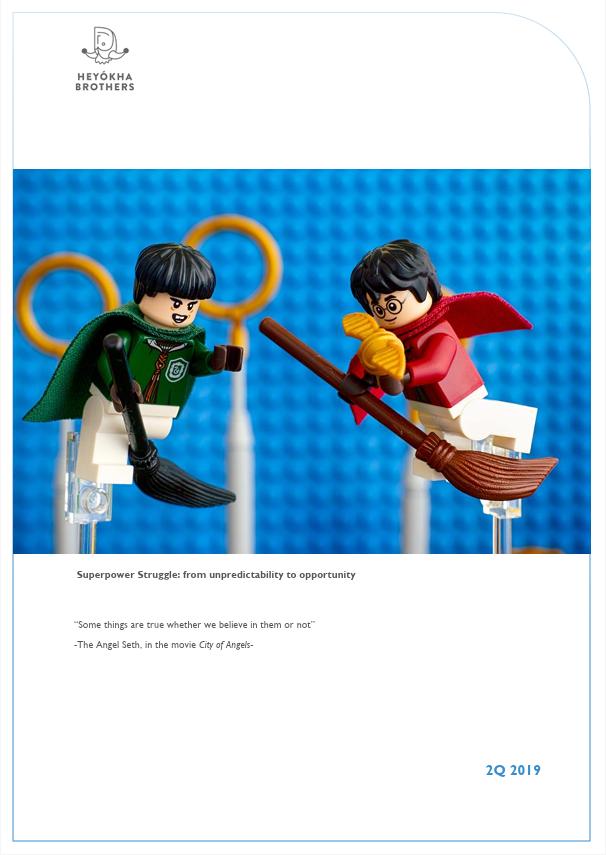
Read our reports here!
There is clear external validation of just how permanent that fracture has become, look at the architecture of the East today. The Shanghai Cooperation Organisation (SCO) now counts 10 full members accounting for 40% of the world’s population, 30% of global GDP (PPP), and 60% of the Eurasian landmass. All in all, they are holding 20% of proven global oil reserves and 44% of proven natural gas. This is not some fringe realignment. It is a structured, institutional counter to the Western-led order.
The Present Reality: The “Rupture” is Here
Fast forward to today, and the exact deglobalization thesis we mapped out in 2018 is now the consensus among global leaders. There is proof that the old system is breaking, just listen to the people who used to run it.
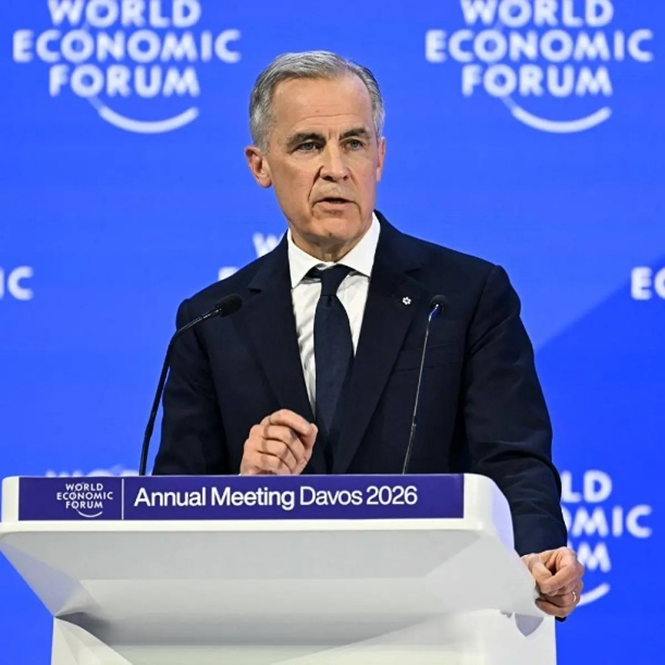
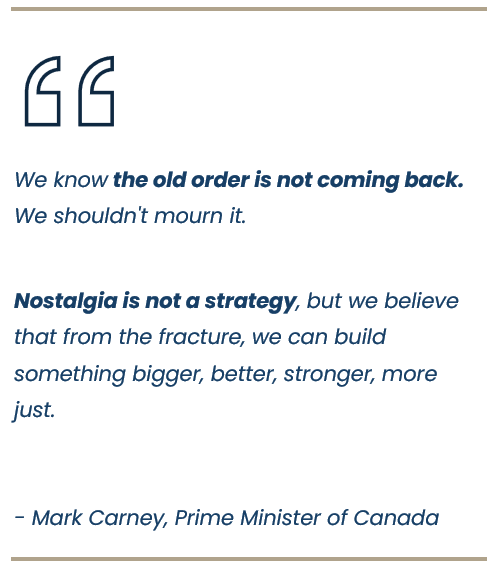
At the World Economic Forum earlier this year, Mark Carney bluntly defined the current state of international relations as a “rupture,” noting that it is not merely a transition. He warned that the old rules-based order no longer functions as advertised, with economic integration now being actively weaponized by great powers.
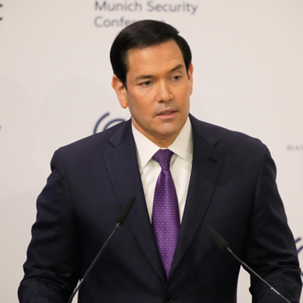
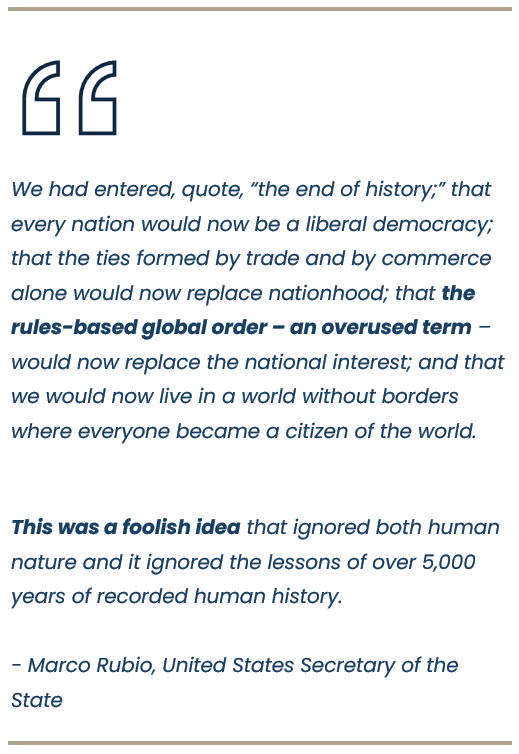
Meanwhile, U.S. Secretary of State Marco Rubio has explicitly declared that the era of globalization is over. He has consistently argued that the old economic consensus failed to moderate national rivalries, pushing instead for aggressive industrial policy, new trade barriers, and a focus on national security over cheap consumer goods.
The clearest proof of this rupture is the semiconductor war. Initial U.S. export controls were viewed in Beijing as a declaration of economic war. The response? According to the Australian Strategic Policy Institute, China now leads in 57 of 64 critical technologies—up from leading in just three a couple of decades ago. Critics argue that the attempt to contain China through tech restrictions backfired, pushing Beijing toward self-reliance and accelerating the very competition it sought to prevent. Supporters counter that the controls have still kept China’s most advanced chipmakers well behind the leading edge, and that Beijing’s push for self-reliance, Made in China 2025, began years before the controls arrived. Either way, the outcome that matters for us is the same: two technology systems pulling further apart.
Now, the U.S. is reacting in kind. Despite heavy political rhetoric regarding deregulation, the U.S. government spent heavily in 2025 to take direct equity stakes in major private companies like Intel and MP Materials. When the U.S. government starts directly buying 10% to 15% stakes in chipmakers and rare earth mines, they are no longer operating in a free-market global economy. This is what weaponized economic integration looks like from the inside.
Capital Chasing Security
The data and the rhetoric are finally aligned. We are watching the artificial intelligence arms race turn aggressively physical. Governments are finally waking up to the fact that they cannot power a sovereign AI grid or secure a defense supply chain with a multilateral trade agreement. They need secure transit and hard assets.
Capital is no longer chasing the lowest marginal cost. It is chasing security.
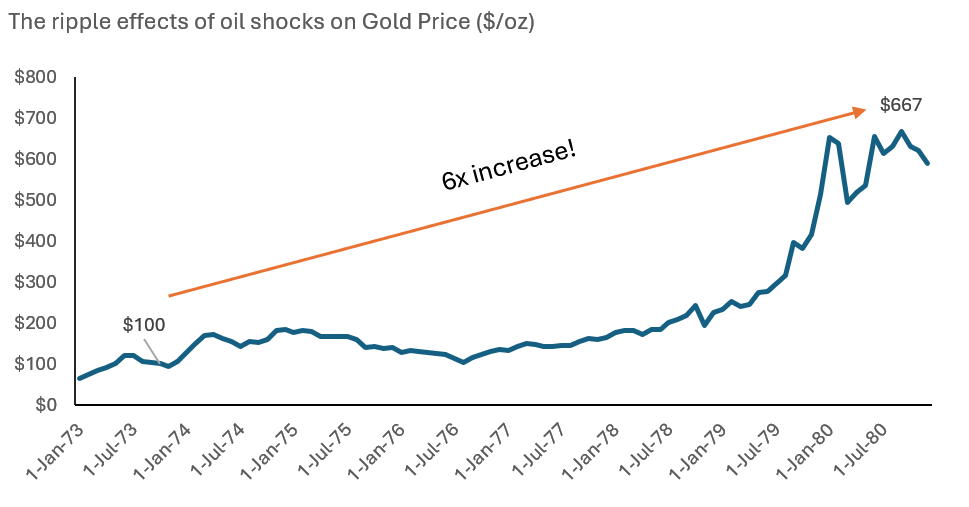
The transition is bumpy, and some of the symptoms are already visible: inflation that has proved stickier than central banks hoped, industrial policy used as a weapon, and heavy gold buying by central banks. The picture isn’t uniform, though. Iron ore and many other industrial commodities spent much of 2024 and 2025 falling, and in China, the world’s biggest manufacturer, inflation has hovered around zero.
Since we have been warning about this exact trend for over half a decade, and looking at the current state of the fractured global board, we felt it was finally time to acknowledge the inevitable.
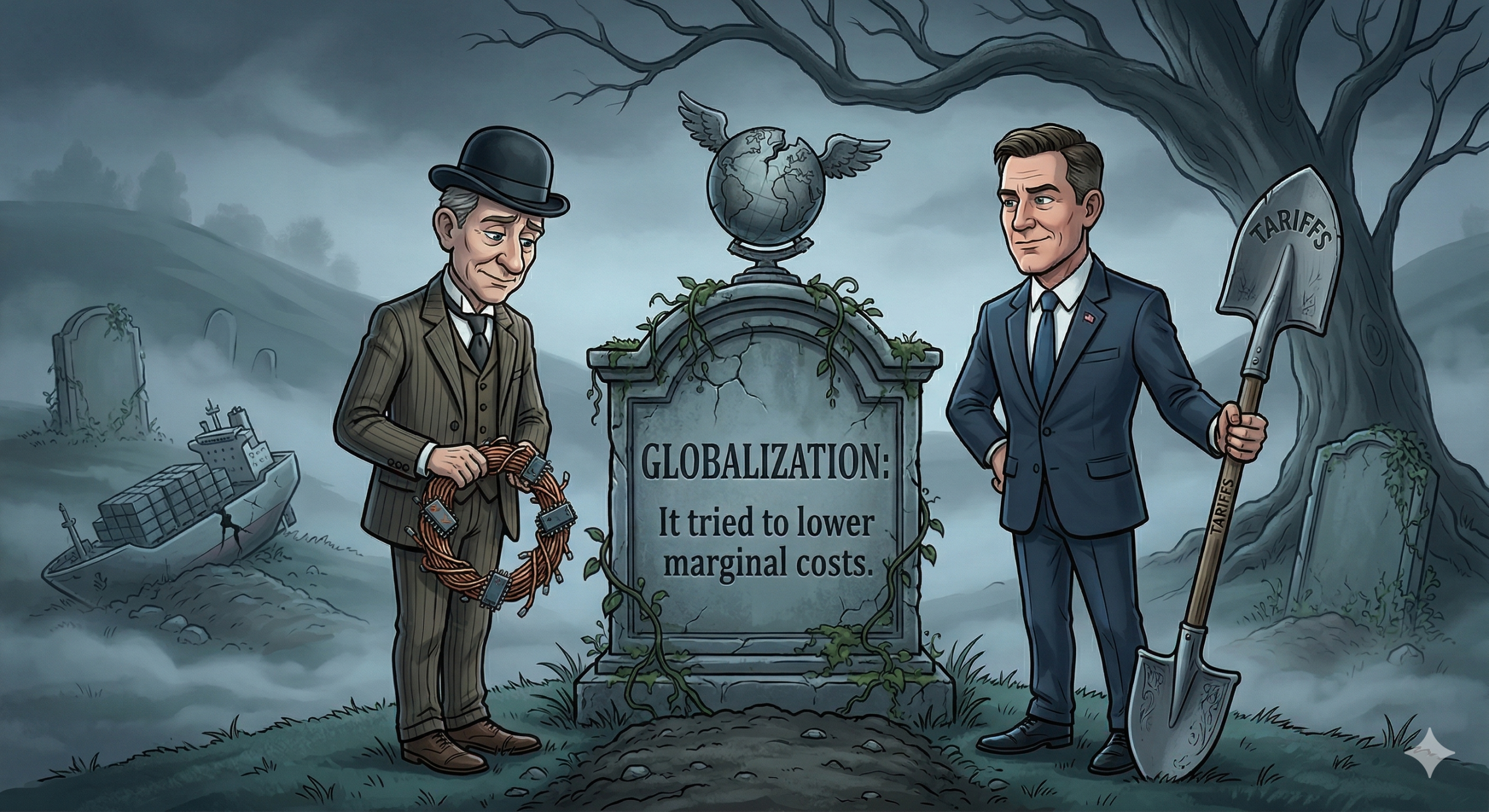
So, we wrote a premature obituary.
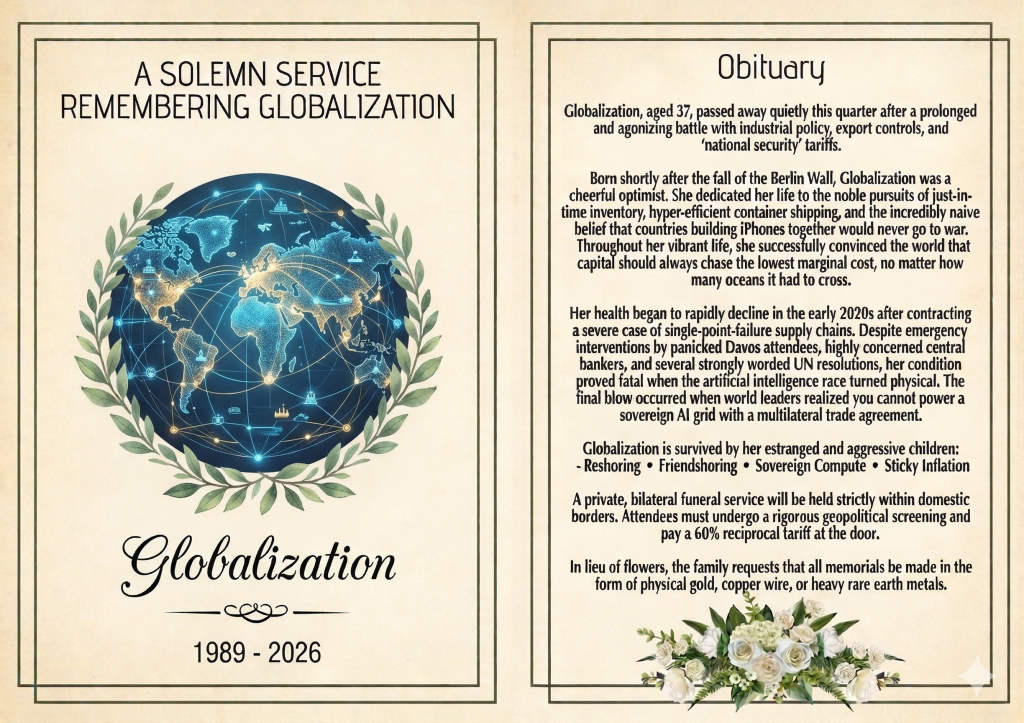
But every death brings a rebirth. As the illusion of a frictionless global economy is laid to rest, a new era is already rising from the ashes. This is the renaissance of the physical.
When supply chains fracture and fiat currencies are actively weaponized in great power competition, paper promises lose their premium. In times of deep systemic fear, capital instinctively flees the abstract and seeks out the tangible.
That helps explain why hard assets have drawn so much attention in this new environment.
Physical gold, silver, and critical industrial commodities do not rely on friendly diplomatic relations or multilateral trade agreements to hold their value. Gold and silver held in physical form are also nobody else’s liability: unlike a bond or a bank deposit, their value doesn’t depend on someone paying you back. But they come with risks of their own. They have to be stored and insured, holding them through a vault, bank or fund brings custody risk back in, and their prices can swing hard; gold lost roughly 45% between 2011 and 2015. Industrial commodities are more cyclical still, and tend to suffer when the global economy slows.
None of this makes hard assets a one-way bet. If tensions ease, if a few big trade deals stick, or if the AI build-out turns out to need fewer physical resources than expected, the premium on the tangible could shrink. The question now is whether the fracturing we have tracked since 2018 is a permanent reset, or a long, painful phase that eventually settles into a new balance.
Tara Mulia
For more blogs like these, subscribe to our newsletter here!
Important information
This article is published by Heyokha Brothers Limited (“Heyokha”), a corporation licensed by the Securities and Futures Commission of Hong Kong (CE No. BOS569). It is provided for general information and discussion purposes only. It reflects the authors’ views and observations at the date of publication, and these may change without notice.
Nothing in this article is investment, legal, tax or other professional advice, investment research, or a recommendation, offer or solicitation to buy or sell any security, fund or other investment product. It is not directed at any person in any jurisdiction where its publication or availability would be unlawful. Any companies, securities or assets mentioned are for illustration only and are not a recommendation.
Information from third-party sources is believed to be reliable, but it has not been independently verified. No representation or warranty is given as to its accuracy or completeness. Forward-looking statements are inherently uncertain, and actual outcomes may differ materially. Investment involves risk, the value of investments can go down as well as up, and past performance is not indicative of future results. Heyokha, its directors and employees, and funds it manages may hold positions in assets mentioned.
Readers should seek independent professional advice before making any investment decision. This article has not been reviewed by the Securities and Futures Commission.
Admin heyokha

Share


Everyone knows the world is fracturing. We cannot read a financial headline today without seeing the impact of tariffs or supply chain realignments. But acknowledging a headline is not the same as pricing in a permanent reality.
The broader market still treats geopolitical friction as a temporary headache, viewing it as a short-term risk premium that will eventually be resolved by the next election cycle or a neat trade deal. They still believe, deep down, that capital’s ultimate loyalty is to the lowest marginal cost. That view has real support. Global trade has kept growing, companies have mostly rerouted their supply chains through countries like Vietnam and Mexico rather than abandoning them, and past trade wars have often ended in a deal. But we think it underestimates how far things have shifted. In our view, the era of frictionless borders is on life support, and it is a trend we have been tracking for years.
The Red Thread: We Saw the Fractures in 2018
We have been talking about the reality of deglobalization as far back as our Q3 2018 report. When the U.S. and China first started trading tariff blows, the mainstream financial media brushed it off as a temporary political spat that would be resolved with a neat trade deal.
We disagreed. We noted then that this was the first tremor of a massive, structural decoupling.
By our Q2 and Q3 2019 reports, the writing was clearly on the wall. The trade dispute had morphed into a full-blown technology cold war. With entities being blacklisted and supply chains fracturing, we explicitly warned that the era of relying purely on hyper-efficient global trade was coming to an end. We saw that the unipolar world order was breaking apart and that strategic competition was replacing economic integration. We knew that a system built purely on chasing the lowest marginal cost across oceans was fundamentally fragile.
Read our reports here!
There is clear external validation of just how permanent that fracture has become, look at the architecture of the East today. The Shanghai Cooperation Organisation (SCO) now counts 10 full members accounting for 40% of the world’s population, 30% of global GDP (PPP), and 60% of the Eurasian landmass. All in all, they are holding 20% of proven global oil reserves and 44% of proven natural gas. This is not some fringe realignment. It is a structured, institutional counter to the Western-led order.
The Present Reality: The “Rupture” is Here
Fast forward to today, and the exact deglobalization thesis we mapped out in 2018 is now the consensus among global leaders. There is proof that the old system is breaking, just listen to the people who used to run it.
At the World Economic Forum earlier this year, Mark Carney bluntly defined the current state of international relations as a “rupture,” noting that it is not merely a transition. He warned that the old rules-based order no longer functions as advertised, with economic integration now being actively weaponized by great powers.
Meanwhile, U.S. Secretary of State Marco Rubio has explicitly declared that the era of globalization is over. He has consistently argued that the old economic consensus failed to moderate national rivalries, pushing instead for aggressive industrial policy, new trade barriers, and a focus on national security over cheap consumer goods.
The clearest proof of this rupture is the semiconductor war. Initial U.S. export controls were viewed in Beijing as a declaration of economic war. The response? According to the Australian Strategic Policy Institute, China now leads in 57 of 64 critical technologies—up from leading in just three a couple of decades ago. Critics argue that the attempt to contain China through tech restrictions backfired, pushing Beijing toward self-reliance and accelerating the very competition it sought to prevent. Supporters counter that the controls have still kept China’s most advanced chipmakers well behind the leading edge, and that Beijing’s push for self-reliance, Made in China 2025, began years before the controls arrived. Either way, the outcome that matters for us is the same: two technology systems pulling further apart.
Now, the U.S. is reacting in kind. Despite heavy political rhetoric regarding deregulation, the U.S. government spent heavily in 2025 to take direct equity stakes in major private companies like Intel and MP Materials. When the U.S. government starts directly buying 10% to 15% stakes in chipmakers and rare earth mines, they are no longer operating in a free-market global economy. This is what weaponized economic integration looks like from the inside.
Capital Chasing Security
The data and the rhetoric are finally aligned. We are watching the artificial intelligence arms race turn aggressively physical. Governments are finally waking up to the fact that they cannot power a sovereign AI grid or secure a defense supply chain with a multilateral trade agreement. They need secure transit and hard assets.
Capital is no longer chasing the lowest marginal cost. It is chasing security.
The transition is bumpy, and some of the symptoms are already visible: inflation that has proved stickier than central banks hoped, industrial policy used as a weapon, and heavy gold buying by central banks. The picture isn’t uniform, though. Iron ore and many other industrial commodities spent much of 2024 and 2025 falling, and in China, the world’s biggest manufacturer, inflation has hovered around zero.
Since we have been warning about this exact trend for over half a decade, and looking at the current state of the fractured global board, we felt it was finally time to acknowledge the inevitable.
So, we wrote a premature obituary.
But every death brings a rebirth. As the illusion of a frictionless global economy is laid to rest, a new era is already rising from the ashes. This is the renaissance of the physical.
When supply chains fracture and fiat currencies are actively weaponized in great power competition, paper promises lose their premium. In times of deep systemic fear, capital instinctively flees the abstract and seeks out the tangible.
That helps explain why hard assets have drawn so much attention in this new environment.
Physical gold, silver, and critical industrial commodities do not rely on friendly diplomatic relations or multilateral trade agreements to hold their value. Gold and silver held in physical form are also nobody else’s liability: unlike a bond or a bank deposit, their value doesn’t depend on someone paying you back. But they come with risks of their own. They have to be stored and insured, holding them through a vault, bank or fund brings custody risk back in, and their prices can swing hard; gold lost roughly 45% between 2011 and 2015. Industrial commodities are more cyclical still, and tend to suffer when the global economy slows.
None of this makes hard assets a one-way bet. If tensions ease, if a few big trade deals stick, or if the AI build-out turns out to need fewer physical resources than expected, the premium on the tangible could shrink. The question now is whether the fracturing we have tracked since 2018 is a permanent reset, or a long, painful phase that eventually settles into a new balance.
Tara Mulia
For more blogs like these, subscribe to our newsletter here!
Important information
This article is published by Heyokha Brothers Limited (“Heyokha”), a corporation licensed by the Securities and Futures Commission of Hong Kong (CE No. BOS569). It is provided for general information and discussion purposes only. It reflects the authors’ views and observations at the date of publication, and these may change without notice.
Nothing in this article is investment, legal, tax or other professional advice, investment research, or a recommendation, offer or solicitation to buy or sell any security, fund or other investment product. It is not directed at any person in any jurisdiction where its publication or availability would be unlawful. Any companies, securities or assets mentioned are for illustration only and are not a recommendation.
Information from third-party sources is believed to be reliable, but it has not been independently verified. No representation or warranty is given as to its accuracy or completeness. Forward-looking statements are inherently uncertain, and actual outcomes may differ materially. Investment involves risk, the value of investments can go down as well as up, and past performance is not indicative of future results. Heyokha, its directors and employees, and funds it manages may hold positions in assets mentioned.
Readers should seek independent professional advice before making any investment decision. This article has not been reviewed by the Securities and Futures Commission.
Admin heyokha
Share