
Once in a while, a thesis you’ve been quietly writing for years lands on the front page via someone the market cannot ignore. Last week, that was Janet Yellen.

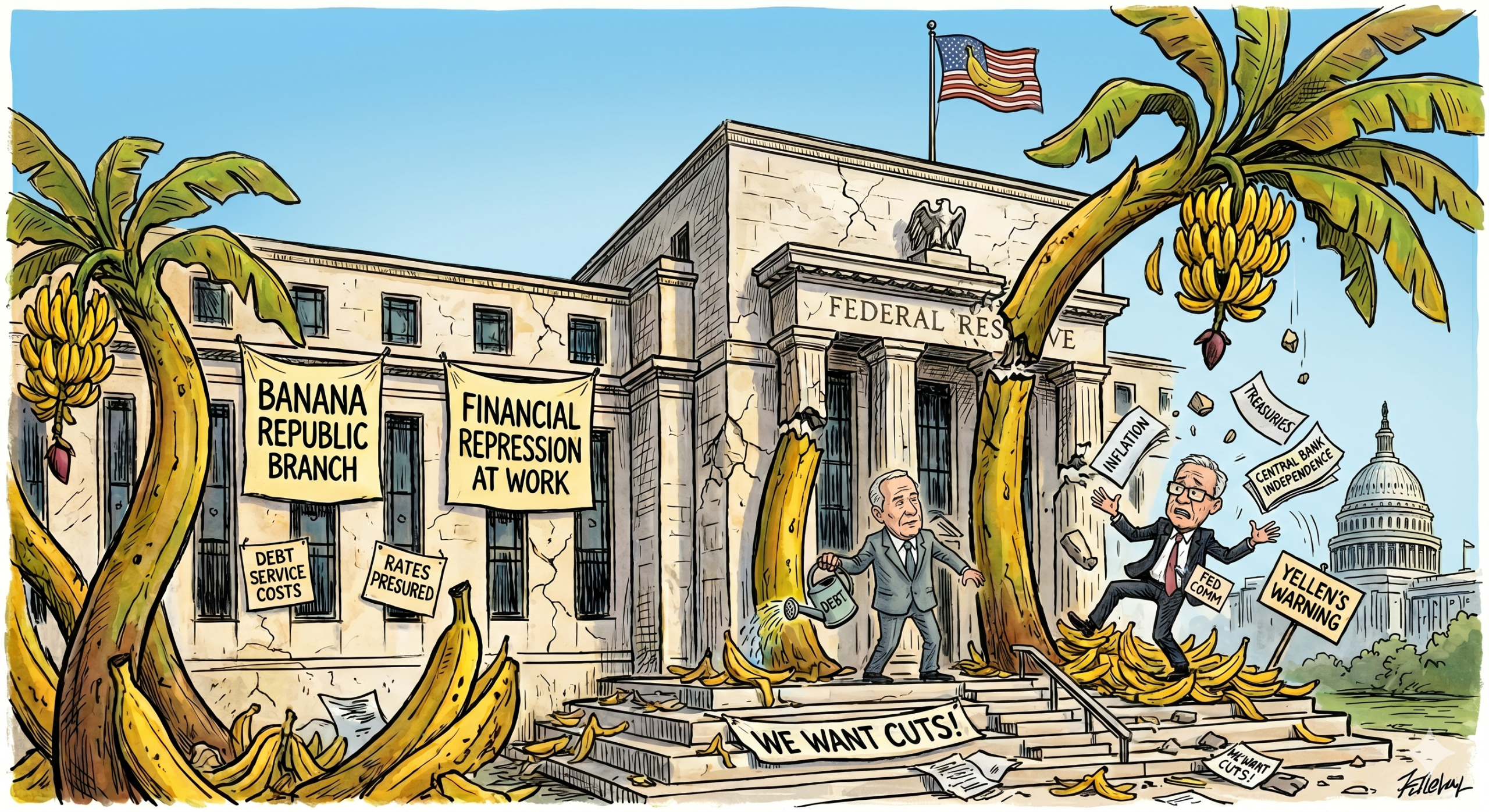
Speaking at the HSBC Global Investment Summit in Hong Kong on April 15, the former U.S. Treasury Secretary, and before that former Fed Chair, was asked about the Trump administration’s campaign to pressure the Federal Reserve into cutting rates to reduce the government’s debt service costs. Her answer was not diplomatic:


“How often does the president of a developed country express the view that the interest rate should be set to reduce the debt service cost?

This is what you hear in a banana republic.”

– Janet Yellen, Hong Kong, 15 April 2026

Source: South China Morning Post


She added that she had “never seen a threat of this level to the Fed before,” and called the White House’s floated threats of criminal charges against Chair Jerome Powell “the ultimate step,” an “unprecedented” way of interfering with central bank independence.
We have been writing about this dynamic since 2018. Not this specific headline, but this specificargument. In our quarterly reports, our special report Gold: The Return of Real Money, and as recently as our April 3 blog The 1974 Illusion, we have argued the same thing: when a government carries a structurally unsustainable debt load, the arithmetic leaves only one viable exit. What is new is that it is now being proposed openly, from the White House, with a straight face.

The Playbook Of An Indebted Government

When a government carries a debt load it cannot grow or tax its way out of, it reaches for the same playbook every time. The playbook has a name, financial repression, and the mechanics are simple:

  • Cap nominal rates below inflation. Pressure the central bank, directly or via appointments, to keep policy rates low even as prices rise.
  • Let inflation run hot. Don’t fight it. Let it erode the real value of the outstanding debt stock.
  • Create captive buyers. Force pension funds, banks, and insurers to hold low-yielding sovereign paper by regulation, tax incentive, or outright mandate.
  • Wait. Over a decade or two, the real burden of the debt silently melts. The holders of the bonds, usually savers and retirees, pay the bill through lost purchasing power.

Source: Heyokha Research

This is not theoretical. The United States ran this exact playbook from 1946 to 1951 to work off the WWII debt stock. The UK did the same across the post-war decades, Japan has run a variant for thirty years, and every emerging market that has ever been in fiscal trouble has arrived at the same door. There is no clever third option. The arithmetic always wins.

Now it’s higher than WW2!
Source: Bloomberg

The Arithmetic That Forces It

We laid the numbers out in The 1974 Illusion. They are worth repeating, because the gap between what the math says and what markets are pricing is where the opportunity lives.

  • U.S. federal debt: ~$39 trillion. Debt-to-GDP now above 120%, higher than the post-WWII peak that triggered the last formal repression episode.
  • Interest expense + mandatory outlays: ~92% of federal tax revenue. That leaves almost nothing left over to run the country, never mind rebuilding infrastructure or funding a great-power rivalry.
  • The gap Trump wants closed: 250 basis points. Fed funds sits at 3.50–3.75%; the White House wants 1%. Not all of it flows through overnight: long rates don’t follow Fed funds one-for-one, and only maturing debt reprices. But about $7–9 trillion of Treasury paper rolls every year, so even a partial pass-through compounds into hundreds of billions over a few cycles. That is the prize.


Paul Volcker could hike to 17% in 1980 because debt-to-GDP was 33% and the sovereign could absorb the medicine. In 2026, with the structural inflation now building on the back of the Iran energy shock, the same medicine kills the patient. The Volcker playbook is dead, and everyone who runs the numbers knows it.

Source: Heyokha Research

So the choice is not between hawkish discipline and dovish indulgence. The choice is between an explicit repression regime, run openly, and a quiet one, run by nods and winks. Yellen’s point is that Trump is picking the former. That is what makes it a banana republic: not the arithmetic, but the willingness to stop pretending.

Three Red Lines in Just Two Working Days

If this were only an American story, one could call it a political aberration that corrects when administrations change. It isn’t. In five working days in April, three supposedly-inviolable lines got walked past in public.

  • April 15, Hormuz. The U.S. turned back the Rich Starry, a sanctioned tanker attempting to break the American blockade at the entrance to the Strait. Washington is now actively interdicting the flow of energy to China. The mechanism is explicit.
  • April 16, London. The House of Commons passed the first leg of a bill letting a government minister mandate the asset allocation of UK pension funds. This is literal financial repression, legislated, at a moment when most of the market is busy looking at equities making new highs.
  • April 16, Bloomberg TV. Former U.S. Treasury Secretary Hank Paulson, the man who effectively nationalised much of the American financial system in 2008, admitted on air that there is a “break the glass” plan for the moment the U.S. government cannot sell Treasuries at a yield it can afford. One man saying that in public at that moment is not an accident. That is a former Treasury Secretary pre-positioning the idea in the discourse.


These are not three stories. They are one story: governments reaching, in public, for coercive tools the post-1980 consensus promised would stay on the shelf. Control of commodity flows. Control of where private savings clear. Control of the price a Treasury pays for its own debt. Three levers. One direction of travel. All of it inside two working days.

What To Do When The Playbook Is Public

The uncomfortable truth about financial repression is that it is engineered to punish the people who did exactly what they were told to do: save responsibly in sovereign bonds and hold cash in the local currency. It has to work that way for the arithmetic to resolve. A few things follow:

  1. Gold is insurance, not speculation. We argued in Gold: The Return of Real Money that a reversion to historical gold-to-monetary-base ratios implies fair value well north of where we are today. Yellen’s quote didn’t change our view. It shortened the distance between our view and the consensus one.
  2. Own real assets with genuine pricing power. Commodity producers outside the repression geography, food-chain businesses whose margins flex with input costs, and equities with monopolistic or near-monopolistic pricing. Bonds are not shelters in this regime.
  3. Treat inflation expectations as the variable, not the constant. The entire developed-world pricing complex is currently behaving as if inflation expectations are anchored. Yellen’s warning and the UK pension bill say the same thing: that assumption is on borrowed time.

The Arithmetic Doesn’t Wait

This isn’t a prediction. The playbook is already running, in public, with fingerprints on it. Yellen put a name on it this week. Paulson rehearsed its next move on Bloomberg. Westminster started legislating the machinery on the 16th. The only part still pending is the part where markets stop discounting it.

For our readers, none of this is new. We’ve argued the structure, written about gold as insurance rather than speculation, and laid out the arithmetic in blog after blog. What is new this week is that the argument no longer requires a footnote.


Tara Mulia
For more blogs like these, subscribe to our newsletter here!


Admin heyokha


Share


Once in a while, a thesis you’ve been quietly writing for years lands on the front page via someone the market cannot ignore. Last week, that was Janet Yellen.

Speaking at the HSBC Global Investment Summit in Hong Kong on April 15, the former U.S. Treasury Secretary, and before that former Fed Chair, was asked about the Trump administration’s campaign to pressure the Federal Reserve into cutting rates to reduce the government’s debt service costs. Her answer was not diplomatic:


“How often does the president of a developed country express the view that the interest rate should be set to reduce the debt service cost?

This is what you hear in a banana republic.”

– Janet Yellen, Hong Kong, 15 April 2026

Source: South China Morning Post


She added that she had “never seen a threat of this level to the Fed before,” and called the White House’s floated threats of criminal charges against Chair Jerome Powell “the ultimate step,” an “unprecedented” way of interfering with central bank independence.
We have been writing about this dynamic since 2018. Not this specific headline, but this specificargument. In our quarterly reports, our special report Gold: The Return of Real Money, and as recently as our April 3 blog The 1974 Illusion, we have argued the same thing: when a government carries a structurally unsustainable debt load, the arithmetic leaves only one viable exit. What is new is that it is now being proposed openly, from the White House, with a straight face.

The Playbook Of An Indebted Government

When a government carries a debt load it cannot grow or tax its way out of, it reaches for the same playbook every time. The playbook has a name, financial repression, and the mechanics are simple:

  • Cap nominal rates below inflation. Pressure the central bank, directly or via appointments, to keep policy rates low even as prices rise.
  • Let inflation run hot. Don’t fight it. Let it erode the real value of the outstanding debt stock.
  • Create captive buyers. Force pension funds, banks, and insurers to hold low-yielding sovereign paper by regulation, tax incentive, or outright mandate.
  • Wait. Over a decade or two, the real burden of the debt silently melts. The holders of the bonds, usually savers and retirees, pay the bill through lost purchasing power.

Source: Heyokha Research

This is not theoretical. The United States ran this exact playbook from 1946 to 1951 to work off the WWII debt stock. The UK did the same across the post-war decades, Japan has run a variant for thirty years, and every emerging market that has ever been in fiscal trouble has arrived at the same door. There is no clever third option. The arithmetic always wins.

Now it’s higher than WW2!
Source: Bloomberg

The Arithmetic That Forces It

We laid the numbers out in The 1974 Illusion. They are worth repeating, because the gap between what the math says and what markets are pricing is where the opportunity lives.

  • U.S. federal debt: ~$39 trillion. Debt-to-GDP now above 120%, higher than the post-WWII peak that triggered the last formal repression episode.
  • Interest expense + mandatory outlays: ~92% of federal tax revenue. That leaves almost nothing left over to run the country, never mind rebuilding infrastructure or funding a great-power rivalry.
  • The gap Trump wants closed: 250 basis points. Fed funds sits at 3.50–3.75%; the White House wants 1%. Not all of it flows through overnight: long rates don’t follow Fed funds one-for-one, and only maturing debt reprices. But about $7–9 trillion of Treasury paper rolls every year, so even a partial pass-through compounds into hundreds of billions over a few cycles. That is the prize.


Paul Volcker could hike to 17% in 1980 because debt-to-GDP was 33% and the sovereign could absorb the medicine. In 2026, with the structural inflation now building on the back of the Iran energy shock, the same medicine kills the patient. The Volcker playbook is dead, and everyone who runs the numbers knows it.

Source: Heyokha Research

So the choice is not between hawkish discipline and dovish indulgence. The choice is between an explicit repression regime, run openly, and a quiet one, run by nods and winks. Yellen’s point is that Trump is picking the former. That is what makes it a banana republic: not the arithmetic, but the willingness to stop pretending.

Three Red Lines in Just Two Working Days

If this were only an American story, one could call it a political aberration that corrects when administrations change. It isn’t. In five working days in April, three supposedly-inviolable lines got walked past in public.

  • April 15, Hormuz. The U.S. turned back the Rich Starry, a sanctioned tanker attempting to break the American blockade at the entrance to the Strait. Washington is now actively interdicting the flow of energy to China. The mechanism is explicit.
  • April 16, London. The House of Commons passed the first leg of a bill letting a government minister mandate the asset allocation of UK pension funds. This is literal financial repression, legislated, at a moment when most of the market is busy looking at equities making new highs.
  • April 16, Bloomberg TV. Former U.S. Treasury Secretary Hank Paulson, the man who effectively nationalised much of the American financial system in 2008, admitted on air that there is a “break the glass” plan for the moment the U.S. government cannot sell Treasuries at a yield it can afford. One man saying that in public at that moment is not an accident. That is a former Treasury Secretary pre-positioning the idea in the discourse.


These are not three stories. They are one story: governments reaching, in public, for coercive tools the post-1980 consensus promised would stay on the shelf. Control of commodity flows. Control of where private savings clear. Control of the price a Treasury pays for its own debt. Three levers. One direction of travel. All of it inside two working days.

What To Do When The Playbook Is Public

The uncomfortable truth about financial repression is that it is engineered to punish the people who did exactly what they were told to do: save responsibly in sovereign bonds and hold cash in the local currency. It has to work that way for the arithmetic to resolve. A few things follow:

  1. Gold is insurance, not speculation. We argued in Gold: The Return of Real Money that a reversion to historical gold-to-monetary-base ratios implies fair value well north of where we are today. Yellen’s quote didn’t change our view. It shortened the distance between our view and the consensus one.
  2. Own real assets with genuine pricing power. Commodity producers outside the repression geography, food-chain businesses whose margins flex with input costs, and equities with monopolistic or near-monopolistic pricing. Bonds are not shelters in this regime.
  3. Treat inflation expectations as the variable, not the constant. The entire developed-world pricing complex is currently behaving as if inflation expectations are anchored. Yellen’s warning and the UK pension bill say the same thing: that assumption is on borrowed time.

The Arithmetic Doesn’t Wait

This isn’t a prediction. The playbook is already running, in public, with fingerprints on it. Yellen put a name on it this week. Paulson rehearsed its next move on Bloomberg. Westminster started legislating the machinery on the 16th. The only part still pending is the part where markets stop discounting it.

For our readers, none of this is new. We’ve argued the structure, written about gold as insurance rather than speculation, and laid out the arithmetic in blog after blog. What is new this week is that the argument no longer requires a footnote.


Tara Mulia
For more blogs like these, subscribe to our newsletter here!


Admin heyokha


Share


We sat down to watch the latest sci-fi film “Project Hail Mary” last week expecting something light but got the opposite.

Early in the film, the head of an international task force lays out the stakes to the main character being sent on a desperate space mission: an alien microorganism is slowly consuming the sun’s energy. At current trajectory of colder temperatures, food production will collapses and roughly 25% of the world’s population will die of starvation. Very dire situation for the main character.

Source: MGM

We couldn’t stop thinking about it — not because we’re facing a dying sun, but because a version of a similar downward cascade is playing out right now in the Strait of Hormuz. The oil story has dominated every headline. What isn’t being talked about nearly enough is what’s happening to food.

This Is Not Just an Oil Story

Since late February 2026, the Strait of Hormuz has been effectively disrupted, caught in the crossfire of an escalating Iran conflict. The world knows this. Markets have priced in the oil shock. Analysts have run the Brent scenarios. That conversation is well underway.

Here is the conversation that hasn’t started yet.

The Strait of Hormuz isn’t just the world’s most important oil chokepoint. It is also the jugular vein of global fertilizer trade. And right now, it is being squeezed.

Source: Goldman Sachs

Consider what flows through those 33 kilometers of water:

  • Around 34% of global urea shipments
  • Around 23% of global ammonia
  • Around 20% of global phosphates


That means close to 50% of world urea exports originate west of Hormuz and must pass through it. That also means close to 30% of all global fertilizer trade transits the Strait.

Oil gets the headlines because its price moves immediately and visibly. Fertilizer deserves its own headline because its price also moves quite quickly and the damage lands months later in the food supply, long after the Strait has reopened and the world has moved on.

The Price Shock Is Already Here

We said slow motion. But the first act has already been fast. In the roughly six weeks since disruption intensified, fertilizer markets have repriced violently:

  • Urea: up around 70% in six weeks, now above $800/ton; up roughly 104% year-to-date on a futures basis
  • India import bids: $935–959/ton — roughly double what buyers were paying two months ago


To put the immediate jolt in context: in the first weeks post-disruption, fertilizer markets saw a 28–30% spike. That’s not a rounding error. That’s a supply chain cardiac event.

Will we see it test higher prices than the Russian-Ukraine war?

Source: Bloomberg

We Have Seen This Movie Before — In 2022

In our earlier blog “Rising Fertiliser and Food Prices: Who Will Be Spared?”, written in April 2022, we tracked what happened when Russia invaded Ukraine and effectively weaponized the nitrogen supply chain. The mechanism was the same: a geopolitical shock hit the gas supply (ammonia’s key feedstock), fertilizer plants went dark across Europe, and prices detonated.

The 2022 Ukraine shock produced:

  • Ammonia prices up ~200% from pre-war levels at peak
  • Global urea prices hitting record highs above $900/ton
  • Food price index (FAO) reaching its highest level ever recorded — March 2022
  • Export bans from India, China, and Russia as countries hoarded supply
  • Egypt, Sri Lanka, and Pakistan facing acute fertilizer shortages

In case you need a refresher of how it went down back in 2022

Source: Heyokha research, Bloomberg

In 2022, the shock was upstream energy: gas prices broke fertilizer production. In 2026, the shock is logistics: a physical blockade on the world’s most fertilizer-intensive shipping lane. The mechanism is different. The destination is the same.

The Chain Reaction Nobody Is Pricing In

Here is what makes this crisis different from an oil shock — and more dangerous for long-term inflation. Oil prices move, and within months, the effect is felt at the pump. Consumers adjust. Central banks watch CPI. The feedback loop is fast and visible.

Fertilizer doesn’t work that way. It operates on an agricultural calendar. And right now, we are in the exact wrong moment of that calendar.

The sequence looks like this:

  • Fertilizer prices spike (now) → farmers in Asia, Africa, and LatAm face input costs they cannot absorb
  • Planting decisions change (within weeks) → farmers reduce application rates, switch to lower-input crops, or skip planting altogether
  • Crop yields fall (harvest season, Q3–Q4 2026) → lower output than the market expects
  • Food supply tightens (post-harvest) → grain, rice, and staple inventories shrink
  • Food prices rise (lagged CPI impact) → the inflation the market didn’t price in arrives on schedule


This is not cyclical inflation. This is not a demand shock that the Fed can cool with a rate hike. This is structural inflation driven by a real, physical constraint on one of the most inelastic goods on earth: food. You cannot print more rice. You cannot stimulate your way to a better harvest.

And crucially — the data will look fine right now. Commodity desks will note that food CPI has not moved. Analysts will say the market is calm. That calm is the problem. The harvest hasn’t happened yet.

Who Gets Hit First

Not everyone feels this equally. The geography of vulnerability follows the fertilizer import map, and it skews heavily toward the countries least able to absorb it. India is already bidding urea at $935–959 per ton, roughly double two months ago. Bangladesh, Pakistan, and much of Sub-Saharan Africa run food expenditure ratios above 50% of household income; a 30–50% fertilizer input shock is not an abstraction for the people at the end of this supply chain — it is a decision about whether to plant at all. When farmers in import-dependent economies reduce application rates or skip a crop cycle, the deficit gets quietly written into soil that won’t talk back until harvest season.

Source: Bloomberg

The Inflation That Was Already Coming

We want to be precise about something: this is not a new worry for us. We first wrote about ammonia as a geopolitical weapon in early 2022, in “Rising Fertiliser and Food Prices: Who Will Be Spared?” — before most investors were treating it as anything other than a niche commodity story. The thesis then was that supply chain breakdown, energy crisis, and geopolitical tension had crystallised into a perfect storm for food prices, and that the effects would travel through the system far more slowly and durably than markets expected.

Later that year, when food prices briefly cooled and analysts declared the crisis over, we pushed back in “The End of the Decade of Plenty” blog back in November 2022. The FAO food price index had fallen 14.7% from its March peak,  but the dollar had risen 21.5% over the same period, meaning most countries were actually paying more in local currency terms. Export bans were proliferating. The underlying supply-side pressures had not resolved; they had merely gone quiet. We said then: don’t mistake a pause for a resolution.

That lesson applies with full force today. The latest data from FAO ((Food and Agriculture Organization of the United Nations)) is already seeing Food Price Index rising for a second consecutive month, driven by energy related pressures from the Middle East conflict.

Averaged 128.5 points in March 2026, up 3.0 points from February

Source: FAO

What we are describing is not a cyclical event central banks can hike away. It is structural inflation — driven by real, physical constraints on the most inelastic thing on earth. You cannot print more rice. The Hormuz crisis will eventually ease and shipping lanes will reopen, but the harvest that didn’t happen won’t come back.

You cannot retroactively fertilize a field that went under-dosed in April. The consequences are already baked into the ground.

The question for investors isn’t whether this inflation arrives, it’s whether you’re positioned for a world where food prices reprice structurally and stay there. We’ve long believed the answer lies in owning the things scarcity makes more valuable and the kind of exposure to real assets that actually benefits when the fiction of infinite, frictionless abundance runs into a closed strait. The broader point is the same one we’ve been making since the decade of plenty ended: efficiency was the trade of the last era; resilience is the trade of this one.

In the film, (spoiler alert) humanity gets its Hail Mary — a one-in-a-billion miracle, executed by a lone astronaut and some extra-terrestrial help, arriving in the nick of time. Inspiring. Also not our base case.

What is our Hail Mary?
source: MGM

The real-world version of this story doesn’t end with a miracle. It ends with whoever read the data early enough being fine, and whoever assumed the world would stay frictionless being very surprised by their future grocery bill.


Tara Mulia
For more blogs like these, subscribe to our newsletter here!


Admin heyokha


Share


We sat down to watch the latest sci-fi film “Project Hail Mary” last week expecting something light but got the opposite.

Early in the film, the head of an international task force lays out the stakes to the main character being sent on a desperate space mission: an alien microorganism is slowly consuming the sun’s energy. At current trajectory of colder temperatures, food production will collapses and roughly 25% of the world’s population will die of starvation. Very dire situation for the main character.

Source: MGM

We couldn’t stop thinking about it — not because we’re facing a dying sun, but because a version of a similar downward cascade is playing out right now in the Strait of Hormuz. The oil story has dominated every headline. What isn’t being talked about nearly enough is what’s happening to food.

This Is Not Just an Oil Story

Since late February 2026, the Strait of Hormuz has been effectively disrupted, caught in the crossfire of an escalating Iran conflict. The world knows this. Markets have priced in the oil shock. Analysts have run the Brent scenarios. That conversation is well underway.

Here is the conversation that hasn’t started yet.

The Strait of Hormuz isn’t just the world’s most important oil chokepoint. It is also the jugular vein of global fertilizer trade. And right now, it is being squeezed.

Source: Goldman Sachs

Consider what flows through those 33 kilometers of water:

  • Around 34% of global urea shipments
  • Around 23% of global ammonia
  • Around 20% of global phosphates


That means close to 50% of world urea exports originate west of Hormuz and must pass through it. That also means close to 30% of all global fertilizer trade transits the Strait.

Oil gets the headlines because its price moves immediately and visibly. Fertilizer deserves its own headline because its price also moves quite quickly and the damage lands months later in the food supply, long after the Strait has reopened and the world has moved on.

The Price Shock Is Already Here

We said slow motion. But the first act has already been fast. In the roughly six weeks since disruption intensified, fertilizer markets have repriced violently:

  • Urea: up around 70% in six weeks, now above $800/ton; up roughly 104% year-to-date on a futures basis
  • India import bids: $935–959/ton — roughly double what buyers were paying two months ago


To put the immediate jolt in context: in the first weeks post-disruption, fertilizer markets saw a 28–30% spike. That’s not a rounding error. That’s a supply chain cardiac event.

Will we see it test higher prices than the Russian-Ukraine war?

Source: Bloomberg

We Have Seen This Movie Before — In 2022

In our earlier blog “Rising Fertiliser and Food Prices: Who Will Be Spared?”, written in April 2022, we tracked what happened when Russia invaded Ukraine and effectively weaponized the nitrogen supply chain. The mechanism was the same: a geopolitical shock hit the gas supply (ammonia’s key feedstock), fertilizer plants went dark across Europe, and prices detonated.

The 2022 Ukraine shock produced:

  • Ammonia prices up ~200% from pre-war levels at peak
  • Global urea prices hitting record highs above $900/ton
  • Food price index (FAO) reaching its highest level ever recorded — March 2022
  • Export bans from India, China, and Russia as countries hoarded supply
  • Egypt, Sri Lanka, and Pakistan facing acute fertilizer shortages

In case you need a refresher of how it went down back in 2022

Source: Heyokha research, Bloomberg

In 2022, the shock was upstream energy: gas prices broke fertilizer production. In 2026, the shock is logistics: a physical blockade on the world’s most fertilizer-intensive shipping lane. The mechanism is different. The destination is the same.

The Chain Reaction Nobody Is Pricing In

Here is what makes this crisis different from an oil shock — and more dangerous for long-term inflation. Oil prices move, and within months, the effect is felt at the pump. Consumers adjust. Central banks watch CPI. The feedback loop is fast and visible.

Fertilizer doesn’t work that way. It operates on an agricultural calendar. And right now, we are in the exact wrong moment of that calendar.

The sequence looks like this:

  • Fertilizer prices spike (now) → farmers in Asia, Africa, and LatAm face input costs they cannot absorb
  • Planting decisions change (within weeks) → farmers reduce application rates, switch to lower-input crops, or skip planting altogether
  • Crop yields fall (harvest season, Q3–Q4 2026) → lower output than the market expects
  • Food supply tightens (post-harvest) → grain, rice, and staple inventories shrink
  • Food prices rise (lagged CPI impact) → the inflation the market didn’t price in arrives on schedule


This is not cyclical inflation. This is not a demand shock that the Fed can cool with a rate hike. This is structural inflation driven by a real, physical constraint on one of the most inelastic goods on earth: food. You cannot print more rice. You cannot stimulate your way to a better harvest.

And crucially — the data will look fine right now. Commodity desks will note that food CPI has not moved. Analysts will say the market is calm. That calm is the problem. The harvest hasn’t happened yet.

Who Gets Hit First

Not everyone feels this equally. The geography of vulnerability follows the fertilizer import map, and it skews heavily toward the countries least able to absorb it. India is already bidding urea at $935–959 per ton, roughly double two months ago. Bangladesh, Pakistan, and much of Sub-Saharan Africa run food expenditure ratios above 50% of household income; a 30–50% fertilizer input shock is not an abstraction for the people at the end of this supply chain — it is a decision about whether to plant at all. When farmers in import-dependent economies reduce application rates or skip a crop cycle, the deficit gets quietly written into soil that won’t talk back until harvest season.

Source: Bloomberg

The Inflation That Was Already Coming

We want to be precise about something: this is not a new worry for us. We first wrote about ammonia as a geopolitical weapon in early 2022, in “Rising Fertiliser and Food Prices: Who Will Be Spared?” — before most investors were treating it as anything other than a niche commodity story. The thesis then was that supply chain breakdown, energy crisis, and geopolitical tension had crystallised into a perfect storm for food prices, and that the effects would travel through the system far more slowly and durably than markets expected.

Later that year, when food prices briefly cooled and analysts declared the crisis over, we pushed back in “The End of the Decade of Plenty” blog back in November 2022. The FAO food price index had fallen 14.7% from its March peak,  but the dollar had risen 21.5% over the same period, meaning most countries were actually paying more in local currency terms. Export bans were proliferating. The underlying supply-side pressures had not resolved; they had merely gone quiet. We said then: don’t mistake a pause for a resolution.

That lesson applies with full force today. The latest data from FAO ((Food and Agriculture Organization of the United Nations)) is already seeing Food Price Index rising for a second consecutive month, driven by energy related pressures from the Middle East conflict.

Averaged 128.5 points in March 2026, up 3.0 points from February

Source: FAO

What we are describing is not a cyclical event central banks can hike away. It is structural inflation — driven by real, physical constraints on the most inelastic thing on earth. You cannot print more rice. The Hormuz crisis will eventually ease and shipping lanes will reopen, but the harvest that didn’t happen won’t come back.

You cannot retroactively fertilize a field that went under-dosed in April. The consequences are already baked into the ground.

The question for investors isn’t whether this inflation arrives, it’s whether you’re positioned for a world where food prices reprice structurally and stay there. We’ve long believed the answer lies in owning the things scarcity makes more valuable and the kind of exposure to real assets that actually benefits when the fiction of infinite, frictionless abundance runs into a closed strait. The broader point is the same one we’ve been making since the decade of plenty ended: efficiency was the trade of the last era; resilience is the trade of this one.

In the film, (spoiler alert) humanity gets its Hail Mary — a one-in-a-billion miracle, executed by a lone astronaut and some extra-terrestrial help, arriving in the nick of time. Inspiring. Also not our base case.

What is our Hail Mary?
source: MGM

The real-world version of this story doesn’t end with a miracle. It ends with whoever read the data early enough being fine, and whoever assumed the world would stay frictionless being very surprised by their future grocery bill.


Tara Mulia
For more blogs like these, subscribe to our newsletter here!


Admin heyokha


Share


Trying to gauge the exact status of the Strait of Hormuz from a desk is a bit like trying to review a restaurant by reading the menu through a telescope. You can spend all day squinting at maritime transponder data on a Bloomberg terminal, trying to guess if the shipping lanes are clear.

Citrini Research decided to do something a bit more practical: they sent an analyst directly to the Strait of Hormuz.

Analyst #3 is either the bravest person alive or the most suicidal

source: Citrini Research

What their field agent found completely dismantles the mainstream narrative. The Strait of Hormuz hasn’t been completely barricaded, nor is it freely open. It has morphed into a geopolitical tollbooth. Standard maritime tracking is basically useless right now because as much as 50% of the vessel traffic is running “dark.”

Ships are turning their transponders off and tiptoeing through the Qeshm-Larak channel to dodge drones. It is global trade on incognito mode.

But the real punchline isn’t how the ships are passing. It is who is passing.

By early April, at least 10 major nations, including staunch U.S. allies like France, Japan, and India, had actively negotiated direct transit access with Iran. Think about that for a second. Sovereign nations allied with Washington are making bespoke side-deals with the exact country the U.S. is currently in direct conflict with.

It’s the geopolitical equivalent of finding out your loyal business partners are quietly negotiating a separate supply contract with your biggest rival.

Why are U.S. allies suddenly acting like free agents? Well take a look at Trump’s own tweet:

Last week, Donald Trump lashed out at European allies who refused to join the Middle East conflict. His message to countries sweating over their jet fuel and energy supplies was refreshingly blunt: “Build up some delayed courage, go to the Strait, and just TAKE IT,” adding that they should “go get your own oil.”

This validates the exact macro thesis we mapped out in 2018. De-globalization isn’t a forecast anymore. The United States has officially retired as the guarantor of frictionless global trade.

The Tollbooth Empire

This brings us to an interesting framework recently outlined by Jiang Xueqin, better known online as “Professor Jiang.” If you haven’t seen him on your timeline yet, he is a Beijing-based educator who recently skyrocketed to internet fame after an old YouTube lecture of his predicting the exact contours of the 2026 US-Iran war went incredibly viral.

Jiang points out a stark reality: If the U.S. is facing de-dollarization, how does it maintain its global leverage? By pivoting to a war of attrition.

For the last 50 years, the U.S. leveraged its status as the global reserve currency to encourage free trade. But if nations are going to actively opt out of the dollar system, the American strategy has to shift from guaranteeing the sea lanes to simply controlling the chokepoints. Whether it is the Panama Canal, the Strait of Malacca, or naval blockades in the Caribbean, the new playbook is brutally simple: If you want to access Western resources, you have to pay the toll and ask for permission.

Source: GIS, Visual Capitalist

The global reaction to this new reality is a sudden, very expensive realization that every nation needs to build its own security apparatus. Industrial nations are waking up to the fact that if the energy supply from the GCC or Russia goes offline, like the 40% of Russian oil export capacity that recently got hit by Ukrainian drones, they are completely on their own. That is your fuel, your food, and your savings. The geopolitical anxiety is getting so heavy that rumors are even circulating about European nations drafting travel restrictions for fighting-age males just to prepare for conscription.

Nothing says “transitory geopolitical friction” quite like preparing for a national draft.

Heyokha’s “On the Ground” Research

Here at Heyokha, we also pride ourselves on doing on-the-ground research. Though, admittedly, our latest fieldwork didn’t involve dodging drones in the Middle East. It involved walking through the MRT stations and observing billboards here in Central Jakarta.

The desperate scramble for physical security isn’t just a macroeconomic debate for Davos attendees; it has hit the retail streets.

Right now, Jakarta is plastered with advertisements for the “Tring! Golden Run 2026″—a massive 5K and 10K race sponsored by Pegadaian, the state-owned pawnbroker. The prize? Participants are literally racing to win physical gold vouchers.

And guess what? It is completely sold out.

Fresh off the streets


Sounds like a great deal to me

When everyday citizens are voluntarily sprinting 10 kilometers through the Jakarta humidity just to get their hands on a fraction of an ounce of gold, the psychological shift has happened. People are already moving. Literally sprinting. The sea lanes are heavily contested, the fiat system has been weaponized, and public trust in paper promises is evaporating.

Gold is no longer just a hedge. It is the only thing that makes sense.


Tara Mulia

For more blogs like these, subscribe to our newsletter here!


Admin heyokha


Share


Trying to gauge the exact status of the Strait of Hormuz from a desk is a bit like trying to review a restaurant by reading the menu through a telescope. You can spend all day squinting at maritime transponder data on a Bloomberg terminal, trying to guess if the shipping lanes are clear.

Citrini Research decided to do something a bit more practical: they sent an analyst directly to the Strait of Hormuz.

Analyst #3 is either the bravest person alive or the most suicidal

source: Citrini Research

What their field agent found completely dismantles the mainstream narrative. The Strait of Hormuz hasn’t been completely barricaded, nor is it freely open. It has morphed into a geopolitical tollbooth. Standard maritime tracking is basically useless right now because as much as 50% of the vessel traffic is running “dark.”

Ships are turning their transponders off and tiptoeing through the Qeshm-Larak channel to dodge drones. It is global trade on incognito mode.

But the real punchline isn’t how the ships are passing. It is who is passing.

By early April, at least 10 major nations, including staunch U.S. allies like France, Japan, and India, had actively negotiated direct transit access with Iran. Think about that for a second. Sovereign nations allied with Washington are making bespoke side-deals with the exact country the U.S. is currently in direct conflict with.

It’s the geopolitical equivalent of finding out your loyal business partners are quietly negotiating a separate supply contract with your biggest rival.

Why are U.S. allies suddenly acting like free agents? Well take a look at Trump’s own tweet:

Last week, Donald Trump lashed out at European allies who refused to join the Middle East conflict. His message to countries sweating over their jet fuel and energy supplies was refreshingly blunt: “Build up some delayed courage, go to the Strait, and just TAKE IT,” adding that they should “go get your own oil.”

This validates the exact macro thesis we mapped out in 2018. De-globalization isn’t a forecast anymore. The United States has officially retired as the guarantor of frictionless global trade.

The Tollbooth Empire

This brings us to an interesting framework recently outlined by Jiang Xueqin, better known online as “Professor Jiang.” If you haven’t seen him on your timeline yet, he is a Beijing-based educator who recently skyrocketed to internet fame after an old YouTube lecture of his predicting the exact contours of the 2026 US-Iran war went incredibly viral.

Jiang points out a stark reality: If the U.S. is facing de-dollarization, how does it maintain its global leverage? By pivoting to a war of attrition.

For the last 50 years, the U.S. leveraged its status as the global reserve currency to encourage free trade. But if nations are going to actively opt out of the dollar system, the American strategy has to shift from guaranteeing the sea lanes to simply controlling the chokepoints. Whether it is the Panama Canal, the Strait of Malacca, or naval blockades in the Caribbean, the new playbook is brutally simple: If you want to access Western resources, you have to pay the toll and ask for permission.

Source: GIS, Visual Capitalist

The global reaction to this new reality is a sudden, very expensive realization that every nation needs to build its own security apparatus. Industrial nations are waking up to the fact that if the energy supply from the GCC or Russia goes offline, like the 40% of Russian oil export capacity that recently got hit by Ukrainian drones, they are completely on their own. That is your fuel, your food, and your savings. The geopolitical anxiety is getting so heavy that rumors are even circulating about European nations drafting travel restrictions for fighting-age males just to prepare for conscription.

Nothing says “transitory geopolitical friction” quite like preparing for a national draft.

Heyokha’s “On the Ground” Research

Here at Heyokha, we also pride ourselves on doing on-the-ground research. Though, admittedly, our latest fieldwork didn’t involve dodging drones in the Middle East. It involved walking through the MRT stations and observing billboards here in Central Jakarta.

The desperate scramble for physical security isn’t just a macroeconomic debate for Davos attendees; it has hit the retail streets.

Right now, Jakarta is plastered with advertisements for the “Tring! Golden Run 2026″—a massive 5K and 10K race sponsored by Pegadaian, the state-owned pawnbroker. The prize? Participants are literally racing to win physical gold vouchers.

And guess what? It is completely sold out.

Fresh off the streets


Sounds like a great deal to me

When everyday citizens are voluntarily sprinting 10 kilometers through the Jakarta humidity just to get their hands on a fraction of an ounce of gold, the psychological shift has happened. People are already moving. Literally sprinting. The sea lanes are heavily contested, the fiat system has been weaponized, and public trust in paper promises is evaporating.

Gold is no longer just a hedge. It is the only thing that makes sense.


Tara Mulia

For more blogs like these, subscribe to our newsletter here!


Admin heyokha


Share


Let’s talk about the gold panic.

This past March, gold took a sharp around 15% dive in 4 weeks. Cue the mainstream commentators rushing to their history books, frantically pointing to the mid-1970s. They want you to look at the correction between December 1974 and August 1976, when gold plummeted 44% amid oil shocks and rate hikes.

The narrative they are peddling? An oil shock is happening right now too. The bull run is over. Pack it up.

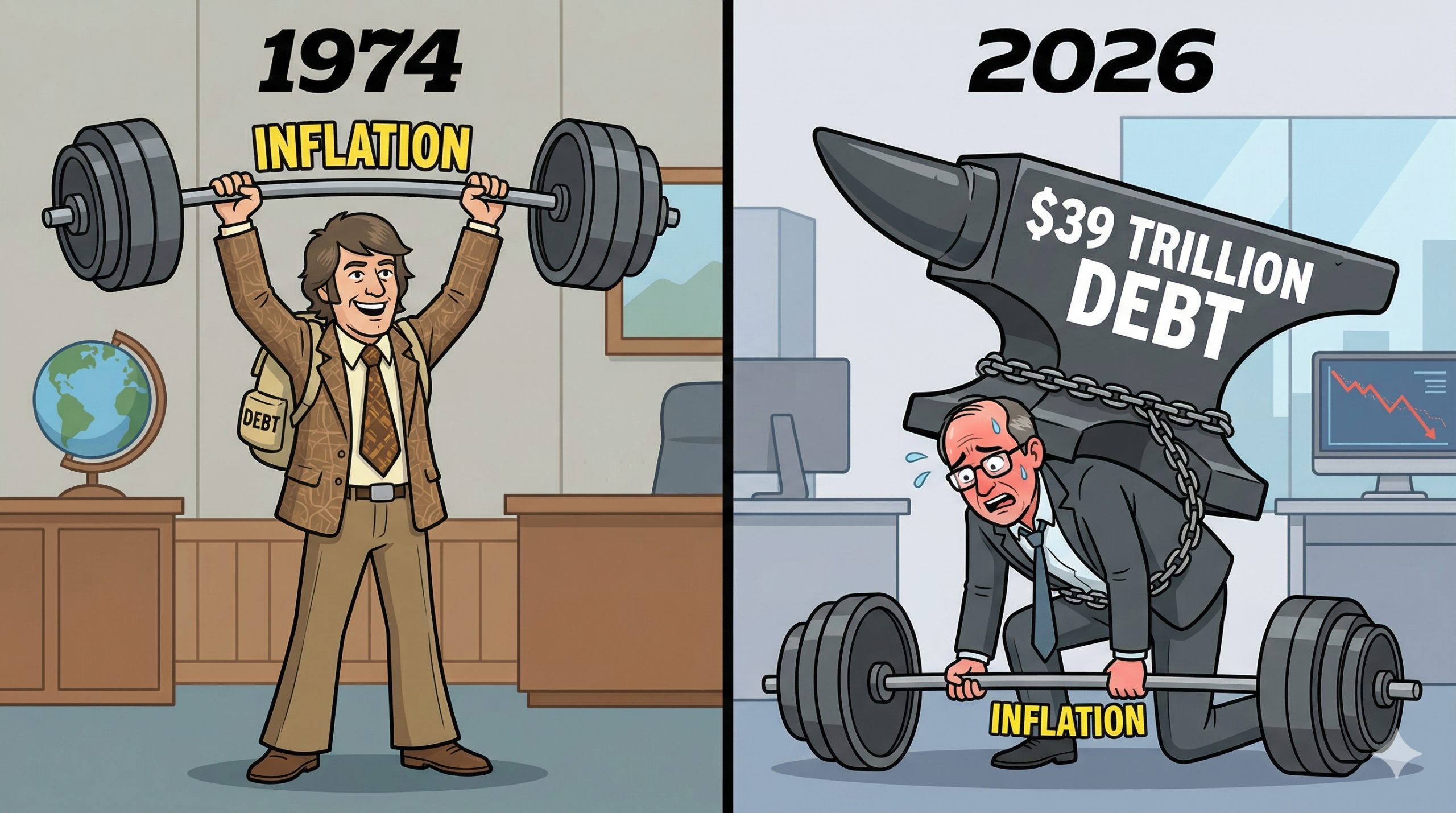
It’s a great story. But it is built on a massive macro illusion. Comparing the monetary landscape of 1974 to the mathematical reality of 2026 is worse than comparing apples to oranges—it’s like comparing a paper cut to a terminal diagnosis.

If you are selling your physical assets here, you are falling for a massive liquidity trap. Let’s look at the math.

The Death of the Volcker Playbook

To understand why 1974 played out the way it did, you have to look at the sovereign balance sheet.

Back then, the U.S. debt-to-GDP ratio was sitting around 33%. The fiscal house was relatively clean. Because the government wasn’t drowning in leverage, Paul Volcker had the superpower of policy flexibility. He could hike the fed funds rate above 17% to crush inflation. It was brutal medicine, but the system could absorb it. Real rates spiked, inflation died, and gold naturally corrected.

Source: Heyokha Research

Welcome to 2026. Debt-to-GDP is 122%. The federal debt is a staggering $39 trillion.

You cannot run the Volcker playbook on a $39 trillion mountain of debt. Today, even at current interest rates, nearly 92% of all tax revenue is being consumed just to pay back interest expense and mandatory outlays.

Read that again: 92%.

Source: Heyokha Research

There is almost nothing left over to run the country, let alone rebuild infrastructure or fund a global arms race. If the Federal Reserve actually hiked rates high enough to combat today’s structural inflation, they would instantly bankrupt the U.S. Treasury.

The policy flexibility of the 1970s is dead and buried. What cured inflation then would collapse the sovereign now.

The Only Exit: Financial Repression

So, if raising rates triggers a sovereign default, what does the government do?

They do the only thing the math allows: Financial Repression.

They have to artificially cap nominal interest rates below the actual rate of inflation. They fire up the printers, buy their own debt, and force captive audiences (like pension funds and banks) to hold low-yielding government paper.

Source: Heyokha Research

Make no mistake—this isn’t a policy failure. It is the exact design.

By letting inflation run hotter than those capped interest rates, the real value of that $39 trillion debt silently melts away. The government pays off its historical debts with heavily devalued dollars, and regular citizens and investors foot the bill through a relentless loss of purchasing power.

The History of Shake-Outs and Liquidity Squeeze

 When nominal rates are capped and inflation runs hot, real rates turn deeply negative. Returns for low-yielding bonds drops, weakening the dollar and making the case for finite gold even stronger.

Which brings us to the recent anomaly 15% drop.

That wasn’t a structural breakdown. It was a classic liquidity squeeze. We saw the exact same script play out during the 2008 Global Financial Crisis, gold plummeted nearly 30% in a matter of months. Twelve years later, during the COVID panic of March 2020, roughly had a 15% drawdown.

When equity and bond portfolios crash, highly leveraged investors are forced to liquidate their only remaining “winner”—gold—just to cover margin calls. It’s a desperate scramble for cash, not a shift in the fundamental thesis.

And what happens immediately after the forced liquidation ends? The surge.

In 2008, that drop was the springboard for a massive rally that took gold to all-time highs by 2011. In 2020, the March dump preceded a furious run-up later that same year. Every major gold bull market in history has shake-outs, which is normal and healthy.

Source: Heyokha Research

Back to the 1970s, the infamous 44% correction convinced the mainstream that the gold trade was dead. They were wrong. It was the precursor to a 721% surge.

Source: Heyokha Research

The March 2026 drop is playing out exactly according to the historical script. It is the springboard for the next massive leg up.

While retail investors panic-sell the dip, the smart money is doing the exact opposite. Global central banks are aggressively accelerating their physical gold accumulation and structurally abandoning the dollar. Because global mine production has essentially plateaued, fulfilling that massive institutional demand is mathematically impossible without a significant upward revaluation in price.

Source: Metals Focus, World Gold Council

Every major gold bull market in history has shake-outs, which is normal and healthy. That 1970s correction? It was the precursor to a 721% surge. The March 2026 drop is just the springboard for the next massive leg up.

As the fiat system breaks under the weight of its own debt, gold remains the only constant. A reversion to historical gold-to-monetary base ratios puts fair value north of $20,000 (Read more on how high gold can go up to in our Special Report – Gold the Return of Real Money)

In a world of weaponized fiat, hard assets are the ultimate financial sovereignty.


Tara Mulia

For more blogs like these, subscribe to our newsletter here!


Admin heyokha


Share


Let’s talk about the gold panic.

This past March, gold took a sharp around 15% dive in 4 weeks. Cue the mainstream commentators rushing to their history books, frantically pointing to the mid-1970s. They want you to look at the correction between December 1974 and August 1976, when gold plummeted 44% amid oil shocks and rate hikes.

The narrative they are peddling? An oil shock is happening right now too. The bull run is over. Pack it up.

It’s a great story. But it is built on a massive macro illusion. Comparing the monetary landscape of 1974 to the mathematical reality of 2026 is worse than comparing apples to oranges—it’s like comparing a paper cut to a terminal diagnosis.

If you are selling your physical assets here, you are falling for a massive liquidity trap. Let’s look at the math.

The Death of the Volcker Playbook

To understand why 1974 played out the way it did, you have to look at the sovereign balance sheet.

Back then, the U.S. debt-to-GDP ratio was sitting around 33%. The fiscal house was relatively clean. Because the government wasn’t drowning in leverage, Paul Volcker had the superpower of policy flexibility. He could hike the fed funds rate above 17% to crush inflation. It was brutal medicine, but the system could absorb it. Real rates spiked, inflation died, and gold naturally corrected.

Source: Heyokha Research

Welcome to 2026. Debt-to-GDP is 122%. The federal debt is a staggering $39 trillion.

You cannot run the Volcker playbook on a $39 trillion mountain of debt. Today, even at current interest rates, nearly 92% of all tax revenue is being consumed just to pay back interest expense and mandatory outlays.

Read that again: 92%.

Source: Heyokha Research

There is almost nothing left over to run the country, let alone rebuild infrastructure or fund a global arms race. If the Federal Reserve actually hiked rates high enough to combat today’s structural inflation, they would instantly bankrupt the U.S. Treasury.

The policy flexibility of the 1970s is dead and buried. What cured inflation then would collapse the sovereign now.

The Only Exit: Financial Repression

So, if raising rates triggers a sovereign default, what does the government do?

They do the only thing the math allows: Financial Repression.

They have to artificially cap nominal interest rates below the actual rate of inflation. They fire up the printers, buy their own debt, and force captive audiences (like pension funds and banks) to hold low-yielding government paper.

Source: Heyokha Research

Make no mistake—this isn’t a policy failure. It is the exact design.

By letting inflation run hotter than those capped interest rates, the real value of that $39 trillion debt silently melts away. The government pays off its historical debts with heavily devalued dollars, and regular citizens and investors foot the bill through a relentless loss of purchasing power.

The History of Shake-Outs and Liquidity Squeeze

 When nominal rates are capped and inflation runs hot, real rates turn deeply negative. Returns for low-yielding bonds drops, weakening the dollar and making the case for finite gold even stronger.

Which brings us to the recent anomaly 15% drop.

That wasn’t a structural breakdown. It was a classic liquidity squeeze. We saw the exact same script play out during the 2008 Global Financial Crisis, gold plummeted nearly 30% in a matter of months. Twelve years later, during the COVID panic of March 2020, roughly had a 15% drawdown.

When equity and bond portfolios crash, highly leveraged investors are forced to liquidate their only remaining “winner”—gold—just to cover margin calls. It’s a desperate scramble for cash, not a shift in the fundamental thesis.

And what happens immediately after the forced liquidation ends? The surge.

In 2008, that drop was the springboard for a massive rally that took gold to all-time highs by 2011. In 2020, the March dump preceded a furious run-up later that same year. Every major gold bull market in history has shake-outs, which is normal and healthy.

Source: Heyokha Research

Back to the 1970s, the infamous 44% correction convinced the mainstream that the gold trade was dead. They were wrong. It was the precursor to a 721% surge.

Source: Heyokha Research

The March 2026 drop is playing out exactly according to the historical script. It is the springboard for the next massive leg up.

While retail investors panic-sell the dip, the smart money is doing the exact opposite. Global central banks are aggressively accelerating their physical gold accumulation and structurally abandoning the dollar. Because global mine production has essentially plateaued, fulfilling that massive institutional demand is mathematically impossible without a significant upward revaluation in price.

Source: Metals Focus, World Gold Council

Every major gold bull market in history has shake-outs, which is normal and healthy. That 1970s correction? It was the precursor to a 721% surge. The March 2026 drop is just the springboard for the next massive leg up.

As the fiat system breaks under the weight of its own debt, gold remains the only constant. A reversion to historical gold-to-monetary base ratios puts fair value north of $20,000 (Read more on how high gold can go up to in our Special Report – Gold the Return of Real Money)

In a world of weaponized fiat, hard assets are the ultimate financial sovereignty.


Tara Mulia

For more blogs like these, subscribe to our newsletter here!


Admin heyokha


Share


Stay Connected with Heyokha

Sign up to receive insights, updates, and perspectives directly from Heyokha

Stay Connected with Heyokha

Sign up to receive insights, updates, and perspectives directly from Heyokha

Heyokha Footer Logo

We drive our mission with an exceptional culture through applying a growth mindset where holistic and on the ground research is at our core.

Help
×

Terms & Conditions

You must read the following information before proceeding. By accessing this website and any pages thereof, you acknowledge that you have read the following information and accept the terms and conditions set out below and agree to be bound by such terms and conditions. If you do not agree to such terms and conditions, please do not access this website or any pages thereof.

The website has been prepared by Heyokha Brothers Limited and is solely intended for informational purposes and should not be construed as an inducement to purchase or sell any security, product, service, or investment. The Site does not solicit an offer to buy or sell any financial instrument or enter into any agreement. It is important to note that the opinions expressed on the Site are not considered investment advice, and it is recommended that individuals seek independent advice as needed to address their specific objectives, financial situation, or needs. It is the responsibility of the persons who access this website to observe all applicable laws and regulations.

The Site offers general information exclusively and does not consider the individual circumstances of any person. The data, opinions, and estimates presented on the Site are current as of the publication date and are subject to changes without notice. Additionally, it is possible that such information may become obsolete with time.

Intended Users

The content presented on this website is exclusively intended for authorized intermediaries and qualified investors within Hong Kong, such as institutional investors, professional investors, and accredited investors (as defined under the SFO). It is not intended for retail investors or individuals located outside of Hong Kong.

The products and services mentioned on this website may or may not be authorized or registered for distribution in a particular jurisdiction and may not be suitable for all investor types. It is important to note that this website is not intended to constitute an offer or solicitation, nor is it directed toward individuals if the provider of the information is prohibited by any law of any jurisdiction from making the information available. Moreover, the website is not intended for any use that would violate local laws or regulations. The provider of the information is not permitted to promote any products or services mentioned on this website in jurisdictions where such promotion would be prohibited.

If you are not a qualified investor or licensed intermediary in Hong Kong, you should not proceed any further.

No Investment Advice

The information provided on this Website is for informational purposes only and should not be considered as investment advice or a recommendation to buy, sell, hold, or transact in any investment. It is strongly recommended that individuals seek professional investment advice before making any investment decisions.

The information presented on this Website does not consider the investment objectives, specific needs, or financial situations of any investor. It is important to note that nothing on this Website is intended to constitute financial, legal, accounting, or tax advice.

Before making any investment decision, individuals should carefully consider whether an investment aligns with their investment objectives, specific needs, and financial situation. This should also include informing oneself of any potential tax implications, legal requirements, foreign exchange restrictions, or exchange control requirements that may be relevant to an investment based on the laws of one’s citizenship, residence, or domicile. If there is any doubt regarding the information on this Website, it is recommended that individuals seek independent professional financial advice.

It is important to note that any opinion, comment, article, financial analysis, market forecast, market commentary, or other information published on the Website is not binding on Heyokha or its affiliates, and they are not responsible for the information, opinions, or ideas presented.

Obligations and Resposibilities of Users

Users are solely responsible for protecting and backing up their data and equipment, as well as taking reasonable precautions against any computer virus or other destructive elements. Additionally, users must ensure that their access to the Site is adequately secured against unauthorized access.

Users are prohibited from using the Site for any unlawful, defamatory, offensive, abusive, indecent, menacing, or threatening purposes, or in any way that infringes upon intellectual property rights or confidentiality obligations. Furthermore, users may not use the Site to cause annoyance, inconvenience, or anxiety to others, or in any way that violates any applicable laws or regulations.

Users must comply with any terms notified to them by third-party suppliers of data or services to the Site. This may include entering into a direct agreement with such third parties in respect of their use of the dat

Third-Party Content

This website may contain Third Party Content or links to websites maintained by third parties that are not affiliated with Heyokha. Heyokha does not participate in the preparation, adoption, or editing of such third-party materials and does not endorse or approve such content, either explicitly or implicitly. Any opinions or recommendations expressed on third party materials are solely those of the independent providers and not of Heyokha. Heyokha is not responsible for any errors or omissions relating to specific information provided by any third party.

Although Heyokha aims to provide accurate and timely information to users, neither Heyokha nor the Third-Party Content providers guarantee on the accuracy, timeliness, completeness, usefulness, or any other aspect of the information presented. Heyokha is not responsible or liable for any content, including advertising, products, or other materials on or available from third party sites. Users access and use Third Party content is at their own risk, and it is provided for informational purposes only. Both Heyokha and the Third-Party shall not be liable for any loss or damage arising from users’ reliance upon such information.

Intellectual Property Rights

The content of this website is subject to copyright and other intellectual property laws. All trademarks, service marks, logos, and brand features displayed on the website are owned by their respective owners, except as explicitly noted. Users may use the information on this website and reproduce it for personal reference only. However, reproduction, distribution, transmission, incorporation in any other database, document, or material, and sale or distribution of any part of the contents of the website is strictly prohibited. Users may download or print individual sections of the website for personal use and information only, provided they are legally entitled to access the material and retain all copyright and other proprietary notices.

Any unauthorized use of the content, trademarks, service marks, or logos displayed on the website may violate copyright, trademark, or other intellectual property laws, as well as laws of privacy and publicity and communications. Any reference or link to any specific commercial product, process, or service by trade name, trademark, manufacturer, or otherwise, does not necessarily constitute or imply its endorsement, recommendation, or favouring by our company.

We provide such references or links solely for the convenience of our users and to provide additional information. Our company is not responsible for the accuracy, legality, or content of any external website or resource linked to or referenced from our website. Users are solely responsible for complying with the terms and conditions of any external websites or resources.

Cookies

In order to enhance user experience and simplify future visits, this website may utilize cookies to track your activity. However, if you do not want to store cookies on your device, you can disable them by adjusting your browser’s security settings.

Data Privacy

Please read our Privacy Statement before providing Heyokha with any personal information on this website. By providing any personal information on this website, you will be deemed to have read and accepted our Privacy Statement.

Use of Website

The information contained on the website is accurate only as of the date of publication and does not constitute investment advice or recommendations. While certain tools available on the website may provide general investment or financial analyses based upon personalized input, such results are for information purposes only, and users should refer to the assumptions and limitations relevant to the use of such tools as set out on the website. Users are solely responsible for determining whether any investment, security or strategy, or any other product or service is appropriate or suitable for them based on their investment objectives and personal and financial situation. Users should consult their independent professional advisers if they have any questions. Any person considering an investment should seek independent advice on the suitability or otherwise of the particular investment.

Disclaimer of Liability Heyokha makes no warranty as to the accuracy, completeness, security, and confidentiality of information available through the website. Heyokha, its affiliates, directors, officers, or employees accept no liability for any errors or omissions relating to information available through the website or for any damages, losses or expenses arising in connection with the website, whether direct or indirect, arising from the use of the website or its contents. Heyokha also reserves the right to modify, suspend, or discontinue the website at any time without notice. Heyokha shall not be liable for any such modification, suspension, or discontinuance.

×

Data Privacy Terms and Conditions

Personal Information Collection Statement:

Pursuant to the Personal Data (Privacy) Ordinance (the ‘Ordinance’), Heyokha Brothers Limited is fully committed to safeguarding the privacy and security of personal information in compliance with all relevant laws and regulations. This statement outlines how we collect, use, and protect personal information provided to us.

Collection of Personal Information:

We collect and maintain personal information, in a manner consistent with all relevant laws and regulations. We take necessary measures to ensure that personal information is correct and up to date. Personal information will only be used for the purpose of utilization and will not be disclosed to third parties (except our related parties e.g.: Administrators) without consent from the individual, except for justifiable grounds as required by laws and regulations.

We may collect various types of personal data from or about you, including:

  • Your name
  • Your user names and passwords
  • Contact information, including address, email address and/or telephone number
  • Information relating to your engagement with material that we publish or otherwise provide to you
  • Records of our interactions with you, including any messages you send us, your comments and questions and any other information you choose to provide.

The Company may automatically collect information about you from computer or internet browser through the use of cookies, pixel tags, and other similar technologies to enhance the user experience on its websites. Third parties may be used to collect personal data and information indirectly through monitoring activities conducted by the Company or on its behalf.

Company does not knowingly collect personal data from anyone under the age of 18 and does not seek to collect or process sensitive information unless required or permitted by law and with express consent.

Uses of your Personal Data:

We may use your personal data for the purposes it was provided and in connection with our services as described below:

  • Provide products/services or info as requested or expected.
  • Fulfill agreements and facilitate business dealings.
  • Manage relationships, analyse websites and communications, and merge personal data for relevance.
  • Support and improve existing products/services, and plan/develop new ones.
  • Count/recognize website visitors and analyse usage.
  • To comply with and assess compliance with applicable laws, rules and regulations and internal policies and procedures.
  • Use information for any other purpose with consent.

Protection of Personal Information:

We provide thorough training to our officers and employees to prevent the leakage or inappropriate use of personal information and provide information on a need-to-know basis. Managers in charge for controls and inspections are appointed, and appropriate control systems are established to ensure the privacy and security of personal information.

In the event that personal information is provided to an external contractor (e.g.: Administrator), we take responsibility for ensuring that the external contractor has proper systems in place to protect the privacy of personal information.

Third parties disclosure of Personal Information:

Personal information held by us relating to an individual will be kept confidential but may be provided to third parties the following purpose:

  • Comply with applicable laws or legal processes.
  • Investigate and prevent illegal activity, fraud, or violations of terms and conditions.
  • Protect and defend legal rights or defend against legal claims.
  • Facilitate business or asset transactions, such as financing, mergers, acquisitions, or bankruptcy.
  • With our related parties (e.g.: administrators) that are subject to appropriate data protection obligations
  • Representatives, agents or custodians appointed by the client (e.g.: Auditors, accountant)

Retention of Personal Information:

Disclosure, correction and termination of usage shall be carried out upon request of an individual in accordance with relevant laws and regulations.

Personal information collected will be retained for no longer than is necessary for the fulfilment of the purposes for which it was collected as per applicable laws and regulations.

Rights of the Individual:

Under relevant laws and regulations, any individual has the right to request access to any of the personal data that we hold by submitting a written request. Individuals are also entitled to request to correct, cancel or delete any of the personal data we hold if they believe such information is inaccurate, out of date or we no longer have a legitimate interest or lawful justification to retain or process.

×

Disclaimer

Heyokha Brothers Limited is the issuer of this website and holds Type 4 (advising on securities) and Type 9 (asset management) licenses issued by the Securities and Futures Commission in Hong Kong.

The information provided on this website has been prepared solely for licensed intermediaries and qualified investors in Hong Kong, including professional investors, institutional investors, and accredited investors (as defined under the Securities and Futures Ordinance). The information provided on this website is for informational purposes only and should not be construed as investment advice, nor an offer to sell or a solicitation of an offer to buy any security, investment product, or service.

Investment involves risk and investors may lose their entire investment. Investors are advised to seek professional advice before making any investment decisions. Past performance is not indicative of future performance and the value of investments may fluctuate. Please refer to the offering document(s) for
details, including the investment objectives, risk factors, and fees and charges.

Heyokha Brothers Limited reserves the right to amend, update, or remove any information on this website at any time without notice. By accessing and using this website, you agree to be bound by the above terms and conditions.

Heyokha Footer Logo

We drive our mission with an exceptional culture through applying a growth mindset where holistic and on the ground research is at our core.

Publications
Help
×

Thank you for subscribing!

You will now gain access to our latest insights, updates, and carefully selected stories, designed to keep you informed and ahead of the curve.