
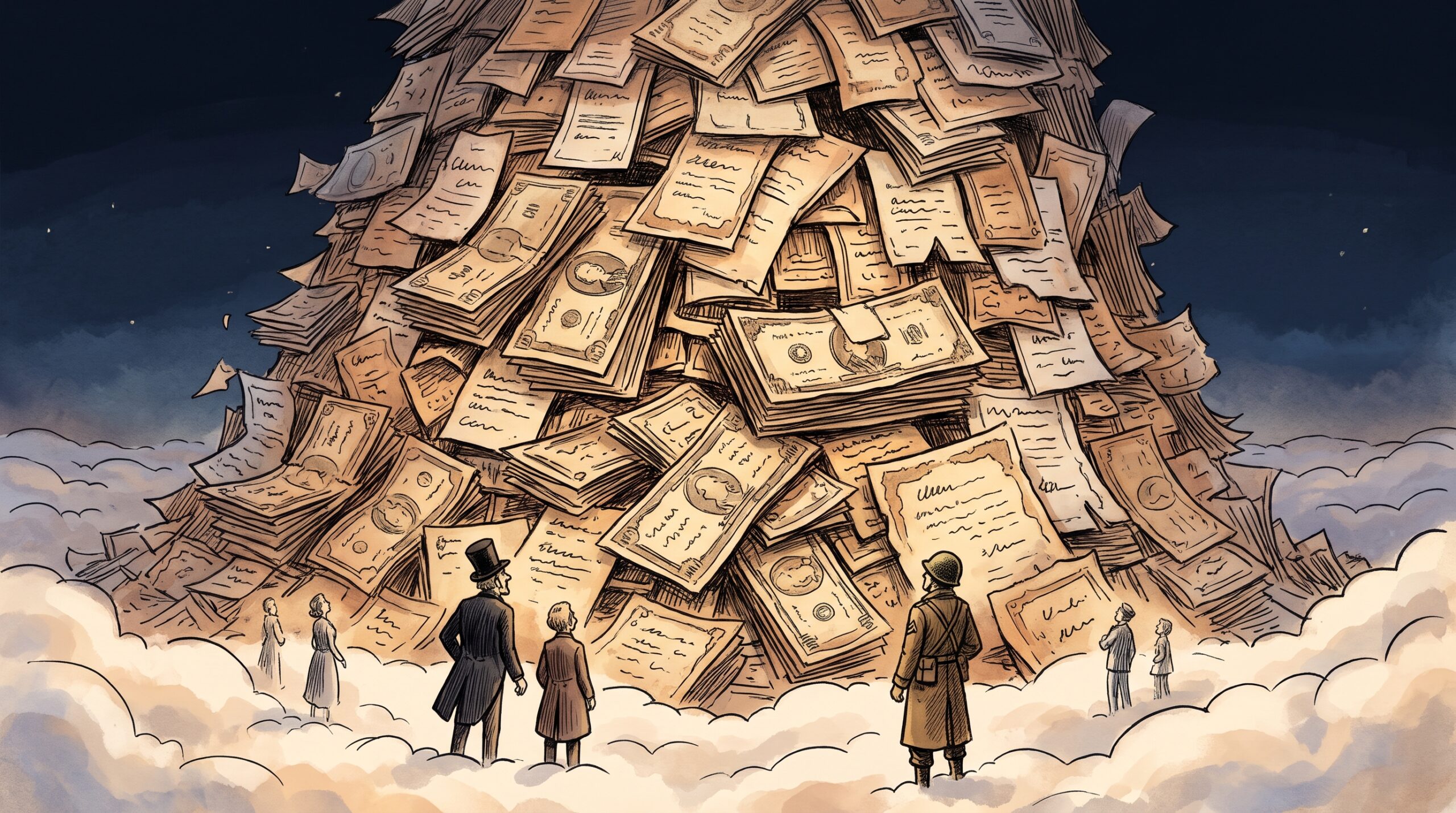
On a recent flight from Jakarta to Hong Kong, one of our colleagues picked a film more or less at random: Contagion, Steven Soderbergh’s 2011 thriller about a virus that jumps from a bat to a pig to a person. Watched in 2026, it plays like a home video of 2020. What stays with you isn’t the virus but the panic: the queues, the stripped shelves, the people who have never seen anything like it and have no playbook.

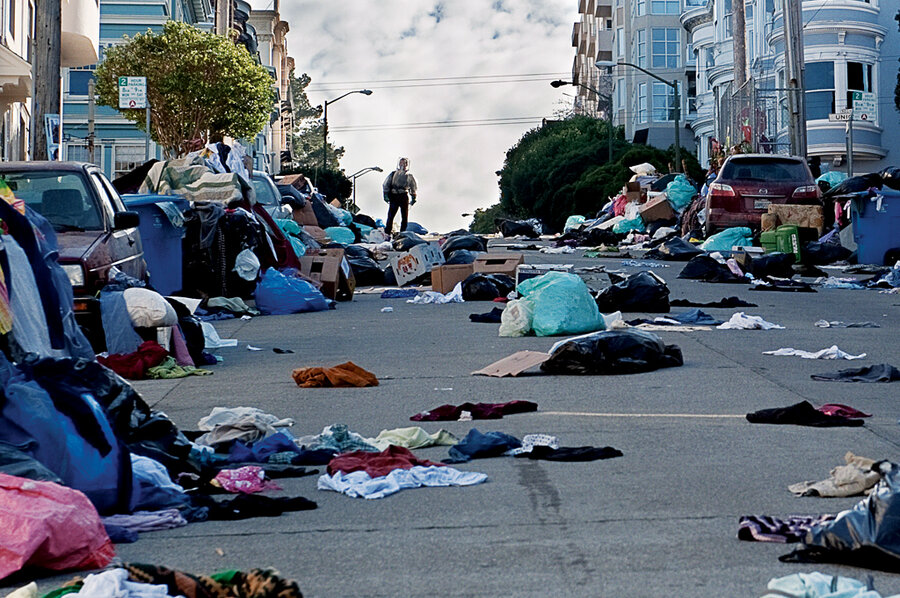
Source: Warner Brothers
It took her straight back to that spring, when the whole world seemed to reach for the same word. Google searches for “unprecedented” hit a record in April 2020, nearly six times their 2019 average. Even Oxford gave up on a single word of the year and called its 2020 report Words of an Unprecedented Year.
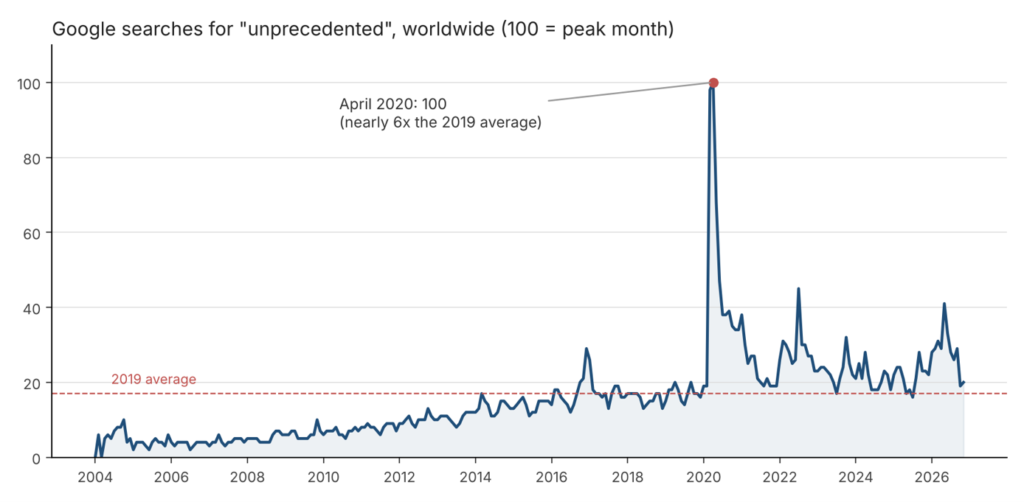
Source: Google Trends, monthly worldwide web-search interest in “unprecedented”, January 2004 to November 2026 (November partial), downloaded 5 November 2026. 100 = the peak month; the index is relative, not a count of searches.
And the word never quite went away. Every year since has averaged above 2019, and this year searches are running at about 1.7 times that level.
By the time the plane landed, though, the thing on our colleague’s mind wasn’t a virus. It was debt, which has been hard to avoid in the headlines this year. In August the U.S. national debt passed $40 trillion, a figure the Associated Press called “unprecedented”. In April the IMF warned that global government debt is on track to reach 100% of GDP by 2029, “a level previously reached only in the aftermath of World War II”. And in late October, new projections from the Congressional Budget Office had America paying around $20 trillion in interest over the next decade.
Which left her with a question for the rest of the trip. Will we look back on this year and call this debt unprecedented? Or is “unprecedented” simply what we say when we’ve forgotten the precedents?
A word that tells you how it feels
It’s an odd word to lean on so hard. Strictly, “unprecedented” is a claim about history: this has never happened before. In practice we use it to describe a feeling: we have never seen this before. Those are two very different statements, and the gap between them is where a lot of bad forecasts live.
Economists Carmen Reinhart and Kenneth Rogoff spent years mapping that gap. Their 2009 history of financial crises, spanning eight centuries of defaults, bank runs and inflations, carries a title that reads like a warning label: This Time Is Different. Their point, roughly, is that the phrase tends to be said loudest just before it turns out not to be true.
So let’s do the thing the word skips. Let’s check.
On paper, we’ve been here before
Start with America. U.S. federal debt held by the public was about 97% of GDP in the second quarter of this year. In 1946, at the end of the Second World War, it was 106%. By that yardstick America is close to its own record, but not past it.
Britain makes today’s numbers look almost modest. According to the UK’s Office for Budget Responsibility, British government debt was close to 180% of GDP at Waterloo in 1815, and hit 249% at the end of the Second World War, an all-time high. Today Britain’s public sector net debt stands at about 94% of GDP, a level the Office for National Statistics says was last seen in the early 1960s. Japan, meanwhile, carries gross government debt of about 200% of GDP this year, roughly double the G7 average, according to IMF estimates.
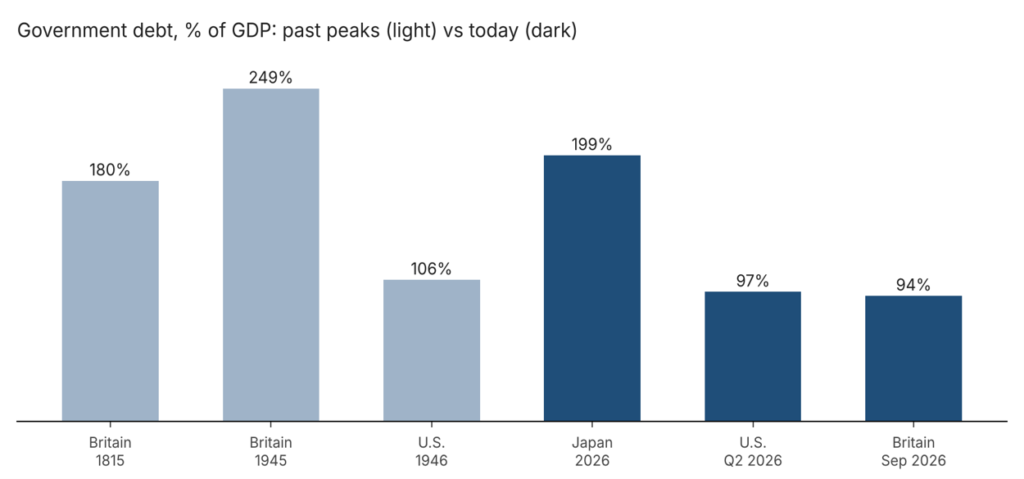
Sources: UK Office for Budget Responsibility (Britain, 1815 and 1945); Office for National Statistics, public sector net debt, end-September 2026 (Britain today); U.S. Office of Management and Budget via FRED, series FYPUGDA188S (U.S. 1946) and FYGFGDQ188S (U.S., second quarter of 2026), debt held by the public; IMF World Economic Outlook, October 2026 (Japan, 2026 estimate of gross general government debt). Definitions differ across countries; figures are approximate.
High debt hasn’t always meant disaster, either. A St. Louis Fed analysis points out that Britain’s debt stayed above 120% of GDP from the 1780s until the 1850s, decades that overlap with its Industrial Revolution, and concludes that “it cannot be asserted” that the debt held back growth. At both of its great peaks, the British government “did not need to offer abnormally large yields to attract lenders”.
On the level alone, then, the honest answer is no. Not unprecedented. Which raises a better question: if this has happened before, how did it end, and who paid?
Who paid last time
Often, nobody you could point to. After 1815, Britain didn’t so much repay its debt as outgrow it. With no major wars and a booming economy, debt fell to 29% of GDP by 1913, the OBR notes. It took almost a century, but a bigger economy simply made the old debt look smaller.
Post-war America shrank its debt much faster, from 106% of GDP in 1946 to about 22% by 1974. Growth did a lot of the work, but not all of it. Between 1945 and 1980, real interest rates in advanced economies were negative “roughly half of the time”, according to Reinhart and M. Belen Sbrancia. Savers who held government bonds earned less than inflation, year after year, and the difference whittled the debt down by 3% to 4% of GDP a year in the U.S. and Britain, they estimate.
Economists call this financial repression. It needs no vote and makes no headlines, which is either its genius or its problem, depending on whether you are the government or the saver.
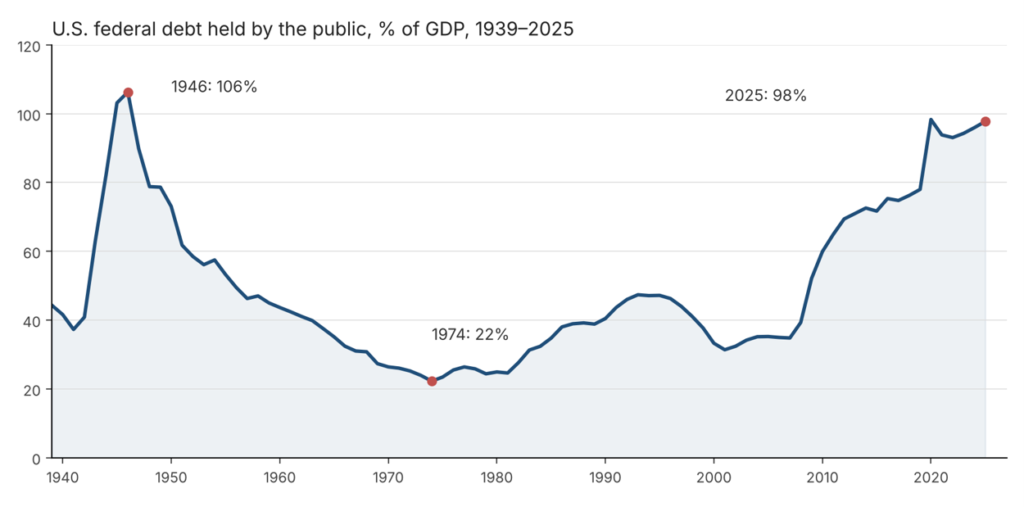
Source: U.S. Office of Management and Budget, via Federal Reserve Bank of St. Louis (FRED series FYPUGDA188S), retrieved 5 November 2026.
Others paid in plain sight. Greece cut spending and raised taxes under its bailout programmes in the 2010s, and by 2013 its economy had shrunk for 20 quarters in a row. Then there is default, which Reinhart and Rogoff’s book is crowded with, and which every government insists it will never need. History has a habit of filing “never” under “not yet”.
So what’s actually new?
This is where the word starts to earn its keep. Almost every great debt peak in the history books was a war debt. Wars end. The spending stops, the soldiers come home and go to work, and the economy grows into the bill.
Today’s debt wasn’t built by a war, so there is no peace deal coming to switch the spending off. Read the IMF’s line again: 100% of GDP is a level “previously reached only in the aftermath of World War II”. This time there is no aftermath to grow out of. Much of the borrowing goes to pensions and healthcare for ageing populations, commitments that tend to grow rather than end, and more and more of it goes to interest on the borrowing itself.
In the fiscal year that ended in September, the U.S. government spent $1.14 trillion on net interest, more than the $916 billion the Defense Department spent on the military, while running a deficit of about $2 trillion, according to the Congressional Budget Office.
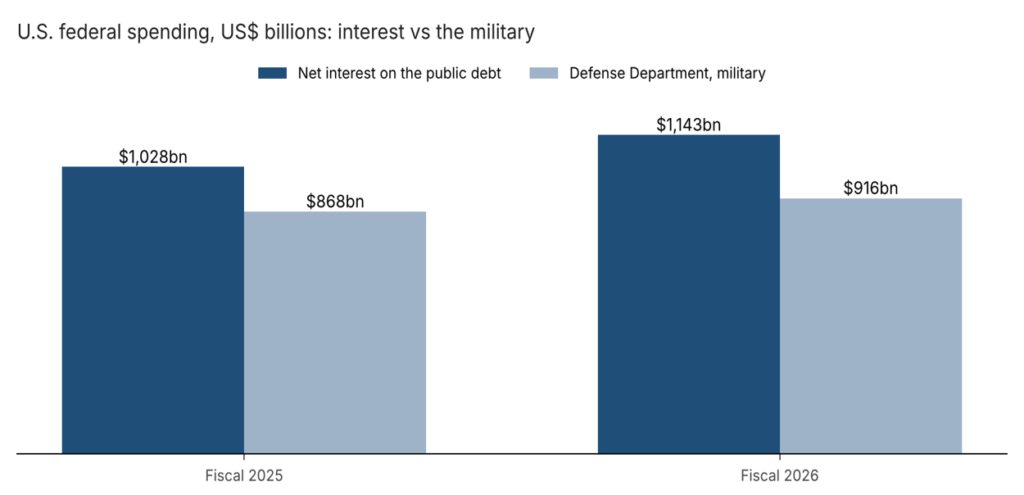
Source: Congressional Budget Office, Monthly Budget Review: September 2026 (8 October 2026), Table 3.
Fiscal years end 30 September.
France is where these strands have knotted together. Students began protesting in mid-September at a high school in Créteil, outside Paris, over teacher shortages, overcrowded classrooms and dilapidated buildings, just as the government was preparing a 2027 budget built on spending restraint and tax measures, including a public-sector pay freeze and limits on pension increases.

Source: Financial Times
After nationwide demonstrations on 17 October, with shops looted in Paris, Marseille, Lyon and Bordeaux, police arrested at least 1,800 people across the country. Four days later, France’s 10-year borrowing cost crossed 5%, its highest since 2002. Finance minister Roland Lescure had already summed up the budget in September: “Nous n’avons plus de gras.” We have no fat left.
The bond market had been saying something similar for a while. For most of the past decade France borrowed far more cheaply than Italy or Greece. On monthly averages, it has paid more than Greece every month since June, and by the summer it had edged above Italy too.
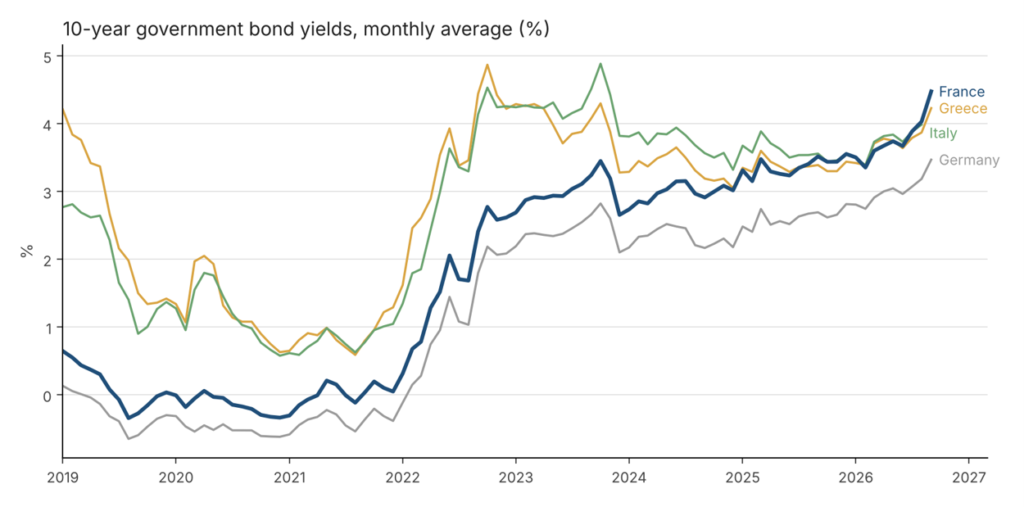
Source: OECD long-term interest rates, via Federal Reserve Bank of St. Louis (FRED series IRLTLT01FRM156N, IRLTLT01ITM156N, IRLTLT01GRM156N, IRLTLT01DEM156N), retrieved 5 November 2026. Latest data: September 2026 (Italy: August 2026).
It is tempting to draw a straight line from there to the second half of Contagion: a squeeze, a promise that can’t be kept, a street on fire. It is tempting, too, to call it a generational bargain in which the old vote, the young pay and the bill has finally arrived. Is that fair? Partly, perhaps. But money flows both ways between generations, through parents’ help with housing, education and inheritance, and pensioners can fairly say they paid in for decades on the terms they were offered. The generational ledger is murkier than the slogan.
The case for keeping calm
The most influential argument against alarm came from Olivier Blanchard, a former chief economist of the IMF, in his 2019 presidential lecture to the American Economic Association. When the interest rate a government pays stays below the economy’s growth rate, debt can shrink relative to GDP more or less by itself, and Blanchard argued that this situation “is more the historical norm than the exception”. His bluntest line: “public debt may have no fiscal cost.”
Japan is the living example the calm camp points to. Its debt is the highest in the advanced world, yet last year the effective interest rate on it was “only 0.7 percent” while the economy expanded by 4.5%, the IMF economists note. Long maturities, debt held mostly at home in its own currency, and sizeable public assets on the other side of the ledger all help explain why the crisis keeps not arriving.
Then there is the optimists’ wildcard: technology. If AI makes workers markedly more productive, it would grow the economy, the bottom half of the debt-to-GDP ratio, rather than shrink the debt itself. Researchers at Yale’s Budget Lab modelled scenarios this year in which exactly that trims America’s debt, while stressing that they are illustrations, not forecasts, and that generous support for the workers AI displaces could cancel out the gain. The early data are intriguing: U.S. labour productivity grew at a 3.6% annualised pace in the third quarter, though nobody can yet say how much of that is down to AI.
Could AI be the Hail Mary? Markets have just grown less sure. After the Democrats won control of both houses of Congress in this month’s U.S. midterms, AI-linked shares slid sharply on fears of tougher rules on data centres, the very infrastructure the bet rests on. Others point out that a divided Washington tends to pass fewer sweeping laws, not more. Is this a real speed bump for AI, or a market getting ahead of itself?
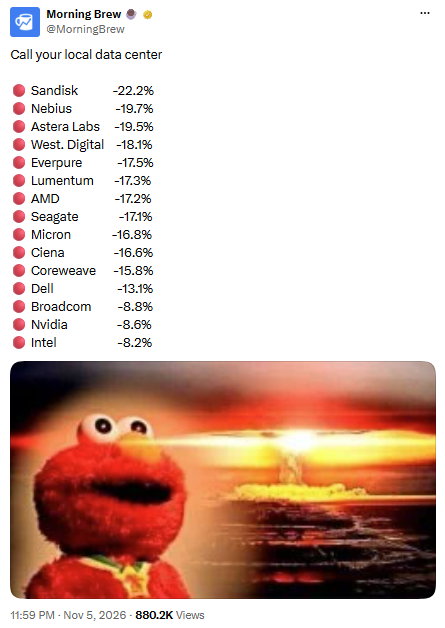
Source: Morning Brew
The case for worry
Every one of those arguments comes with fine print, often written by the same people. Blanchard was careful to say he was not arguing for more public debt, and he flagged the risk that investors can suddenly start demanding a premium on debt they view as risky, a shift that can become self-fulfilling. That is not a bad description of what France’s bond market did this autumn.
The IMF’s Japan economists end on a warning of their own: “Japan’s debt remains exceptionally high, and long-term pressures from aging and higher interest rates are real.” Interest payments there are “poised to roughly double from 2025 to 2031”.
And the cushion of cheap money has been thinning. U.S. interest spending rose 11% in the latest fiscal year, which the CBO put down to a larger debt and higher long-term interest rates. The IMF’s own stress test suggests global debt could reach about 117% of GDP within three years in a bad scenario. If the interest rate starts to outrun growth, Blanchard’s comforting arithmetic runs in reverse. Will it? The honest answer is that nobody can say how long the gap stays open.
Not the number, the situation
Our read is this: the number isn’t unprecedented. The situation might be.
The level has been seen before, by Britain twice and by America once. What hasn’t been seen is this level reached in peacetime, across most of the rich world at once, with populations ageing and no war ending to give the economy room. In the past, the bill always landed somewhere: on taxpayers through austerity, on savers through inflation, on lenders through default, or, in the lucky cases, on nobody at all, because growth made it shrink.
So perhaps the useful question isn’t “is this unprecedented?” but “who pays this time?” The student in Créteil? The retiree in Lyon? The saver whose bank deposit earns less than inflation? Nobody has announced the answer, and perhaps nobody will, which is precisely what makes the quiet option so tempting.
What would change our minds? A rich democracy reforming its pension and healthcare promises without the street catching fire. Growth that outruns interest rates for years, not quarters. Or AI turning out to be the productivity miracle its boosters promise. Any of those would turn “unprecedented” into a word for good news, and that really would be a first.
Contagion ends with a flashback. After two hours of chaos, the last scene jumps back to “Day 1” to show how it all began: a bulldozer, a bat, a pig, a handshake. Nobody noticed at the time, because nothing about it looked unprecedented. Which of today’s small, ordinary decisions will turn out to be our Day 1?
Tara Mulia
For more blogs like these, subscribe to our newsletter here!
Important information
This article is published by Heyokha Brothers Limited (“Heyokha”), a corporation licensed by the Securities and Futures Commission of Hong Kong (CE No. BOS569). It is provided for general information and discussion purposes only. It reflects the authors’ views and observations at the date of publication, and these may change without notice.
Nothing in this article is investment, legal, tax or other professional advice, investment research, or a recommendation, offer or solicitation to buy or sell any security, fund or other investment product. It is not directed at any person in any jurisdiction where its publication or availability would be unlawful. Any companies, securities or assets mentioned are for illustration only and are not a recommendation.
Information from third-party sources is believed to be reliable, but it has not been independently verified. No representation or warranty is given as to its accuracy or completeness. Forward-looking statements are inherently uncertain, and actual outcomes may differ materially. Investment involves risk, the value of investments can go down as well as up, and past performance is not indicative of future results. Heyokha, its directors and employees, and funds it manages may hold positions in assets mentioned.
Readers should seek independent professional advice before making any investment decision. This article has not been reviewed by the Securities and Futures Commission.
Admin heyokha

Share


On a recent flight from Jakarta to Hong Kong, one of our colleagues picked a film more or less at random: Contagion, Steven Soderbergh’s 2011 thriller about a virus that jumps from a bat to a pig to a person. Watched in 2026, it plays like a home video of 2020. What stays with you isn’t the virus but the panic: the queues, the stripped shelves, the people who have never seen anything like it and have no playbook.
Source: Warner Brothers
It took her straight back to that spring, when the whole world seemed to reach for the same word. Google searches for “unprecedented” hit a record in April 2020, nearly six times their 2019 average. Even Oxford gave up on a single word of the year and called its 2020 report Words of an Unprecedented Year.
Source: Google Trends, monthly worldwide web-search interest in “unprecedented”, January 2004 to November 2026 (November partial), downloaded 5 November 2026. 100 = the peak month; the index is relative, not a count of searches.
And the word never quite went away. Every year since has averaged above 2019, and this year searches are running at about 1.7 times that level.
By the time the plane landed, though, the thing on our colleague’s mind wasn’t a virus. It was debt, which has been hard to avoid in the headlines this year. In August the U.S. national debt passed $40 trillion, a figure the Associated Press called “unprecedented”. In April the IMF warned that global government debt is on track to reach 100% of GDP by 2029, “a level previously reached only in the aftermath of World War II”. And in late October, new projections from the Congressional Budget Office had America paying around $20 trillion in interest over the next decade.
Which left her with a question for the rest of the trip. Will we look back on this year and call this debt unprecedented? Or is “unprecedented” simply what we say when we’ve forgotten the precedents?
A word that tells you how it feels
It’s an odd word to lean on so hard. Strictly, “unprecedented” is a claim about history: this has never happened before. In practice we use it to describe a feeling: we have never seen this before. Those are two very different statements, and the gap between them is where a lot of bad forecasts live.
Economists Carmen Reinhart and Kenneth Rogoff spent years mapping that gap. Their 2009 history of financial crises, spanning eight centuries of defaults, bank runs and inflations, carries a title that reads like a warning label: This Time Is Different. Their point, roughly, is that the phrase tends to be said loudest just before it turns out not to be true.
So let’s do the thing the word skips. Let’s check.
On paper, we’ve been here before
Start with America. U.S. federal debt held by the public was about 97% of GDP in the second quarter of this year. In 1946, at the end of the Second World War, it was 106%. By that yardstick America is close to its own record, but not past it.
Britain makes today’s numbers look almost modest. According to the UK’s Office for Budget Responsibility, British government debt was close to 180% of GDP at Waterloo in 1815, and hit 249% at the end of the Second World War, an all-time high. Today Britain’s public sector net debt stands at about 94% of GDP, a level the Office for National Statistics says was last seen in the early 1960s. Japan, meanwhile, carries gross government debt of about 200% of GDP this year, roughly double the G7 average, according to IMF estimates.
Sources: UK Office for Budget Responsibility (Britain, 1815 and 1945); Office for National Statistics, public sector net debt, end-September 2026 (Britain today); U.S. Office of Management and Budget via FRED, series FYPUGDA188S (U.S. 1946) and FYGFGDQ188S (U.S., second quarter of 2026), debt held by the public; IMF World Economic Outlook, October 2026 (Japan, 2026 estimate of gross general government debt). Definitions differ across countries; figures are approximate.
High debt hasn’t always meant disaster, either. A St. Louis Fed analysis points out that Britain’s debt stayed above 120% of GDP from the 1780s until the 1850s, decades that overlap with its Industrial Revolution, and concludes that “it cannot be asserted” that the debt held back growth. At both of its great peaks, the British government “did not need to offer abnormally large yields to attract lenders”.
On the level alone, then, the honest answer is no. Not unprecedented. Which raises a better question: if this has happened before, how did it end, and who paid?
Who paid last time
Often, nobody you could point to. After 1815, Britain didn’t so much repay its debt as outgrow it. With no major wars and a booming economy, debt fell to 29% of GDP by 1913, the OBR notes. It took almost a century, but a bigger economy simply made the old debt look smaller.
Post-war America shrank its debt much faster, from 106% of GDP in 1946 to about 22% by 1974. Growth did a lot of the work, but not all of it. Between 1945 and 1980, real interest rates in advanced economies were negative “roughly half of the time”, according to Reinhart and M. Belen Sbrancia. Savers who held government bonds earned less than inflation, year after year, and the difference whittled the debt down by 3% to 4% of GDP a year in the U.S. and Britain, they estimate.
Economists call this financial repression. It needs no vote and makes no headlines, which is either its genius or its problem, depending on whether you are the government or the saver.
Source: U.S. Office of Management and Budget, via Federal Reserve Bank of St. Louis (FRED series FYPUGDA188S), retrieved 5 November 2026.
Others paid in plain sight. Greece cut spending and raised taxes under its bailout programmes in the 2010s, and by 2013 its economy had shrunk for 20 quarters in a row. Then there is default, which Reinhart and Rogoff’s book is crowded with, and which every government insists it will never need. History has a habit of filing “never” under “not yet”.
So what’s actually new?
This is where the word starts to earn its keep. Almost every great debt peak in the history books was a war debt. Wars end. The spending stops, the soldiers come home and go to work, and the economy grows into the bill.
Today’s debt wasn’t built by a war, so there is no peace deal coming to switch the spending off. Read the IMF’s line again: 100% of GDP is a level “previously reached only in the aftermath of World War II”. This time there is no aftermath to grow out of. Much of the borrowing goes to pensions and healthcare for ageing populations, commitments that tend to grow rather than end, and more and more of it goes to interest on the borrowing itself.
In the fiscal year that ended in September, the U.S. government spent $1.14 trillion on net interest, more than the $916 billion the Defense Department spent on the military, while running a deficit of about $2 trillion, according to the Congressional Budget Office.
Source: Congressional Budget Office, Monthly Budget Review: September 2026 (8 October 2026), Table 3.
Fiscal years end 30 September.
France is where these strands have knotted together. Students began protesting in mid-September at a high school in Créteil, outside Paris, over teacher shortages, overcrowded classrooms and dilapidated buildings, just as the government was preparing a 2027 budget built on spending restraint and tax measures, including a public-sector pay freeze and limits on pension increases.
Source: Financial Times
After nationwide demonstrations on 17 October, with shops looted in Paris, Marseille, Lyon and Bordeaux, police arrested at least 1,800 people across the country. Four days later, France’s 10-year borrowing cost crossed 5%, its highest since 2002. Finance minister Roland Lescure had already summed up the budget in September: “Nous n’avons plus de gras.” We have no fat left.
The bond market had been saying something similar for a while. For most of the past decade France borrowed far more cheaply than Italy or Greece. On monthly averages, it has paid more than Greece every month since June, and by the summer it had edged above Italy too.
Source: OECD long-term interest rates, via Federal Reserve Bank of St. Louis (FRED series IRLTLT01FRM156N, IRLTLT01ITM156N, IRLTLT01GRM156N, IRLTLT01DEM156N), retrieved 5 November 2026. Latest data: September 2026 (Italy: August 2026).
It is tempting to draw a straight line from there to the second half of Contagion: a squeeze, a promise that can’t be kept, a street on fire. It is tempting, too, to call it a generational bargain in which the old vote, the young pay and the bill has finally arrived. Is that fair? Partly, perhaps. But money flows both ways between generations, through parents’ help with housing, education and inheritance, and pensioners can fairly say they paid in for decades on the terms they were offered. The generational ledger is murkier than the slogan.
The case for keeping calm
The most influential argument against alarm came from Olivier Blanchard, a former chief economist of the IMF, in his 2019 presidential lecture to the American Economic Association. When the interest rate a government pays stays below the economy’s growth rate, debt can shrink relative to GDP more or less by itself, and Blanchard argued that this situation “is more the historical norm than the exception”. His bluntest line: “public debt may have no fiscal cost.”
Japan is the living example the calm camp points to. Its debt is the highest in the advanced world, yet last year the effective interest rate on it was “only 0.7 percent” while the economy expanded by 4.5%, the IMF economists note. Long maturities, debt held mostly at home in its own currency, and sizeable public assets on the other side of the ledger all help explain why the crisis keeps not arriving.
Then there is the optimists’ wildcard: technology. If AI makes workers markedly more productive, it would grow the economy, the bottom half of the debt-to-GDP ratio, rather than shrink the debt itself. Researchers at Yale’s Budget Lab modelled scenarios this year in which exactly that trims America’s debt, while stressing that they are illustrations, not forecasts, and that generous support for the workers AI displaces could cancel out the gain. The early data are intriguing: U.S. labour productivity grew at a 3.6% annualised pace in the third quarter, though nobody can yet say how much of that is down to AI.
Could AI be the Hail Mary? Markets have just grown less sure. After the Democrats won control of both houses of Congress in this month’s U.S. midterms, AI-linked shares slid sharply on fears of tougher rules on data centres, the very infrastructure the bet rests on. Others point out that a divided Washington tends to pass fewer sweeping laws, not more. Is this a real speed bump for AI, or a market getting ahead of itself?
Source: Morning Brew
The case for worry
Every one of those arguments comes with fine print, often written by the same people. Blanchard was careful to say he was not arguing for more public debt, and he flagged the risk that investors can suddenly start demanding a premium on debt they view as risky, a shift that can become self-fulfilling. That is not a bad description of what France’s bond market did this autumn.
The IMF’s Japan economists end on a warning of their own: “Japan’s debt remains exceptionally high, and long-term pressures from aging and higher interest rates are real.” Interest payments there are “poised to roughly double from 2025 to 2031”.
And the cushion of cheap money has been thinning. U.S. interest spending rose 11% in the latest fiscal year, which the CBO put down to a larger debt and higher long-term interest rates. The IMF’s own stress test suggests global debt could reach about 117% of GDP within three years in a bad scenario. If the interest rate starts to outrun growth, Blanchard’s comforting arithmetic runs in reverse. Will it? The honest answer is that nobody can say how long the gap stays open.
Not the number, the situation
Our read is this: the number isn’t unprecedented. The situation might be.
The level has been seen before, by Britain twice and by America once. What hasn’t been seen is this level reached in peacetime, across most of the rich world at once, with populations ageing and no war ending to give the economy room. In the past, the bill always landed somewhere: on taxpayers through austerity, on savers through inflation, on lenders through default, or, in the lucky cases, on nobody at all, because growth made it shrink.
So perhaps the useful question isn’t “is this unprecedented?” but “who pays this time?” The student in Créteil? The retiree in Lyon? The saver whose bank deposit earns less than inflation? Nobody has announced the answer, and perhaps nobody will, which is precisely what makes the quiet option so tempting.
What would change our minds? A rich democracy reforming its pension and healthcare promises without the street catching fire. Growth that outruns interest rates for years, not quarters. Or AI turning out to be the productivity miracle its boosters promise. Any of those would turn “unprecedented” into a word for good news, and that really would be a first.
Contagion ends with a flashback. After two hours of chaos, the last scene jumps back to “Day 1” to show how it all began: a bulldozer, a bat, a pig, a handshake. Nobody noticed at the time, because nothing about it looked unprecedented. Which of today’s small, ordinary decisions will turn out to be our Day 1?
Tara Mulia
For more blogs like these, subscribe to our newsletter here!
Important information
This article is published by Heyokha Brothers Limited (“Heyokha”), a corporation licensed by the Securities and Futures Commission of Hong Kong (CE No. BOS569). It is provided for general information and discussion purposes only. It reflects the authors’ views and observations at the date of publication, and these may change without notice.
Nothing in this article is investment, legal, tax or other professional advice, investment research, or a recommendation, offer or solicitation to buy or sell any security, fund or other investment product. It is not directed at any person in any jurisdiction where its publication or availability would be unlawful. Any companies, securities or assets mentioned are for illustration only and are not a recommendation.
Information from third-party sources is believed to be reliable, but it has not been independently verified. No representation or warranty is given as to its accuracy or completeness. Forward-looking statements are inherently uncertain, and actual outcomes may differ materially. Investment involves risk, the value of investments can go down as well as up, and past performance is not indicative of future results. Heyokha, its directors and employees, and funds it manages may hold positions in assets mentioned.
Readers should seek independent professional advice before making any investment decision. This article has not been reviewed by the Securities and Futures Commission.
Admin heyokha
Share